Showing posts with label First Amendment. Show all posts

Friday, January 31, 2025

NJ Should Pass on the International Holocaust Remembrance Alliance’s Definition of Anti-Semitism

 New Jersey Spotlight News reports that there is Strong support in Assembly for adopting IHRA definition of antisemitism, but adds that “Aspects of the International Holocaust Remembrance Alliance’s definition are controversial.” Indeed. NJSN reports:

The International Holocaust Remembrance Alliance’s definition underlines widely accepted aspects of antisemitism, including statements that the Holocaust was a lie or exaggerated, or claiming that Jewish people control the media. What has proved controversial is the part of the definition that specifies certain criticisms of Israel — that Israel is a racist state, and that Israelis should be held to a different standard than other democracies — as antisemitic.


“This has nothing to do with Jews. This is about protecting Israel,” said Raz Segal, an associate professor of Holocaust and Genocide Studies at Stockton University. “It silences Palestinians who, for example, will say that Israel is a racist state, which is a very legitimate critique against any other state in the world, including the United States.”


The International Holocaust Remembrance Alliance’s definition includes this example:


"Denying the Jewish people their right to self-determination, e.g., by claiming that the existence of a State of Israel is a racist endeavor."


Of course, identifying "the Jewish People" as a collective is racist, by definition. A group of Jews has no right to a state that legally prioritizes Jews over non-Jews. A legitimate state recognizes individual rights equally for all. If the above IHRA example is taken literally, then the state of Israel is a racist endeavor. All individuals have a right to their own personal self-determination, whether acting individually or in voluntary agreement with others as a group. But none should be favored or disfavored under the law.


So, is the State of Israel designed to guarantee only the Jewish people their collective right to self-determination?] If so, Israel is racist. But Israel's Declaration of Independence states: 


THE STATE OF ISRAEL will be the Jewish people their right to self-determination and for the Ingathering of the Exiles; it will foster the development of the country for the benefit of all its inhabitants; it will be based on freedom, justice and peace as envisaged by the prophets of Israel; it will ensure complete equality of social and political rights to all its inhabitants irrespective of religion, race or sex; it will guarantee freedom of religion, conscience, language, education and culture; it will safeguard the Holy Places of all religions; and it will be faithful to the principles of the Charter of the United Nations.


Despite the opening nod to  "the Jewish people [and] their right to self-determination," that paragraph doesn't sound racist to me. In fact, Israel, while majority Jewish, includes 20% Palestinian, ranging from Arab descent to Christian orientation, as well as Muslim. There are atheists and the non-Jews also, all of whom live in equality under the law. But the point is that accusing Israel of being a racist state, or of having racist policies or laws, does not necessarily make that person anti-Semitic. The IHRA definition of antisemitism seems to shield racists who happen to be Jewish from criticism. But a racist who happens to be Jewish is still racist, and people should be free to call that person out without being accused of being an anti-Semite. 


The IHRA definition of antisemitism includes some uncontroversial manifestations. For example:


Accusing Jews as a people of being responsible for real or imagined wrongdoing committed by a single Jewish person or group, or even for acts committed by non-Jews.


Yes, this is anti-Semitic. But such views are racist across the board. Substitute “Jews” with black and “Jewish” with black (or any other ethnic group), and you still get racism. Racism is the idea that a person's beliefs, character, choices, and moral standing are inherited through body chemistry—such as skin color, genes, or blood—and thus should be judged by the actions of ancestors of his ethnic group. That definition already describes anti-Semitism. It doesn’t need a special exception. 


The IHRA’s definition of antisemitism is a bad, biased definition. It seems more designed to shield Jews from criticism than to present an objective definition of anti-Semitism.


I should clarify that NJ’s adoption of the IHRA’s definition of antisemitism would not have legal teeth, as there are no hate speech laws in the state, which would be anti-free speech and unConstitutional under the First Amendment. NJSN reports:


A bill that would have New Jersey adopt the International Holocaust Remembrance Alliance’s definition of antisemitism has overwhelming support in the state Assembly, with three primary sponsors and 56 co-sponsors out of 80 possible representatives.


Supporters say a clear definition of antisemitism would protect Jewish people and make hate speech easier to spot and stamp out.


But it is clearly a step toward censorship, especially given the prevalence of DEI initiatives in NJ. The government should never be in the business of “stamping out” any speech, either explicitly through laws or implicitly through biased legal language.


Related Reading:


Racism—Ayn Rand


Fighting Racism With Collectivism is No Way to Exterminate Racism


Facebook Backtracks on Free Speech Policy; Political Extortion?


Individualism vs. Collectivism: Our Future, Our Choice—Craig Biddle


Monday, January 13, 2025

Axios’s Slam of Meta’s Elimination of Fact-Checking System Exhibits Shocking Political Ignorance—Or Worse?

Meta just walked away from fact-checking, and AXIOS didn’t like it one bit. In More Speech and Fewer Mistakes, Meta’s Chief Global Affairs Officer, Joel Kaplan, explained:


In recent years we’ve developed increasingly complex systems to manage content across our platforms, partly in response to societal and political pressure to moderate content. This approach has gone too far. As well-intentioned as many of these efforts have been, they have expanded over time to the point where we are making too many mistakes, frustrating our users and too often getting in the way of the free expression we set out to enable. Too much harmless content gets censored, too many people find themselves wrongly locked up in “Facebook jail,” and we are often too slow to respond when they do. 


We want to fix that and return to that fundamental commitment to free expression. Today, we’re making some changes to stay true to that ideal.


The changes? “Ending Third Party Fact Checking Program, Moving to Community Notes.” These “Independent Experts,” Kaplan explained, are “like everyone else.” [They] have their own biases and perspectives. This showed up in the choices some made about what to fact check and how. 


Great!


But in Behind the Curtain: The new gatekeepers, Axios responded:


The truth is, it is an almost impossible task for companies to police speech without bias or unfairness. That leaves two other options — the government or individuals. Both X and Meta are choosing people, with an imperfect ‘community notes’ mechanism to correct misinformation in real time.


That opens most of social media up as a Wild West of expression, where high-quality, trustworthy information will commingle with garbage and misinformation. That's what free speech absolutists have long fought for.


There isn't a tyrant past or present who wouldn't cheer Axios. What does Axios think the government is? It's people. Individuals. The only difference is that the government people are armed. Axios apparently believes that individuals, acting privately, are incapable of distinguishing between high-quality, trustworthy information and garbage and misinformation, but individuals backed by the power of legalized force—the law—are somehow capable of creating that perfect mechanism by successfully making that distinction! This, from a private media company!


Axios acts like "government or [private] individuals" is a balanced choice. Nothing can be further from the truth. Government has a legal monopoly on the use of force and violence. A government edict is imposed on all media, leaving both media owners and consumers no choice—and with the power to levy fines and jail terms for saying the “wrong” thing. A private individual (or company) has no such legal power of coercion of any kind. A Mark Zuckerberg speech regulation, or lack thereof, only affects his own company, which is subject to competition, leaving the field open to other platforms with different content moderation standards—and consumers free to switch and choose. 


But, in Axios’s view, we end up with some "Wild West of expression," which implies lawlessness. WRONG! Speech cannot be legally used to violate others' rights. That's why we have laws against inciting violence, making terroristic threats, or endangering public safety. We have libel and slander laws to give victims a chance to recover damages inflicted by others’ lies. Our real danger is a Wild West of arbitrary government speech regulation.


The choice "government or individuals" is a choice of despotism or individual freedom—nothing more and nothing less. The very fact that the choice is even posed as legitimate and balanced shows shocking ignorance of basic political philosophy, of America's very Founding ideals, and of history more broadly—or, worse, an understanding of the stakes involved with Axios deliberately opening the door to despotism, with Axios becoming one of the government’s gatekeepers. As Megan McArdle presciently puts it,


If you see someone advocating for more suppression of dangerous speech — be it heresy, hate speech or “misinformation” — you can be sure they expect their side to have exclusive use of the ban-hammer.


I’ll give Axios the benefit of the doubt and assume ignorance. But what does that say about the state of knowledge in our culture that a widely read social media outlet like Axios can spread such political misinformation with apparent impunity? 


Private platforms, of course, have a right to moderate content posted on their platforms by their customers. And they may find that some form of content moderation or suggestive bylines are necessary. Still, kudos to Elon Musk and Mark Zuckerberg for championing the powerful idea of intellectual freedom through  global information platforms governed by free speech — and the people — not by the platforms themselves.


The very idea of centralized fact-checking, whether by a private media company,  which is legitimate but can be problematic, or by the government, which is downright dangerous, ignores a crucial fact. What’s lost in all of the hand wringing over social media misinformation is the fact that it’s never been easier for the average person to do his own fact-checking.  Remember that consumers can easily reference professional fact-checkers on their own. All we need to do is get off of our lazy mental asses and do a bit of intellectual labor. 


Related Reading:


The Nature of Government, by Ayn Rand, From Capitalism: The Unknown Ideal


The First Amendment Restricts Government, Not Private Citizens


Here’s the truth: Meta ending fact-checking is a win against censorship by Megan McArdle for WAPO.


The fact that merely letting people talk to each other feels like a dangerous concession to the right tells you just how much power progressives had amassed. Ironically, it reminds me of a quote cited often when conservatives complained about progressives throttling their opinions: “When you’re accustomed to privilege, equality feels like oppression.”


Meta's Content Moderation Turnabout by Roger Pielke Jur. for The Honest Broker


A Lesson From 1930s Germany: Beware State Control of Social Media By Heidi Tworek for The Atlantic


The Intimidation Game: How the Left Is Silencing Free Speech--by Kimberley Strassel, especially Chapter 2, “Publius & Co.”


HATE: Why We Should Resist it With Free Speech, Not Censorship by Nadine Strossen 


Meta Makes Major Moves to Advance Free Expression on Its Platforms By David Inserra

Saturday, August 3, 2024

KOSA Negates the Government’s Law Enforcement Responsibility

A bill known as the Kids Online Safety Act, or KOSA, passed the U.S. Senate by a 91 - 3 margin. It now [8/3/24] goes to the House of Representatives for consideration.


The bill is not what the title implies. It is much more . . . and much worse.


Reason’s Elizabeth Brown observes: 


The Kids Online Safety Act would have cataclysmic effects on free speech and privacy online.


"Bills like KOSA cynically hide censorship behind the mantle of child protection. Tell Sen. Schumer and other lawmakers to reject KOSA," urged the Freedom of the Press Foundation.


In a New York Times article, Senate Passes Child Online Safety Bill, Sending It to an Uncertain House Fate, Maya Miller reports


The centerpiece of the legislation would create a “duty of care” for social networking platforms that mandates they protect minors against mental health disorders and from abuse, sexual exploitation and other harms. Companies could be held liable for failing to filter out content or limit features that could lead to those adverse impacts. [My emphasis]


What content can anyone say does not fit with "could lead to adverse impacts? What would not  be included is such a vague mandate as “duty of care?”


A second measure included in the package would strengthen privacy protections for anyone under 17 and ban targeted advertising to children and teens. It would create an “eraser button” for parents and children, requiring companies to permit users to delete personal information.


Despite the lop-sided vote margin, the bill has notable critics.


The bill faces strong pushback from technology companies, who argue it would place unacceptable burdens on them to moderate content and verify users’ ages, and groups like the American Civil Liberties Union that contend it would restrict free speech. In the Senate, the measure generated narrow but intense opposition despite several rounds of redrafting to address such concerns.


Senator Rand Paul, Republican of Kentucky, recently called the bill “the Pandora’s box of unintended consequences,” arguing it would stifle First Amendment-protected speech. Other critics, such as Senator Ron Wyden, Democrat of Oregon, said they were worried that limiting children’s access to certain content on social media could further isolate vulnerable youths, including L.G.B.T.Q. young people who often rely on online communities for a sense of belonging and acceptance.


Count me among the opponents.


The Washington Post also reported on the passage of the bill (Senate passes landmark bills to protect kids online, raising pressure on House).


I posted this WAPO Comment:


Note what the Kids Online Safety Act (KOSA) does NOT do—hold the people who actually create and post the harmful content accountable. Instead of doing their duty to identify and prosecute the guilty, the politicians are going after the social media companies. If a crime is planned around a dinner in a restaurant; or committed using the Verizon phone network; or committed using the public roads, would it be right to charge that restaurant owner, Verizon, or the government for the wrong-doing? Yet that is the position that the social media companies, which are no different IN KIND, are being forced into with this horrifically misleading bill. 


Yes, KOSA is a threat to free speech and privacy, as the opponents argue. But it is also a massive abnegation by the political class in its primary function to identify criminal activity, make the necessary laws, and enforce the laws against the guilty while protecting the innocent.* In effect, the bill shifts that function from government, where it belongs, to private enterprise. Under the smokescreen of “kids safety,” KOSA is a massive inversion of the purpose of law and of justice: It evades the guilty and targets innocent third parties.


We should demand that the politicians do their jobs; go after the guilty, rather than take the easy, politically expedient course of making technology companies the scapegoats. 


* [I am indebted to Jon Hersey for pointing out this little-discussed aspect of this and similar laws targeting social media companies. Hersey wrote “Many of the bureaucrats and commentators behind these laws and initiatives against social-media companies share essentially the same tactic. They blame social-media companies for not doing what governments are supposed to do—protect individual rights—and then rationalize that this supposed failure is grounds for doing what governments are not supposed to do—violate individual rights.”]


Related Reading:


Social Media and the Future of Civil Society by Jon Hersey for The Objective Standard


Senate To Vote on Web Censorship Bill Disguised as Kids Safety by Elizabeth Brown for Reason


Linda Stamato’s Broad Attack on Our Intellectual Freedom


Censorship-By-Proxy is Real, and it's Here


The End of the Free Internet Is Near: The idea that the internet should enjoy minimal government oversight precisely because it was a technology that enabled open and free speech for everyone has been turned on its head. -- DECLAN MCCULLAGH for Reason


HATE: Why We Should Resist it With Free Speech, Not Censorship by Nadine Strossen


Review of Free Speech: A Global History from Socrates to Social Media by Michael Dahlen for The Objective Standard


A Lesson From 1930s Germany: Beware State Control of Social Media By Heidi Tworek for The Atlantic


Trump Joins Biden in War on the Average Person’s Newfound Power to be Heard


Wednesday, April 24, 2024

Economic Power and a Free and Independent Media

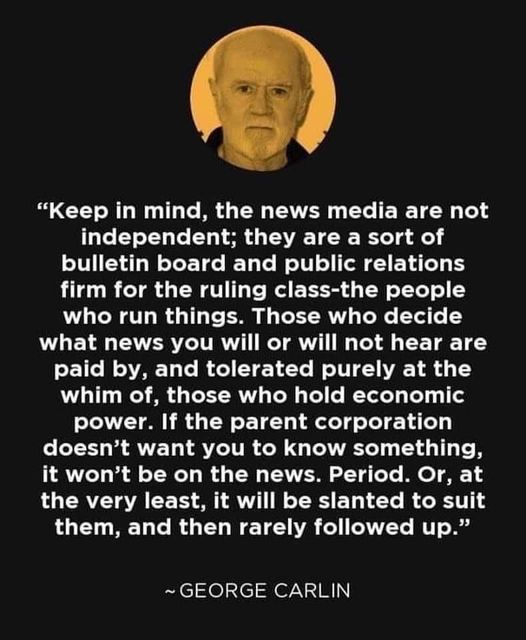
There is a significant and distressing lack of understanding in America about freedom of speech and press. For example, this meme has been circulating on social media:


My comment:


There is a basic contradiction in Carlin’s statement. If private media companies can make legally unfettered editorial judgements about what will or will not be published on their outlets, even if slanted—which is their First Amendment right—they are by definition independent (and free). “The news media” is NOT monolithic, as Carlin implies. They are subject to competition, as Elan Musk proved when he bought Twitter and revised its biased policies. Remember that economic power is benign and voluntary because it derives from consumer choice. Economic power is NOT political power, which is coercive because it grows out of the barrel of a governmental gun. I’ll take economically driven media over politically shackled media any day. It is to the glory of America that we [still] have an economically-driven media.


The First Amendment is clear: “Congress shall make no law . . . abridging the freedom of speech, or of the press. . .” Carlin makes the immensely dangerous equivocation of political and economic power. The First Amendment refers only to political power, and seeks to impose a strict separation of press and state. Carlin’s equivocation implies an opening for the government to step in and enforce an “independent” media, thus making an end run around the First Amendment and—in the name of “an independent media”—substitute political power for economic power, making the press subject to government coercion. On economic vs. political power, see the first link below.


Related Reading:


The Dollar and the Gun by Harry Binswanger


When Private Media ‘Colludes’ With Government, Blame the Government, Not Media: The Dollar is No Match for a Bullet.


Malinowski's Censorship-By-Proxy 'Protecting Americans from Dangerous Algorithms Act' Advances


Americans Abandoning Free Speech Better Brace for the Consequences by J.D. Tuccille for Reason: Government will happily suppress misinformation in favor of misinformation of its own.


Note to #FREEPRESS: A Free Press Derives from Freedom of Speech


Thursday, December 21, 2023

Christmas the Secular, Christmas the American

Is it appropriate for non-Christian Americans to celebrate Christmas? Many do, and why not? I’m an atheist—or, more precisely, a person of reason—and I have no problem celebrating Christmas, even though it has no religious significance for me.


Christmas is obviously a religious holiday for many, signifying the birth of the Christian icon Jesus Christ. But as an American holiday, Christmas is and, by our own Constitution, a secular holiday. That makes it a holiday for everyone. Therefore, people are free to celebrate Christmas according to any meaning they choose.


Why do I say that? Two reasons—one moral, one Constitutional.


I am indebted to philosopher Ayn Rand for showing that, philosophically, in America, Christmas can’t be strictly a Christian holiday. In answer to the question of whether it is appropriate for an atheist to celebrate Christmas, Rand observed:


Yes, of course. A national holiday, in this country, cannot have an exclusively religious meaning. The secular meaning of the Christmas holiday is wider than the tenets of any particular religion: it is good will toward men—a frame of mind which is not the exclusive property… of the Christian religion.


This makes perfect sense. Neither Christianity nor any particular religion can have an exclusive claim on morality. “Good will toward men” is not a monopoly of Christianity. Rand’s reference to the National Holiday aspect of Christmas points to another important reason why Christmas in America cannot be the exclusive domain of Christianity, or of religion more generally.


Here, I am also indebted to the framers of the U.S. Constitution. As the First Amendment to the U.S. Constitution reads, "Congress shall make no law respecting an establishment of religion." In 1870, Congress made Christmas a national legal holiday. This means that anyone who claims, as one NJ letter-to-the-editor wrote, that Without Jesus Christ you can't have Christmas, that person is repudiating the U.S. Constitution. A national religious holiday in a secular nation founded on the principle of separation of church and state (freedom of religion and conscience) is a logical impossibility. Since to have a secular government means to have one that is neutral with regards to the fundamental conscientious beliefs of all of its citizens, an American national holiday by definition cannot be religious.


In fact, what we today call Christmas originally didn't have any connection to Jesus at all, writes Onkar Ghate in U.S.News & World Report:


Before Christians co-opted the holiday in the fourth century (there is no reason to believe Jesus was born in December), it was a pagan celebration of the winter solstice, of the days beginning to grow longer. The Northern European tradition of bringing evergreens indoors, for instance, was a reminder that life and production were soon to return to the now frozen earth.


The Romans celebrated the Winter Solstice with the holiday Saturnalia. In Northern Europe, the holiday was called Yule.


Indeed, as philosopher Leonard Peikoff observes over at Capitalism Magazine, the leading secular Christmas symbol - Santa Claus - actually contradicts some standard Christian tenets:


Santa Claus is a thoroughly American invention. ... In 1822, an American named Clement Clarke Moore wrote a poem about a visit from St. Nick. It was Moore (and a few other New Yorkers) who invented St. Nick's physical appearance and personality, came up with the idea that Santa travels on Christmas Eve in a sleigh pulled by reindeer, comes down the chimney, stuffs toys in the kids' stockings, then goes back to the North Pole.


...Santa implicitly rejected the whole Christian ethics. He did not denounce the rich and demand that they give everything to the poor; on the contrary, he gave gifts to rich and poor children alike. Nor is Santa a champion of Christian mercy or unconditional love. On the contrary, he is for justice -- Santa gives only to good children, not to bad ones.


When Congress declared Christmas a National Holiday, in 1870, Christmas ceased being a strictly religious observance and became a secular holiday. A legal religious holiday in a nation dedicated to freedom of religion and conscience is a contradiction. (The Founders used the terms “religion” and conscience” interchangeably. They understood religious freedom to include the freedom not to believe in or practice any religion—in effect, not just freedom of religion, but freedom from religion as well; i.e. separation of religion and state.) Being a national legal holiday, Christmas can have non-religious, non-Christian meaning just as validly as a Christian meaning. It’s a matter of individual preference. Otherwise, what’s the point of freedom of conscience?


So, regardless of your personal beliefs, go ahead and enjoy Christmas on your own terms.


On that note, let me extend to everyone a hearty wish for a joyous, safe, and thoroughly non-contradictory…


MERRY CHRISTMAS!


Related Reading:


How the Welfare State Stole Christmas, by Yaron Brook and Don Watkins


Don't Need Christ to Celebrate Christmas


Why Christmas Should be More Commercial—Leonard Peikoff


The Real Meaning of Christmas: What Would Jesus Teach Today?


A ‘War on Christmas?’ No: A War on non-Christians