Showing posts with label Economic vs. Political Power. Show all posts

Wednesday, April 24, 2024

Economic Power and a Free and Independent Media

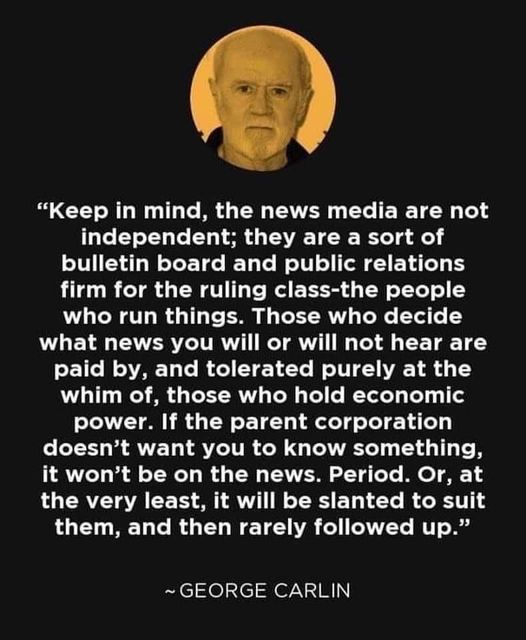
There is a significant and distressing lack of understanding in America about freedom of speech and press. For example, this meme has been circulating on social media:


My comment:


There is a basic contradiction in Carlin’s statement. If private media companies can make legally unfettered editorial judgements about what will or will not be published on their outlets, even if slanted—which is their First Amendment right—they are by definition independent (and free). “The news media” is NOT monolithic, as Carlin implies. They are subject to competition, as Elan Musk proved when he bought Twitter and revised its biased policies. Remember that economic power is benign and voluntary because it derives from consumer choice. Economic power is NOT political power, which is coercive because it grows out of the barrel of a governmental gun. I’ll take economically driven media over politically shackled media any day. It is to the glory of America that we [still] have an economically-driven media.


The First Amendment is clear: “Congress shall make no law . . . abridging the freedom of speech, or of the press. . .” Carlin makes the immensely dangerous equivocation of political and economic power. The First Amendment refers only to political power, and seeks to impose a strict separation of press and state. Carlin’s equivocation implies an opening for the government to step in and enforce an “independent” media, thus making an end run around the First Amendment and—in the name of “an independent media”—substitute political power for economic power, making the press subject to government coercion. On economic vs. political power, see the first link below.


Related Reading:


The Dollar and the Gun by Harry Binswanger


When Private Media ‘Colludes’ With Government, Blame the Government, Not Media: The Dollar is No Match for a Bullet.


Malinowski's Censorship-By-Proxy 'Protecting Americans from Dangerous Algorithms Act' Advances


Americans Abandoning Free Speech Better Brace for the Consequences by J.D. Tuccille for Reason: Government will happily suppress misinformation in favor of misinformation of its own.


Note to #FREEPRESS: A Free Press Derives from Freedom of Speech


Tuesday, December 28, 2021

The ‘Real Meaning of Christmas’: What Would Jesus Teach Today?

[This is a republication of my post of December 26, 2014]


In The Real Meaning of Christmas, Brian Regal, a fellow of the Kean University Center for History, Politics, and Policy, explained why Christmas should be celebrated by all people:


    [A] common refrain today . . . is the exaltation to "keep Christ in Christmas." This, I would suggest, is the much better argument than the "war on Christmas" angle. . . .

    Commercialization and atheists are the least of our problems here. Jesus said some of the simplest, yet most moving statements ever uttered: statements to inspire all human kind.

    Whether Christian, Jewish, Muslim, Buddhist or Ufologist, one can’t help but be touched by the profound humanity of "For I was hungry and you gave me something to eat, I was thirsty and you gave me something to drink, I was a stranger and you invited me in."

    He urged his followers to treat people as we would have them treat us. He rejected the pursuit of wealth and political power. He embraced the poor and the outcast, not Hollywood celebrities or mega-preachers. He said the meek would inherit the Earth. It’s unlikely he ever owned more than one set of clothes, let alone an assault rifle.

    Jesus did not say, "When I was hungry, you turned away from me," or "When I was sick, you cut my health care," or "When I was poor, you mocked me," or "When I was a stranger, you pulled a gun on me and stood your ground."


I have a different take on Christmas. Following is an expanded version of my posted comments:


I agree that Christmas is a holiday for all, but for a different reason. (I don't agree with Jesus's ethics.)


Christmas ceased being a religious holiday when Congress declared it a national holiday. A national religious holiday in a secular nation based on the separation of church and state is a contradiction in terms. Today, Christmas is a secular holiday by law, and everyone should feel free to observe it (or not) based on his own values. You want Christ in Christmas? More power to you. No Christ? Same sentiment. To each his own. To paraphrase Jesus, respect others' right to their values, just as you would have them respect your right to your values.


As to Jesus, the context of the time in which he "rejected the pursuit of wealth and political power" was one in which wealth was largely accumulated by thieving rulers. Poverty was the widespread norm, save for the politically powerful few, who took from the meager earnings of their subjects. The pursuit of wealth and political power were synonymous, so Jesus's position was perhaps understandable, if not justifiable.


But the rise of modern capitalistic, free market individual liberty unleashed productive work and win-win, mutually beneficial trade as the path to wealth. People pursue wealth, not by theft, but by creating wealth and then exchanging value for value, simultaneously enriching both themselves and others. The rise of the free market economy separated the pursuit of wealth (economics) from political power. As the Declaration of Independence states, the purpose of government was set to protect individual rights, not the power of parasitical rulers to enrich themselves at the expense of the average man. What would Jesus say to that? Would he understand the difference between the pursuit of wealth by legalized theft, and the pursuit of wealth by work? Hopefully. But his 2000 year-old ethical ideology is not applicable to a free market economy, to the extent that we have one.


Of course, political power can still be an avenue for pursuing wealth by theft, as is the case with the modern redistributionist welfare state. Regal implies that Jesus would endorse this legalized theft with his statement "When I was sick, you cut my health care"—a slap at those who oppose government handouts paid for by forcibly taking from someone who earned it. Jesus certainly preached the morality of what we know today to be socialism; self-sacrifice for the needs of others. But remember the context. Would he endorse the modern union of wealth pursuit and political power—forced transfer of wealth from those who earned it to those who didn't—over voluntary giving? 


The blind, dogmatic adherence to Jesus's 2000 year-old ethical ideology is resurrecting that ancient evil; the pursuit of wealth through political power. It's time to modernize our ethics. What would Jesus preach today if he observed the broad-based prosperity created by self-interested, reason-guided labor (productive work) and trade? What would he think when he observed "poor" people living in comparative luxury vs. the "rich" rulers of his day, as is the case in the semi-free industrialized nations? 


We need a new ethics. In the modern world of wealth creation, should Christmas be about the worship of poverty? No. It should celebrate the rise from poverty made possible by the liberty to selfishly and rationally pursue one's own happiness by one's own efforts. By all means, lend a helping hand to someone in need, if it's consistent with your values and personal circumstances. That doesn't require a holiday to justify. Christmas should be a celebration of the good things in our lives, including our life-enhancing material achievements and the free exercise of spiritual values like rationality, productiveness, honesty, and pride that made those achievements possible. Spirituality and good will toward one's fellow man are not the exclusive monopoly of religion.


This Christmas season, I'll celebrate family, food, cheery decorations, and the wonderful commercialization—the symbol of freedom of production and trade—that enriches all of our lives. Earned spiritual and material enrichment go hand in hand.


Related Reading:


What is Capitalism?—Ayn Rand


Criminal Socialism vs. a Free Society 


The Capitalist Manifesto by Andrew Berstein


The Creed of Sacrifice vs. The Land of Liberty—Craig Biddle


The Declaration of Independence


Books- Understanding Rational Selfishness


Monday, August 16, 2021

Censorship-By-Proxy is Real, and it's Here

From Joe Biden Is Trying to Impose Online Censorship by Proxy by Jacob Sullum for Reason. All emphasis are mine:


The administration’s public pressure campaign against COVID-19 "misinformation" cannot be reconciled with its avowed respect for freedom of expression. 


President Joe Biden wants to suppress speech that discourages Americans from being vaccinated against COVID-19. Because the First Amendment does not allow him to do that, he is asking Facebook and other social media companies to do it for him.


“Asking!?!” 


Or at least that's the way White House Press Secretary Jen Psaki, who calls the Biden administration's demands for speech restrictions "our asks," describes the situation. But given the federal government's power to make life difficult for Facebook et al., the line between a request and a command is hazy, and so is the line between private content moderation and government censorship.


Psaki's assurances are hard to take seriously given the public pressure that the Biden administration is applying, its ability to launch litigation and support legislation that hurts social media companies, and its threat of "legal and regulatory measures." If those companies do what the president wants by cracking down on speech he does not like, they will be acting as the government's agents.


I've been warning about censorship-by-proxy for a long time. The politicians can't directly censor, because of the First Amendment. But they have a powerful backdoor weapon, the regulatory state. Politicians can "arm twist" companies into submission by threatening regulation, in particular antitrust enforcement. The antitrust "laws" are particularly powerful. They're not really laws. They are unAmerican statutes that grant government arbitrary power, the tool of authoritarianism. Antitrust gives politicians power to prosecute any business for anything, at any time, at will. It's Al Capone "politics," not law. And it's a powerful means of censorship-by-proxy. Given that politicians of both parties are already threatening social media companies with antitrust, how much choice do they have to resist political demand to censor their users?


This demonstrates the integral—and fragile—nature of rights. This case shows how economic controls are used to silence free speech. Intellectual freedom is not possible without economic freedom. Don't blame the social media companies. The dollar is no match for a bullet. Blame the government, and anyone who supports the regulatory/antitrust state. 


Related Reading:


The Banning of Alex Jones: Facebook Choice or Regulatory Extortion?


Malinowski's Censorship-By-Proxy 'Protecting Americans from Dangerous Algorithms Act' Advances


Facebook Backtracks on Free Speech Policy; Political Extortion?


Social Media and the Future of Civil Society by Jon Hersey for The Objective Standard


Americans Abandoning Free Speech Better Brace for the Consequences by J.D. Tuccille for Reason: Government will happily suppress misinformation in favor of misinformation of its own.


Dem Rep Malinowski Reprises Trump in Proposed Legislative Attack on Social Media and Free Speech.


A Conversation About Facebook, the First Amendment, Antitrust, and “The Electronic Octopus”


SCHOLARS WITH THUMBSCREWS: ANTITRUST’S PREDATORY ACADEMICS by Tom

Friday, February 21, 2020

Law Enforcement, Private Enterprise, and Personal Data


The internet era has brought privacy into the forefront of our concerns. But the central issues get too little notice. The following article highlights this neglect.

In a May 2018 article, To catch a killer: Are DNA detectives creating a Brave New World?, updated in June 2019, Julie O'Connor wrote for the New Jersey Star-Ledger Editorial Board:

The Golden State Killer brought terror to the city of Sacramento with a series of spectacularly sadistic rapes and murders, escaping every time, almost taunting the police as he picked his next victims.

But finally, they caught him, at the age of 72, thanks to a sleuthing team of detectives who used a genealogy website to track him down.

The tactic came as a shock to most Americans, who had no idea this was possible.

Yet what most people still don't realize is the threat to privacy this case highlights: Once you submit your DNA to one of these sites, you've effectively lost control of it.

The companies say they set up guardrails, but police have access to this data for the rest of your life. Millions are volunteering their DNA. And even if you don't spit into a vial and send it, a distant cousin could catch you up in a police manhunt.

Now, this case has thrust the issue into the spotlight, much like Cambridge Analytica did for Facebook. It shows just how tentative our grip on privacy really is. 

One expert, John Cohen, a former homeland security official and police officer, defended the police tactic:

And when people decide to hand over their personal information to a private company that profits off it, why should we exclude law enforcement from using these databases to solve crimes? How, Cohen asks, is that in the public interest?

"Why should police be banned from using the same tools available to Cambridge Analytica?" he wonders.

[My emphasis]

O'Connor goes on to make the following equivocation between commercial activity and law enforcement:

And we need government oversight of the companies. Should they be allowed to sell your DNA profile to Big Pharma, which may someday market a drug to you based on your genetic health risks? Maybe you'd rather not know you're prone to Alzheimer's.

I left these comments, edited and expanded for clarity:

There is a dangerous equivocation in the question, "Why should police be banned from using the same tools available to Cambridge Analytica?" The government has a power no private company can have--the power of the gun. Government can compel obedience to its laws. It can seize your wealth. It can throw you in jail. Private enterprise cannot. Private companies cannot harm you, within the law--e.g., barring fraud or breach of contract, upon which the government can prosecute the wrongdoers. Private companies collecting data freely given for commercial purposes does not violate anyone’s rights. 

Government makes the laws. It needs this lawmaking power to fulfil its responsibility to protect us from and prosecute criminals. But it’s for this very reason--its power of the gun--that we have a constitution designed to limit that power; that is, to prevent the government from becoming the criminal.

Giving the same freedom to police to collect our data as Cambridge Analytica amounts to giving the police free reign to search our homes without a warrant. Cambridge Analytica or Facebook or “Big Pharma” should be free to collect our freely given data, so long as it operates within the law--e.g., obeys the government’s privacy and contract laws. They cannot force us. They can only offer us a product. The police, as agents of the state, should be barred from accessing data without a warrant--that is, without “probable cause.” Isn’t there something in the Fourth Amendment about this?

I realize the issue is complex, and the article does call for “rules.” But it’s the equivocation that bothers me. O'Connor is right at the start: It’s government access to our data that we should fear. Government vs. private enterprise are, by their natures, opposites. There is a huge difference between accessing your private data for commercial purposes and accessing for law enforcement purposes. The government can compel. A private firm cannot. 

O’Connor further observes:

But talk to Kimberlee Moran, head of forensics at Rutgers-Camden, and you'll feel leery again.

She believes only the convicted should go into law enforcement DNA databases, not arrestees. That's what they now do in the UK. The European Court of Human Rights ruled it a violation of privacy to keep arrestees who were not found guilty in law enforcement's DNA databases.

But the U.S. constitution doesn't explicitly say we have a right to privacy. And police are navigating a new frontier. They have to get a court order to draw blood from a suspect to get his DNA, or root through his trash. But they apparently searched for distant relatives of the Golden State Killer without one.

[My emphasis.] 

I’m always amazed at people who should know better, such as a reporter, making statements like this about rights in the U.S. Constitution. The constitution doesn’t have to “explicitly say we have a right to privacy.” The Constitution explicitly highlights some of the more important individual rights, such as those listed in the First and Fourteenth Amendments, for example. But the Constitution implicitly protects all rights. The Ninth Amendment reads, “The enumeration in the Constitution, of certain rights, shall not be construed to deny or disparage others retained by the people.” 

This is not exactly some obscure point. As the Legal Information Institute of Cornell Law School explains of the Fourth Amendment:

The Fourth Amendment of the U.S. Constitution provides that "[t]he right of the people to be secure in their persons, houses, papers, and effects, against unreasonable searches and seizures, shall not be violated, and no Warrants shall issue, but upon probable cause, supported by Oath or affirmation, and particularly describing the place to be searched, and the persons or things to be seized."

The ultimate goal of this provision is to protect people’s right to privacy and freedom from unreasonable intrusions by the government. However, the Fourth Amendment does not guarantee protection from all searches and seizures, but only those done by the government and deemed unreasonable under the law.

[My emphasis.] 

In other words, contra Cohen, the police should be banned from using the same tools available to Cambridge Analytica. The Constitution draws a bright red line between government and private entities with regard to searching and seizing the personal information of private individuals, even if such data is freely given and otherwise publicly available. Yet the whole privacy rights discussion routinely sidesteps this crucial red line. If we value our individual rights, we should keep in mind two critical points; the crucial difference between government and private activity, and the fact that the Constitution limits government, not our rights, whether or not the U.S. constitution explicitly says we have that right.

Related Reading:


The Dollar and the Gun
--Harry Binswanger

Monday, December 16, 2019

Government Monopsony vs. Private ‘Monopsony’


One of the most devastating threats to free markets in particular, and freedom more broadly, is to evade the distinction between economic power and political power.

Economic power to derived from voluntary choices. It is a measure of the value consumers place on the goods of producers. It doesn’t matter whether the goods are produced by a giant corporation like Amazon or Merck, or by individuals like plumbers or secretaries. When a consumer buys something from Amazon, that consumer is awarding economic power to Amazon. When a consumer hires a plumber, that consumer is awarding economic power to that plumber. Importantly, that consumer can withdraw that power anytime she decides that a different retailer or plumber better suits her purposes. It’s all voluntary: Economic power is the power to create economic value for consumers willing to buy it.

Political power is the power of physical force; that is, the power to legally override the voluntary choices of consumers. You have a choice on whether to patronize Amazon or abide by its terms of sale, by virtue of the freedom to just not buy its product. You have no choice on whether to “patronize” Medicare or conform to a government law or regulation. You cannot simply walk away, lest you be fined or thrown in jail. 

It has been said that “power is power.” That’s not true. There is a black-and-white difference between the power to produce and persuade and the power to physically force. To fail to recognize this distinction is dangerous. One of the areas in which this distinction is evaded is in the issue of monopoly. A true monopoly is when the government protects a business by legally forbidding competition, leaving the consumer with no alternate choice. A good example of this is electric utilities or the United States Post office regarding first class mail. These have been labeled “coercive monopolies” because their “market” position is cemented by political power. That is a coercive monopoly. A market monopoly—a dominant market position earned without access to government protection—is not a true monopoly, because competitors are free to enter and compete.

The corollary of monopoly power is monopsony—the capture of a market through buying rather than product activity. And like with monopoly, there is a sharp distinction between a coercive monopsony and a market monopsony. Blurring the distinction between the two is the classic tactic of the statist.

Monopsony power is the latest tactic of the economic regulators. In Booker, Warren take aim at chains that use ‘non-poaching’ deals to keep workers stuck at one store, Washington Post reporter Jeff Stein reports:

Say you work at a Jiffy Lube 30 miles from your house. You're happy enough there, but when you see an opening at another Jiffy Lube that's around the corner from where you live, you can't resist applying. You think you've got a decent chance; after all, you're already trained for the job. After you apply, however, you don't hear anything back.

It's possible you just weren't the candidate they wanted. But it's also possible that you were never even considered because your local Jiffy Lube was barred from hiring you, thanks to a “non-poaching” agreement it signed with the corporate headquarters. The non-poaching pacts vary, but generally they eliminate or limit franchise owners' ability to hire workers from other locations within the franchise.

The agreements are common at fast-food giants like Burger King and chains like Jiffy Lube and H&R Block in other industries, and they’re gaining prominence: Non-poaching clauses are now included in up to 56 percent of large franchises, up about 20 percent from two decades ago, according to a report published Wednesday by two prominent economists.

Worker advocacy groups have long opposed such agreements, arguing they hurt employees' leverage in negotiating raises and stifle worker pay. And now the agreements are drawing renewed scrutiny from Democratic lawmakers — as well as from President Trump's Justice Department.

Democratic Sens. Cory Booker (N.J.) and Elizabeth Warren (Mass.) on Thursday introduced legislation that would make these arrangements illegal, calling them an “anti-competitive” practice and giving workers the ability to sue and the right to claim damages.

But this is market monopsony power. The “non-poaching” agreement Is just that--an agreement. It is non-coercive and limited to within the company. It is mutually agreed among all parties--the parent company, the franchisee, and the employee. The employee is free to seek employment outside the company, and the franchise owner is free to hire from outside the company. 

But “This is patently unfair and against the ideals of a so-called free market,” Booker said in an interview, forgetting that the “free” in free market means free from government coercion.

This attack on private voluntary contract is particularly outrageous since both Warren and Booker have endorsed the mother-of-all coercive monopsonies--Medicare for All. The existing Medicare program is already a monopsony over the over 65-year-old healthcare market. If Warren and Booker were truly against monopsony power, they would call for the phaseout of existing Medicare. Instead, they want to expand the Medicare monopsony to the entire healthcare market. The same goes for the public school monopsony.

How do Warren and Booker get away with so blatant a double standard--seeking to ban market monopsony power limited only to private parties who voluntarily agree while expanding coercive monopsony power enforced by law? By cashing in on ignorance of the difference between political and economic power, and then inverting the two so that coercion is seen as good and voluntarism as bad.

In fact, just as with monopoly, a market monopsony is not a monopsony at all, because coercion is absent and therefore competitive alternatives cannot be blocked. As with the issue of monopoly, a true monopsony can only grow out of the barrel of a governmental gun—that is, by law.

Warren and Booker have it exactly backwards. Private companies like Burger King, Jiffy Lube, and H&R Block have every right to make “non-poaching” agreements. Whether preventing an employee from moving to a job 30 miles closer to home and thus risk losing a valuable employee, the example cited in the beginning of the article, is good business is questionable. And the example may be a red herring. And if an employee is not made aware of the non-poaching aspect of his job when he is hired, critics may have a case based on transparency or anti-fraud issues. But it is the right of the company to allow such agreements among its franchisees. It is an abuse of power for the government to outlaw such private agreements, or to use its power of law to monopsonize any market for goods and services.

Political versus economic power: That is the issue that must be grasped. A good place to grasp and understand this distinction is Harry Binswanger’s essay The Dollar and the Gun, reprinted by permission from Why Businessmen Need Philosophy on his HBL newsletter.

Related Reading:


The rest of my articles published under the label “Economic vs. Political Power” that relate this dangerous equivocation to concrete issues.
The Dollar and the Gun
by Harry Binswanger

Tuesday, February 12, 2019

‘We’ Did Not Create the ‘Mighty Middle Class’: ‘I’ Did


In a January 2019 editorial, The $15 wage: Reaffirming what New Jersey stands for, the New Jersey Star-Ledger lauded Nj politicians for enacting a phased-in $15 minimum wage. What’s important here is not the rise in the minimum wage, bad as that is. What caught my eye is the Star-Ledger’s rationalization for it.

This historic act, made by people who value the dignity of work, will enable nearly a million more New Jerseyans to soon make something that approximates a living wage.

Our state took a prodigious step toward addressing decades of economic injustice, and all it took was for our elected leaders to affirm what we believe in. For centuries, when we saw someone who needed a hand up, we had the compassion and wisdom to do it without overdoing it. We welcomed immigrants from every corner of the world and brought them into the circle of opportunity. We took the poor and made them middle class. We took the middle class and made it mighty.

I left these comments, somewhat expanded and edited for clarity:

“When we saw someone who needed a hand up, we had the compassion and wisdom to do it”

There’s a fundamental difference between a voluntary ‘hand up’ and a government-forced hand out. The first is compassion, the second injustice. Notice the heartless collectivist repudiation of individual self-reliance; “We took the poor and made them middle class. We took the middle class and made it mighty.” No, “We” didn’t. The middle class stands for individual productiveness and upward mobility, achieved through individual effort and voluntary association based on mutual consent. Each individual earned it. The collectivist worldview of the Star-Ledger and its ilk leaves no room for the value of the individual. It’s all about some mystical “We” to which each of us is only a helpless cog. But in fact, “We” didn’t create the middle class. “I” created the middle class.

Collectivism is the weapon of the statist who imagines that he can simply legislate a “living wage.” There is no economic justice in getting a wage forced on your employer, the job creator. There is no dignity in an unearned “living wage”. There is no dignity in losing a job, or being unable to find a job, because your skill level doesn’t yet warrant the $15 some politician mandates. And if you manage to keep your job at the higher coerced wage, there is certainly no dignity is profiting at the expense of someone else’s being forced into unemployment by the same law that “gave” you your raise.

The economic destructiveness of price controls is well-known and undisputed. Force up the price of something, including of labor, and you get less of it--in this case, fewer jobs and fewer sustainable businesses. But minimum wage laws are also immoral, because they not only force businesses to pay more than voluntarily agreed to, but deny entry level and low-skilled workers the right to accept a job at less, thus denying them access to the economic opportunity that the lower rungs of the “economic ladder of success” offers.

-----------------------------------------------

Once again we can see the “You didn’t build that” weapon that Obama set up. The worst thing Obama did was to establish a philosophical springboard for American socialists to complete the task of fundamentally transforming America into a socialist state. If “you didn’t build that”--if “We” made the middle class--then created wealth is a tribal product. If wealth is due to tribal “effort”, rather than at root an individual effort, then there is no reason that the tribe’s--i.e., society’s--wealth should not be controlled and distributed by the tribal chiefs, the government.

If you don’t understand how markets work--how wealth is created and distributed by individuals contracting, collaborated, and trading---and how the infinitely intricate price mechanism sorts out who built and thus deserves what--then you will always be susceptible to the kind of poison Obama has fed us. Unfortunately, too many Americans buy into what is essentially the savages view of wealth as a tribal product. Too many Americans either are ignorant or, worse, know better but buy into the “you didn’t build that”/“We built the Middle Class” view for their own sinister reasons. Welcome to a socialist America.

Related Reading: