Friday, January 6, 2023

Contra Michelle Purdy, Education is about Independent Thinking, Not Indoctrination.

Today’s public schools are not primarily educational facilities. They are indoctrination battlegrounds, whereby political factions fight for control of the schools’ curriculums in order to impose their own ideological agendas across school districts. 


Michelle A. Purdy, an associate professor of education at Washington University in St. Louis, makes this observation plain in a revealing Washington op-ed, As the right fights the teaching of race, a new AP course expands it: The sub-title reads, A tug of war over disrupting or conserving social arrangements has long buffeted schools. After making her far Left ideological bias plain early on, she makes this astounding statement:


The nation’s public schools have long been caught in a tug of war over whether they should be used to conserve or disrupt existing social arrangements. Alternate efforts to constrict and expand academic freedom in the nation’s schools have been central to how politicians, educators and activists have tried to encourage social change or resist it.


Purdy’s ideological bias is plain. If you disagree with my agenda, you are constricting academic freedom and reactionary—resisting social change, as she puts it, as if all change is necessarily good. But we’ll leave that aside for the moment.


What Purdy is acknowledging is: Yes, American schools are political institutions. They are not primarily educational institutions. And what would you expect of a monopolistic government system funded by taxes and populated by students forced into assigned schools based on the students’ addresses? And as with any socialistic institution, conflict over control of the central planning apparatus is bound to flourish in such a setting. Ideological conflict is not a “bug.” It is a feature inherent in government schooling. What’s lost, or at least relegated to the “back burner,” in an institution of this type? Education. 


The purpose of education is to teach the children how to individually think for themselves in order to prepare them for living their lives. 20th Century philosopher Ayn Rand defines education this way:


The only purpose of education is to teach a student how to live his life—by developing his mind and equipping him to deal with reality. The training he needs is theoretical, i.e., conceptual. He has to be taught to think, to understand, to integrate, to prove. He has to be taught the essentials of the knowledge discovered in the past—and he has to be equipped to acquire further knowledge by his own effort.


This is, I believe, correct. It’s the broadest definition. If education is not fundamentally about kids learning how to use their minds objectively and independently, then what is it? 


Instead, they get subjected to the political or social ideological agendas of whomever happens to be in control of the curriculum. Purdy is not wrong to say that there were serious flaws in the ideological biases of the status quo. But she is no more interested in real education than those agendas she would replace. She would merely replace agendas she disagrees with with her own, leaving out the training of students to independently evaluate and compare competing perspectives based on all available facts. 


Purdy doesn’t seem to be concerned with such objectivity in learning, at least not as implied in this article. Purdy denounces the prevailing and/or past teaching of American history as “white history,” and proposes to replace it with “black history,” in the form of myriad black studies curricula. No doubt the teaching of American history has often been tainted by white racism. But replacing it by tainting history with a black racial tinge for the purpose of advancing a social justice political agenda is just as wrong. The truthworthiness of history courses is not determined by the skin color of the person interpreting/teaching it. It is determined by facts. What should be examined and adopted are history lessons that are accurate and fact-based. There could be honest, unbiased disagreements in interpretation of the facts. Where such differences emerge, children could be exposed to the disagreements, and taught how—and allowed—to objectively weigh the differences, discuss them, and come to their own conclusions—the purpose being to teach children how to articulate their case, listen to others’ views, refute them intelligently, and integrate it all objectively. The main ingredient is to teach facts. Facts, not dogma, is the starting point. That is how real education should work. Truth in history (or any other subject) is not determined by the skin color of the person discovering and/or interpreting the facts. We don’t need racially slanted history, whether white or black. We need accurate history.


Getting to a quality, genuine educational system will be all but impossible as long as that system is government controlled—which means, thoroughly, coercively politicized. Purdy labels forcing her own agenda on schools “academic freedom.” But there can be no real academic freedom in a system where any political faction can impose their school agendas on everyone by force. The monopolistic public school system is the ultimate enemy of academic freedom in American education..


Purdy speaks of academic freedom. But academic freedom is not defined by a war of factions over who gets to impose their school dogma on everyone else. Academic freedom means the individual’s right not to have to submit to any school scheme one doesn’t agree with, including being forced to pay for it. Academic freedom means to have a real marketplace of ideas— including educational ideas, where all ideas have the equal opportunity to be market tested. 


Such a market can only flourish when the customers of education, the parents and students, can vote with their feet and their dollars. Under the current system, parents seeking alternatives to the traditional public schools are burdened with the need to pay for the alternative private schooling while still being stuck with thousands of dollars in education taxes that fund the public school, effectively being forced to pay double or triple the private school price. 


I am for the complete separation of school and state, with the government having no role in funding or administering education. Given political realities, I favor an interim step, universal parental/guardian school choice through having education taxes follow the student rather than fund school districts directly. Whether by tax credits, education savings accounts (ESAs), or other broad-based funding methods, Such a liberation would spur a vibrant education marketplace where all education methods, curriculums, philosophies and teacher qualifications would have the opportunities to be market tested by entrepreneurs and businesspersons, afford parents myriad choices, and end the ridiculous and damaging curriculum wars.


That would be real academic freedom.


Related Reading:.


The Comprachicos by Ayn Rand


Toward a Free Market in Education: School Vouchers or Tax Credits by me for The Objective Standard


Educational Freedom, Not Just Education, ‘Has to Be the Top Priority for Candidates'


The Educational Bonanza in Privatizing Government Schools by Andrew Bernstein for The Objective Standard


Monday, January 2, 2023

2022 Vindicated Margaret Hoover’s Warning to the GOP

The Republican Party was in an excellent position to sweep to substantial Congressional majorities in the midterms this year. Yet, it flopped. Why? 


There is no question that Donald Trump’s stolen election demagoguery cost them many seats. But there’s more to the story, I believe. Abortion, in the form of the Supreme Court’s overturning of Roe v. Wade, is believed to have been a major factor. Another is the threat that horrendously reactionary ruling implies for Obergefell v. Hodges, which legalized same-sex marriage across America.


The second cause leads me to a book published about a decade agoe, American Individualism—How a New Generation of Conservatives Can Save the Republican Party—which I reviewed for The Objective Standard. The author, Margaret Hoover, great-granddaughter of Herbert Hoover, made a strong case for the idea that social/religious conservatives were holding the Republican Party back from political dominance. On abortion, gay marriage, drug prohibition, immigration, and other social conservative causes, the GOP was losing votes that they should naturally be able to attract, Hoover argued. Her solution was to embrace a consistent platform of American Individualism, which would lead to pro-individual rights positions on these and other issues, including the environment and, naturally, economics. 


This is a winning platform, Hoover argues, but not until the GOP disconnects its allegiance from the powerful social/religious conservative movement, which contradicts the Republican Party’s historical allegiance to individual rights and limited rights-protecting government.


I believe the biggest political story of 2022 is the vindication of Margaret Hoover’s thesis. The Republican Party must become the party of American Individualism, and all that the principle implies. A consistent platform of individual rights in the social, economic, and academic fields, accompanied by a consistent allegiance to limited government interference in people’s lives generally, could very likely be the path to solid GOP dominance. If the Republican Party abandons American Individualism—currently, the Trump-infused Party is actually moving away from individualism—it will likely “fade into irrelevance.” 


While Hoover is not always consistent, and leaves room for challenge from consistent advocates of individual liberty on some points, she generally points down the correct road. Now more than ever, it’s time for the GOP to heed her challenge and warning. As I concluded in my TOS review:


General support for individualism as the American political ideal is simultaneously a means to a better political environment in the short term and to greater opportunities to make the case for the deeper principles. Imagine a GOP with the explicit banner “American Individualism” firmly planted atop its political platform. This would greatly expand the opportunity for truly consistent champions of individualism to enter the mainstream of political dialogue. It could explicitly redefine American politics as a clash between individualism and collectivism, compelling Republicans toward consistency in defense of freedom while painting Democrats into a collectivist corner. And within both the Republican party and in the country at large, it could infuse U.S. politics with a badly needed debate on individual rights, the proper role of government, and the deeper moral principles at play.


Despite its flaws, Margaret Hoover’s American Individualism is a step by a conservative toward genuine liberty and an opportunity for capitalists to change the terms of the debate for the better.


It’s time—or the GOP’s time may run out.


Related Reading:


Review: American Individualism, by Margaret Hoover by me for The Objective Standard


Contra Mark Levin, Americanism Rests on Reason, Not Faith


George Will: A Conservative “None” in Need of Ayn Rand’s Theory of Rights by Stephen Bourque and Craig Biddle for TOS


A New Textbook of Americanism — edited by Jonathan Hoenig


America's Revolutionary Mind: A Moral History of the American Revolution and the Declaration That Defined It by C. Bradley Thompson.


Individualism vs. Collectivism: Our Future, Our Choice—Craig Biddle


On This Constitution Day, Remember the Declaration of Independence


Saturday, December 31, 2022

HAPPY NEW YEAR

May your 2023 be prosperous, healthy, and fulfilling.

Pursue Your Happiness. It's your moral right.

Wednesday, December 21, 2022

Christmas the Secular, Christmas the American

Can non-Christians celebrate Christmas? Many do, and why not? I’m an atheist and I have no problem celebrating Christmas, even though it has no religious significance for me.


Christmas is a religious holiday for many, signifying the birth of the Christian icon Jesus. But as an American holiday, Christmas is and, by our own Constitution, a secular holiday. That makes it a holiday for everyone. People are free to celebrate Christmas according to any meaning they choose.


But this goes beyond the Constitution. I am indebted to philosopher Ayn Rand for showing that, philosophically, Christmas can’t be strictly a Christian holiday. In answer to the question of whether it is appropriate for an atheist to celebrate Christmas, Rand observed:


Yes, of course. A national holiday, in this country, cannot have an exclusively religious meaning. The secular meaning of the Christmas holiday is wider than the tenets of any particular religion: it is good will toward men—a frame of mind which is not the exclusive property… of the Christian religion.


This makes perfect sense. Neither Christianity nor any particular religion can have an exclusive claim on morality. “Good will toward men” is not a monopoly of Christianity.


I am also indebted to the framers of the U.S. Constitution. As the First Amendment to the U.S. Constitution reads, "Congress shall make no law respecting an establishment of religion." In 1870, Congress made Christmas a national holiday. This means that anyone who claims, as one NJ letter-to-the-editor wrote, that Without Jesus Christ you can't have Christmas, that person is repudiating the U.S. Constitution. A national religious holiday in a secular nation founded on the principle of separation of church and state (religious/conscientious freedom) is a logical impossibility. Since to have a secular government means to have one that is neutral with regards to the fundamental conscientious beliefs of all of its citizens, an American national holiday by definition cannot be religious.


In fact, what we today call Christmas originally didn't have any connection to Jesus at all, writes Onkar Ghate in U.S.News & World Report:


Before Christians co-opted the holiday in the fourth century (there is no reason to believe Jesus was born in December), it was a pagan celebration of the winter solstice, of the days beginning to grow longer. The Northern European tradition of bringing evergreens indoors, for instance, was a reminder that life and production were soon to return to the now frozen earth.


The Romans celebrated the Winter Solstice with the holiday Saturnalia. In Northern Europe, the holiday was called Yule.


Indeed, as philosopher Leonard Peikoff observes over at Capitalism Magazine, the leading secular Christmas symbol - Santa Claus - actually contradicts some standard Christian tenets:


Santa Claus is a thoroughly American invention. ... In 1822, an American named Clement Clarke Moore wrote a poem about a visit from St. Nick. It was Moore (and a few other New Yorkers) who invented St. Nick's physical appearance and personality, came up with the idea that Santa travels on Christmas Eve in a sleigh pulled by reindeer, comes down the chimney, stuffs toys in the kids' stockings, then goes back to the North Pole.


...Santa implicitly rejected the whole Christian ethics. He did not denounce the rich and demand that they give everything to the poor; on the contrary, he gave gifts to rich and poor children alike. Nor is Santa a champion of Christian mercy or unconditional love. On the contrary, he is for justice -- Santa gives only to good children, not to bad ones.


When Congress declared Christmas a National Holiday, in 1870, Christmas ceased being a strictly religious observance and became a secular holiday. A legal religious holiday in a nation dedicated to freedom of religion and conscience is a contradiction. (The Founders used the terms “religion” and conscience” interchangeably. They understood religious freedom to include the freedom not to believe in or practice any religion—in effect, not just freedom of religion, but freedom from religion as well.) Being a national legal holiday, Christmas can have non-religious, non-Christian meaning just as validly as a Christian meaning. It’s a matter of individual preference. Otherwise, what’s the point of freedom of conscience?


So, regardless of your personal beliefs, go ahead and enjoy Christmas on your own terms.


On that note, let me extend to everyone a hearty wish for a joyous, safe, and thoroughly non-contradictory…


MERRY CHRISTMAS!


Related Reading:


How the Welfare State Stole Christmas, by Yaron Brook and Don Watkins


Don't Need Christ to Celebrate Christmas


Why Christmas Should be More Commercial—Leonard Peikoff


The Real Meaning of Christmas: What Would Jesus Teach Today?


A ‘War on Christmas?’ No: A War on non-Christians


Friday, December 16, 2022

Opposing NJ’s ‘Dark Money’ Ban is about Protecting Free Speech, Not Merely the Progressive Agenda

In Overriding dark money bill will cripple progressive groups, grassroots organization says,New Jersey Star-Ledger guest columnists Phyllis Salowe-Kaye and Marcia Marley rightly argued against a “dark money” bill that would force disclosure of private donors to political advocacy organizations. They make the valid point that such forced disclosure would amplify the power of the political class to dominate political discourse.


Unfortunately, they don’t argue from principle, only from partisan ideological motives.They call for favoring advocates of their Progressive liberal agenda, while stifling opponents’ ability to dissent.


Opposing NJ’s ‘dark money’ ban is about protecting free speech--everyone’s free speech, including “trade associations” and “powerful corporate interests.” 


So it’s a shame that Phyllis Salowe-Kaye and Marcia Marley have narrowed the issue down to merely protecting the Progressive agenda. 


But that’s exactly the point of freedom of speech, and thus the protection of donors’ privacy. Nobody’s political agenda should be exempt or “protected” from public scrutiny, dissent, opposing opinions, or accountability. Nobody’s political ideology or agenda should ever be the government’s job to protect. The government should protect everyone’s freedom to express their views equally and at all times.


By advocating forced disclosure on political donors of differing political views, Salowe-Kaye and Marley are exposing their, and more broadly Progressives', authoritarian impulses. They are explicitly and brazenly suggesting targeted government restrictions on free speech so as to protect and advance the Progressive agenda. In doing so, they inadvertently provide powerful evidence for why so-called  “dark money” should never be banned.


Related Reading:


Murphy’s Veto of NJ’s ‘Dark Money’ Ban Should Be Unconditional


The Intimidation Game: How the Left Is Silencing Free Speech--by Kimberley Strassel, especially Chapter 2, “Publius & Co.”


Kill New Jersey’s ‘Dark Money’ Ban


NJ’s ‘Dark Money’ Bill an Attack on Intellectual Freedom


NJ’s ‘Dark Money’ Bill is an Assault on Free Speech


The Anti-Free Speech Fallacy of ‘Dark Money’


N.J. AG Confirms: State’s Disclosure Law is about Stifling Political Accountability


Why Free Speech and Spending on Speech are Inextricably Linked


Tuesday, December 13, 2022

On the Respect for Marriage Act

Congress has passed the  Respect for Marriage Act, and it will become law upon President Biden’s expected signature. In Bill protecting same-sex, interracial unions clears Congress

Mary Clare Jalonick reported for The Associated Press,


The legislation would not require states to allow same-sex couples to marry, as Obergefell now does. But it would require states to recognize all marriages that were legal where they were performed and protect current same-sex unions if the Supreme Court decision were overturned.


This is a preemptive act, in case the same-sex marriage right recognized in Obergefell v. Hodges is overturned. As I wrote on Facebook, This is a very good bill, in my view consistent with Federalism and the 14th Amendment


The 14th Amendment states that 


All persons born or naturalized in the United States, and subject to the jurisdiction thereof, are citizens of the United States and of the State wherein they reside. No State shall make or enforce any law which shall abridge the privileges or immunities of citizens of the United States; nor shall any State deprive any person of life, liberty, or property, without due process of law; nor deny to any person within its jurisdiction the equal protection of the laws. [my emphasis]


Note that U.S. citizenry supersedes state citizenry, in terms of “privileges or immunities,” i.e. individual rights. This Amendment, one of the so-called “Civil War Amendments,” was a monumental advance for individual rights. The U.S. Constitution now made explicit what was implicit from the Founding—that no longer can any state violate the Federally guaranteed rights of any American, by, say, enslaving them, denying them the right to vote, or violating any other inalienable individual right. 


Of course, the Respect for Marriage Act is wholly unnecessary as long as Obergefell v. Hodges, the pro-14th Amendment SCOTUS ruling that nullified state laws banning same-sex marriage, is not overturned. But it is not at all certain that the SCOTUS will not overturn Obergefell given the horrendous anti-Constitutional reasoning behind the shockingly reactionary Dobbs ruling, which ignored the Ninth Amendment and 14th Amendments and violated the Constitution’s philosophic conscience, the Declaration of Independence, to overturn Roe v. Wade.


* [Biden signed the Respect for Marriage Act into law on December 13, 2022, USA Today reported.]


Related Reading:


Gay Marriage and Individual Rights


ObamaCare and Gay Marriage Rulings: One Loss and One Win for the Right


In SCOTUS’ Draft Opinion Overturning Roe Abortion Ruling: Double Standards of Left and Right Exposed


Restoring the Lost Constitution: The Presumption of Liberty by Randy E. Barnett  


The Conscience of the Constitution: The Declaration of Independence and the Right to Liberty by Timothy Sandefur

Monday, December 12, 2022

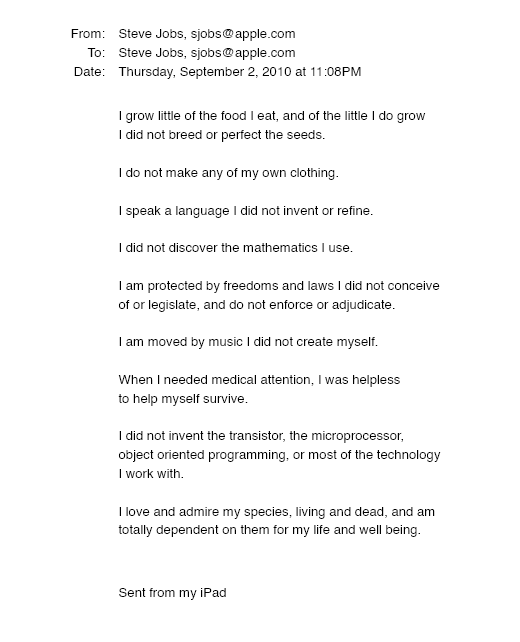
Steve Jobs’ Rational Gratitude

No one can ever accuse Steve Jobs of humility. His inspired drive and vision was the moving force behind the Apple enterprise and the innovative products that have improved the lives of billions of people, and he was rightfully proud of what he accomplished. Jobs was living proof of the falsehood of Obama’s mean-spirited “you didn’t build that” mantra. “If you were successful,” Obama driveled, 


somebody along the line gave you some help. There was a great teacher somewhere in your life. Somebody helped to create this unbelievable American system that we have that allowed you to thrive. Somebody invested in roads and bridges. If you’ve got a business—you didn’t build that. Somebody else made that happen.


Obama is right about achievers who came before you, from teachers to political revolutionaries to road and bridge builders. But he’s cynically wrong that they made your achievements happen. 


No, you made that happen. If you didn make the effort, take the risks, do the thinking, it wouldn’t have happened, all of those prior achievers notwithstanding. They can bequeath to you their legacies. They cannot make your business happen. 


But Jobs is on to something, as you’ll see. While we all individually DID build that, however great or modest our productive achievements, it is also important to recognize that, while doing our building, we stood on the shoulders of the prior achievements of many many other productive people, both living and long dead--and we should be grateful to them. Jobs expresses an incontrovertible truth: Progress is hierarchical, with productiveness built upon prior productiveness, which was itself built on prior productiveness, ultimately traceable back to man’s emergence from the cave. If some Stone Age thinker hadn’t discovered how to harness fire, where would we be today? Still in the Stone Age.


With that, here is the wisdom of Steve Jobs:


From the Steve Jobs Archive


This e-mail by Steve Jobs to himself right before his death, which I just discovered, captures the spirit of the sentiment I am expressing here. It is NOT an “I didn’t build that'' message of any kind. Knowing what I have learned about Jobs—according to his excellent biography Becoming Steve Jobs: The Evolution of a Reckless Upstart into a Visionary Leader, by Brent Schlendler—Jobs is expressing rational gratitude to the many achievers upon whose shoulders he was enabled to do the great things he did. Indeed, no one could ever accomplish what Jobs did by any means other than his own initiative, effort, risk-taking, and thinking. We, all of us, inherit the legacies of those who came before us. But everyone doesn’t automatically become Steve Jobs, or anyone, other than what we make of ourselves. Jobs hits on something we should all remember and take to heart.


Related Reading:


Ayn Rand Anticipated Obama's "You Didn't Build That" Outrage


Obama’s Way vs. The American Way by me for The Objective Standard


Individualism vs. Collectivism: Our Future, Our Choice by Craig Biddle for The Objective Standard


“You Didn’t Build That”—Obama’s Ode to Envy by Ari Armstrong  for The Objective Standard