Showing posts with label Entrepreneurs. Show all posts

Saturday, March 4, 2023

America’s ‘Rebellious’ Spirit

In America’s genius lies in its respect for rebellion, Fareed Zakaria, writing for WAPO, opined: 


2022 has ushered in enormous economic and geopolitical uncertainty. The world is confronting ravaging inflation, an energy crisis, high interest rates and a possible recession. Russia’s invasion of Ukraine has sent international tensions sky-high. And yet, when you sit back and examine it carefully, the country that looks most capable of navigating these murky waters is the United States of America.

So why does the United States show so much promise at a time when others are struggling? Behind the economic data, there does seem to be in America a spirit of innovation that is unusual and powerful.


A mixed, but on-balance positive celebration of American Individualism, without actually mentioning individualism. 


One negative sticks out, though: The author refers to the elections of  "Nixon and Reagan [as] a desire to take America back, not forward." But they couldn't be more opposite. Nixon expanded the welfare state, crippled the economy with wage/price controls, and expanded the regulatory state. His policies, following Lyndon Johnson’s, contributed to the stagflation of the 1970s. 


Reagan celebrated business and innovation, and "greased the skids" for the Microsofts, Intels, and  Apples—and the entrepreneurial restructuring of the U.S.. economy—with pro-producer tax rate, regulatory, and antitrust cutbacks. Whereas Nixon oversaw the decline of America’s economy, Reagan contributed to a reversal that set America, and ultimately the world, on a better course.


Reagan was the most pro-entrepreneurial president of the last century. He was supportive of, not resistant to, America's rebellious spirit. In word and deed, he pushed America forward. His policies of reducing government impediments—”getting the government the hell out of the way”—though limited in scope, were progressive, not regressive. 


Reagan didn’t create America’s rebellious, or entrepreneurial, spirit. It has been there since the beginning. He understood it. Embraced it. Called it out. Productive Americans—the “men and women who raise our food, patrol our streets, man our mines and factories, teach our children, keep our homes, and heal us when we're sick -- professionals, industrialists, shopkeepers, clerks, cabbies, and truckdrivers,” as Reagan put it in his First Inaugural Address—did the rest.


Related Reading:


"Tear Down This Wall"


The Resurrection of Ronald Reagan


Jeb Bush’s Tax Plan, Hoover, and Reagan


Did the New York Times Just Vindicate Reaganomics?


Monday, December 12, 2022

Steve Jobs’ Rational Gratitude

No one can ever accuse Steve Jobs of humility. His inspired drive and vision was the moving force behind the Apple enterprise and the innovative products that have improved the lives of billions of people, and he was rightfully proud of what he accomplished. Jobs was living proof of the falsehood of Obama’s mean-spirited “you didn’t build that” mantra. “If you were successful,” Obama driveled, 


somebody along the line gave you some help. There was a great teacher somewhere in your life. Somebody helped to create this unbelievable American system that we have that allowed you to thrive. Somebody invested in roads and bridges. If you’ve got a business—you didn’t build that. Somebody else made that happen.


Obama is right about achievers who came before you, from teachers to political revolutionaries to road and bridge builders. But he’s cynically wrong that they made your achievements happen. 


No, you made that happen. If you didn make the effort, take the risks, do the thinking, it wouldn’t have happened, all of those prior achievers notwithstanding. They can bequeath to you their legacies. They cannot make your business happen. 


But Jobs is on to something, as you’ll see. While we all individually DID build that, however great or modest our productive achievements, it is also important to recognize that, while doing our building, we stood on the shoulders of the prior achievements of many many other productive people, both living and long dead--and we should be grateful to them. Jobs expresses an incontrovertible truth: Progress is hierarchical, with productiveness built upon prior productiveness, which was itself built on prior productiveness, ultimately traceable back to man’s emergence from the cave. If some Stone Age thinker hadn’t discovered how to harness fire, where would we be today? Still in the Stone Age.


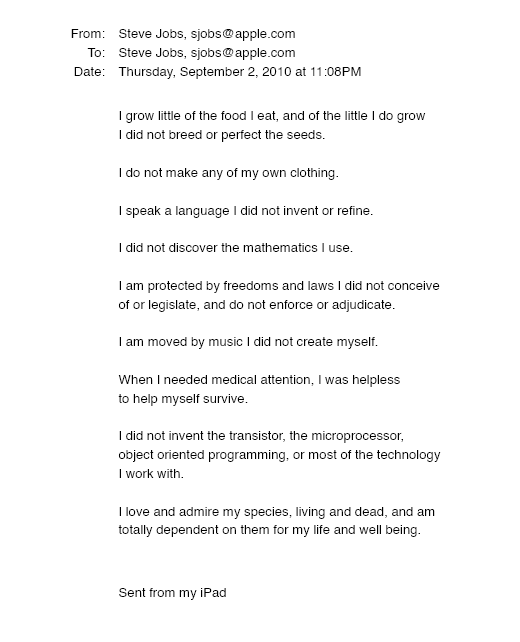
With that, here is the wisdom of Steve Jobs:


From the Steve Jobs Archive


This e-mail by Steve Jobs to himself right before his death, which I just discovered, captures the spirit of the sentiment I am expressing here. It is NOT an “I didn’t build that'' message of any kind. Knowing what I have learned about Jobs—according to his excellent biography Becoming Steve Jobs: The Evolution of a Reckless Upstart into a Visionary Leader, by Brent Schlendler—Jobs is expressing rational gratitude to the many achievers upon whose shoulders he was enabled to do the great things he did. Indeed, no one could ever accomplish what Jobs did by any means other than his own initiative, effort, risk-taking, and thinking. We, all of us, inherit the legacies of those who came before us. But everyone doesn’t automatically become Steve Jobs, or anyone, other than what we make of ourselves. Jobs hits on something we should all remember and take to heart.


Related Reading:


Ayn Rand Anticipated Obama's "You Didn't Build That" Outrage


Obama’s Way vs. The American Way by me for The Objective Standard


Individualism vs. Collectivism: Our Future, Our Choice by Craig Biddle for The Objective Standard


“You Didn’t Build That”—Obama’s Ode to Envy by Ari Armstrong  for The Objective Standard

Tuesday, August 9, 2022

QUORA: ‘Why should capitalists be allowed to continually reap the benefits of others' labor?’

 QUORA: ‘Why should capitalists be allowed to continually reap the benefits of others' labor?


I posted this answer:


The question implies that the capitalist—a label under which I include investors, businessmen, entrepreneurs—can profit only by permission, which the government should have the power to rescind, and thus outlaw and/or confiscate his profits at any time. 


The question ignores the fact that the employees accept and remain in the jobs created by the capitalist/businessman/entrepreneur by voluntary mutual consent, and that consumers willingly buy the businessman’s products. Therefore,  the profits are legitimately earned; meaning that the profits belong to the capitalist not by any authority’s permission but by moral right. It follows that there is only one moral way to “disallow” a capitalist’s profit—by consumers refusing to buy his product. Any other method, including governmental coercion, is criminal. 


That said, the creation of a product that is marketable at a price that is more than the total cost of production is not an easy task. It doesn’t just happen “somehow.” Yet the delusion persists that the labor of the individual workers, each performing a specific delimited task, magically integrates and coordinates into a final product. 


It does not. 


Capitalists reap the benefits of their own capital, ideas, managerial skills, production planning, market analysis, and the general work of running the enterprise and coordinating all of the myriad factors of production, including labor, when and if that work results in successfully creating a marketable product. The direct benefits labor contributes to the capitalist's goals goes to the workers in the form of wages, salaries, and fringe benefits. Certainly capitalists are not “reaping the benefits of others’ labor” if by “reaping” one means taking advantage of workers in the nature of Karl Marx’s absurd exploitation theory of capitalism. Capitalists benefit through their work as the Prime Movers of the business.


The benefits the capitalist receives results from his ability to plan and coordinate the productive contributions of different divisions of labor (and other factors of production) in a way that successfully culminates in the final marketable product, which the capitalist is solely responsible for making possible. It is the capitalist who gives value to the workers. A worker’s job has no value outside of the context as a contributor to the plans of the capitalist regarding the finished product. In this sense, it is actually labor that is reaping benefits—from the capitalists.


Related:


Jeff Bezos’s Beautiful Defense of American Entrepreneurialism


Good Answer  to this question by Saulius Muliolis


My answers to . . .


QUORA: ‘What are the practical proofs that the profits arise from labour which produces surplus value?'

Quora: ‘Is capitalism based on the exploitation of others?’

QUORA: 'How is becoming a billionaire even possible, chronologically?'


Related Reading:


Marx and His Exploitation Theory BY GEORGE REISMAN 


Atlas Shrugged—Ayn Rand


To Whom Does the American Worker Owe His Prowess?


Did Unions Create the Middle Class?


The Myth of the Entrepreneurial State by Deirdre McCloskey and Alberto Mingardi, especially Chapter 24, The Enchaining of Human Action Reverts to a Labor Theory of Value.


George Reisman on Ludwig von Mises, Ayn Rand, and Capitalism, interview with Jim Brown for The Objective Standard


On this Labor Day, Celebrate Intellectual Labor


The Moral Injustice of the Assault on the Space Billionaires


A NJ Letter-Writer’s Comic Book Economics


QUORA: 'How is becoming a billionaire even possible, chronologically?'


Capitalism by George Reisman


The Capitalist Manifesto by Andrew Bernstein  


What is Capitalism? by Ayn Rand 


[Compare: What is Socialism?--Robert Heilbroner, 1982]

Friday, April 29, 2022

A NJ Letter-Writer’s Comic Book Economics

A lot of dumb letters appear in my New Jersey Star-Ledger. I usually ignore them. But every so often one appears that, though dumb, touches on something important that deserves attention. The following letter is one such letter, because the view presented is destructive yet widely believed, including by prominent people who should, and perhaps do, know better. A letter titled What billionaires do is count their profits appeared in the Star-Ledger on April 8, 2022. Written in rebuttal to the letter In defense of billionaire job creators by Bruce Papkin, Charlie Hagel opines


Jobs are created by consumer demand for goods and services, to which profit-seeking companies respond. Can we finally put an end to this canard that billionaires create jobs — although they do profit from creation of jobs?


This implies that profit-seeking companies spring up like weeds on the whims of consumers. These companies have no cause whatsoever. They magically spring up like weeds out of sidewalk cracks, followed by jobs that magically appear for workers to fill, whose individual work is magically coordinated to result in goods and services that fill the “demands” of consumers—all without any intelligent design or direction whatsoever. Somehow, would-be billionaires appear, apparently out of nowhere, to somehow mindlessly profit from the magically “created” jobs—created, how?—until their profits add up to 10 figures! 


This view is a denial of brains. It holds that there is no vision, risk assessment, thinking, planning, decision-making, prioritizing, or intelligence behind the production of consumer goods and services. Yet, that intelligent design is precisely what capitalists/businessmen/entrepreneurs provide. The idea that consumers’ mere desires, rather than innovation, drive production is a toddler’s view of economics. Toddlers want, and their desires are provided. Like the toddler, Hagel has no clue how those desires are met. To Hagel’s worldview, like the toddler’s, stuff consumers “demand”—which they somehow know about before they’re created—just appears out of nowhere—or out of magical job-filled companies.


The idea that goods and services originate with consumer demand is comical. Rather, they originate in the innovative minds of entrepreneurs, who then take the steps necessary to bring their product ideas into being. They create the companies, secure and allocate the capital, assess the employment needs, judge the skills, and hire the employees needed to complete the production and offer it to the consumer market, among many other decisions and actions. Hagel is wrong. Consumers are not responsible for the product or the related jobs created. They are the beneficiaries. The businessman created the product and the jobs. 


Consumers, in fact, rarely know what they want until they see it. Inventors conceive. Capitalists/businessmen/entrepreneurs decide how much consumer demand, if any, there may be for the invention—and then figure out how to manufacture the invention at scale. Often, they are the same people. Often, the risk doesn’t pay off. But when it does, and when the new consumer market for the new product or service amounts into the millions, the businessman gets rich. And in the most successful cases, a billionaire results. It is the now-rich Capitalists/businessmen/entrepreneurs who created and are responsible for the products and the jobs, not the consumer, who is the end, not the beginning, of the productive process.


At this point I’ll concretize this process to demonstrate my point by recounting a personal real-life experience. I often watch CNBC, the financial market channel. Usually, it’s on as sort of “background noise”, since not everything covered particularly interests me. Often, they have interviews with prominent market individuals. In 2019, I was watching when they brought on Ben Silbermann, a founder of a company that had just gone public. The public offering made Silberman, and his co-founder Evan Sharp, billionaires on paper. I’m mildly interested in this type of interview, because I love entrepreneurialism. But my ears really perked up when the name of the company was mentioned, Pinterest. Why perk up? Because I’d been hearing that name mentioned in my household regularly. You see, my wife is an active subscriber to Pinterest, visiting almost every day. As it turns out, she was one of 250 million—yes, million—such subscribers at the time of the public offering. (The company’s active monthly subscriber list has since grown to over 400 million.) 


Now, I asked my wife about what she thought of Pinterest in 2010, the year the company was launched. According to Hagel’s “consumer demand” theory of jobs, there should have been massive demand for Pinterest in 2010. Of course, my wife had never heard of Pinterest in 2010. Pinterest came first, thanks to Silberman and Sharp. It was the product that generated the consumer demand. Hagel has it backwards.


Of course, the founders had no idea how much demand there would be, either. That’s the risk entrepreneurs take. And that’s the point Hagel’s simplistic worldview misses. Capitalist business entrepreneurs become billionaires because they create new goods that consumers didn’t know they wanted, if they wanted it, until they are offered to the marketplace. And, of course, a simple idea, though a vital starting point, is not enough. The entrepreneur then must start and build a company that can figure out how to make the innovative product not only of interest to consumers, but also at a price that consumers are willing and able to pay, yet still high enough to exceed the cost of production so the company can earn a profit. This takes the vision, brains, and actions that the special people who become billionaires provide. It is not consumers who provide it. The myriad products in the market don’t originate with consumers. Goods and services, and the myriad incremental improvements that follow, originate as an idea in the minds of extraordinary innovative individuals. So, too, the related jobs that businesses create to help advance the productive process that results in the products reaching the consumers. The consumer is the last, not the first, step in the productive, job-creating process.


True, the job needs of the established company are subsequently influenced by consumer demand, once the product and company have been created. And true, the original capitalist/businessman/entrepreneur can “count his billions” as the value of the company grows. But, good for him or her. She earned it. Keep in mind that someone still has to do the thinking, planning, and crucial decision-making that keeps the established profit-seeking company going and growing. That’s the indispensable job of the capitalist/businessman/entrepreneur. 


Many creators, of course, go on to new ventures, relinquishing management controls to others. But if the company continues to prosper after the original creator moves on, then that’s thanks to the ability of that original creator—the Prime Mover—to pick competent successors. Apple’s continued success following the death of Steve Jobs is thanks to Job’s ability to pick a great successor, Tim Cook. Billionaires profit from the goods and services they create. Jobs are a secondary social benefit.


But if the now wealthy original creator wants to keep his shares sit back, kick up his heels, and count his riches as the company stock rises, the original creator should still be lauded for his hugely socially beneficial productive achievement[s]. It should always be kept in mind that the company and jobs owe their existence to the original Prime Mover—the Ben Silbermans and Steve Jobs of the world—not to “consumer demand.” . 


Hagel’s worldview is a 2 year-old’s worldview. It is comic book economics, divorced from reality, probably an offshoot of Karl Marx’s absurd “exploitation theory” of labor. Hagel’s view ignores the role of intelligence, and individual minds, in the creation of profit-seeking companies and the jobs that result. Perhaps Hagel can be partially excused, given that prominent politicians like Alexandria Ocasio-Cortez and Bernie Sanders peddle these destructive myths to further their own scandalous socialist political purposes. But only partially excused. Ignorance of this magnitude is never innocent, given the deep injustice implied.


Related Reading:


Quora: ‘Is capitalism based on the exploitation of others?’


The Prime Movers by Edwin Locke


The Moral Injustice of the Assault on the Space Billionaires


QUORA: 'How is becoming a billionaire even possible, chronologically?'


QUORA: ‘What are the practical proofs that the profits arise from labour which produces surplus value?'


Marx and His Exploitation Theory BY GEORGE REISMAN 


Atlas Shrugged—Ayn Rand


To Whom Does the American Worker Owe His Prowess?