Showing posts with label Productivity. Show all posts

Sunday, April 2, 2023

Climate Crisis-Mongers’ New Orwellian Mantra: Poverty Is ‘Abundance’


Hot on the heels of Alissa Quart’s assault on American Individualism comes Rebecca Solnit’s assault on the consequence of that individualism, prosperity.


What if climate change meant not doom — but abundance? By Rebecca Solnit


The article is long on high-minded cliches but devoid of concrete substance. But Solnit’s guilt-drenched, nihilistic message comes through loud and clear.


Solnit wants us to believe that material and spiritual enrichment are opposites—that it is either-or. 


But the creation of material abundance requires spiritual virtues like rationality, learning, inventiveness, entrepreneurship, perseverance, cooperation, and hard work. Material and spiritual abundance compliment and build on each other. Today, thanks to freedom and abundant, economical, reliable energy, mainly fossil fuels, we live amazingly prosperous lives, with an amazingly bright future of greater prosperity. 


So why the doom and despair? Because of the manufactured climate “crisis.” The climate crisis-mongers have infected too many people with a wholly unwarranted doom and gloom. This is especially true of the young, who are victims of mental abuse at a time they should be looking ahead with eager anticipation. Today is the best time in human history in which to be a teenager, the inheritors of unprecedented opportunities for building flourishing lives. The despair and anxiety so many of them feel is real. But it is the climate crisis-mongers who inflicted it. This is not just educational malpractice. It is child abuse.


Solnit’s premise is not new. The environmentalists’ anti-human goal is the same. She just reframes prosperity as poverty, and poverty as “abundance.” This is just a new version of Christianity’s Dark Age glorification of poverty. She speaks of “building stronger societies and being better citizens, on caring for the people,” and then glorifies disasters as paths to joy and “moral beauty.” 


This, the glorification of disaster, is where Solnit’s true colors come through. The Great Enrichment of the past 250 years, the era of Capitalism, freedom, and fossil fuels, has made us safer than ever from climate dangers, and much better able to mitigate the damage of such disasters—with promises of more safety to come. Solnit proposes to abandon the material prosperity that makes this climate mastery possible, and once again make humanity at the full mercy of nature’s fury. That is what Solnit means by her new form of “abundance”—rather than an abundance of money and stuff, an abundance of misery. This is what she terms “spiritual abundance.”


We should be grateful to fossil fuels for the wonderful lives we have today, celebrating the abundance of fossil fuels needed to power further progress in the decades ahead, and advocating to preserve the freedom necessary for the innovation that will eventually lead to better energy sources that can not only grow our economies but make us ever more resilient to future climate dangers. 


Having been lecturing us for years about how our industrial flourishing is destroying the planet, we are now being told that the unprecedentedly enriched lives we enjoy is bad for us. Reject Solnit’s bleak call for a future of scarcity and phony spiritual “enrichment.” It’s just repackaged climate hysteria. Instead, embrace human flourishing. Reason’s Ronald Bailey presents a better vision, as does Alex Epstein.


Related Ruling:


The End of Doom: Environmental Renewal in the Twenty-first Century by Ronald Bailey


Fossil Future: Why Global Human Flourishing Requires More Oil, Coal, and Natural Gas--Not Less by Alex Epstein


The Anti-human Tyrade of an Ungrateful 16-Year-old


We Owe Our Children a More Technologically Advanced Society, Not 'Preserved' Nature


The Collectivist Left Media Launches Major ‘Climate Crisis’ Propaganda Campaign


CLIMATE VULNERABILITY AND THE INDISPENSABLE VALUE OF INDUSTRIAL CAPITALISM—Kieth H. Lockitch

Monday, December 12, 2022

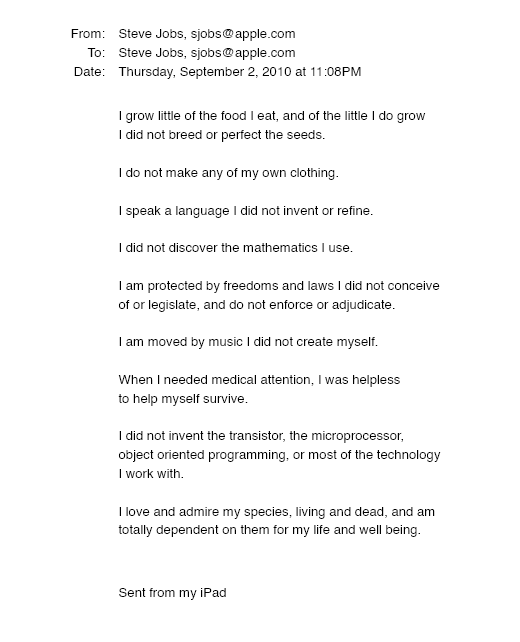
Steve Jobs’ Rational Gratitude

No one can ever accuse Steve Jobs of humility. His inspired drive and vision was the moving force behind the Apple enterprise and the innovative products that have improved the lives of billions of people, and he was rightfully proud of what he accomplished. Jobs was living proof of the falsehood of Obama’s mean-spirited “you didn’t build that” mantra. “If you were successful,” Obama driveled, 


somebody along the line gave you some help. There was a great teacher somewhere in your life. Somebody helped to create this unbelievable American system that we have that allowed you to thrive. Somebody invested in roads and bridges. If you’ve got a business—you didn’t build that. Somebody else made that happen.


Obama is right about achievers who came before you, from teachers to political revolutionaries to road and bridge builders. But he’s cynically wrong that they made your achievements happen. 


No, you made that happen. If you didn make the effort, take the risks, do the thinking, it wouldn’t have happened, all of those prior achievers notwithstanding. They can bequeath to you their legacies. They cannot make your business happen. 


But Jobs is on to something, as you’ll see. While we all individually DID build that, however great or modest our productive achievements, it is also important to recognize that, while doing our building, we stood on the shoulders of the prior achievements of many many other productive people, both living and long dead--and we should be grateful to them. Jobs expresses an incontrovertible truth: Progress is hierarchical, with productiveness built upon prior productiveness, which was itself built on prior productiveness, ultimately traceable back to man’s emergence from the cave. If some Stone Age thinker hadn’t discovered how to harness fire, where would we be today? Still in the Stone Age.


With that, here is the wisdom of Steve Jobs:


From the Steve Jobs Archive


This e-mail by Steve Jobs to himself right before his death, which I just discovered, captures the spirit of the sentiment I am expressing here. It is NOT an “I didn’t build that'' message of any kind. Knowing what I have learned about Jobs—according to his excellent biography Becoming Steve Jobs: The Evolution of a Reckless Upstart into a Visionary Leader, by Brent Schlendler—Jobs is expressing rational gratitude to the many achievers upon whose shoulders he was enabled to do the great things he did. Indeed, no one could ever accomplish what Jobs did by any means other than his own initiative, effort, risk-taking, and thinking. We, all of us, inherit the legacies of those who came before us. But everyone doesn’t automatically become Steve Jobs, or anyone, other than what we make of ourselves. Jobs hits on something we should all remember and take to heart.


Related Reading:


Ayn Rand Anticipated Obama's "You Didn't Build That" Outrage


Obama’s Way vs. The American Way by me for The Objective Standard


Individualism vs. Collectivism: Our Future, Our Choice by Craig Biddle for The Objective Standard


“You Didn’t Build That”—Obama’s Ode to Envy by Ari Armstrong  for The Objective Standard

Saturday, August 31, 2019

This Labor Day, Celebrate Intellectual Labor

The United States Department of Labor, speaking on The History of Labor Day, had this to say on its website:

Some records show that Peter J. McGuire, general secretary of the Brotherhood of Carpenters and Joiners and a cofounder of the American Federation of Labor, was first in suggesting a day to honor those “who from rude nature have delved and carved all the grandeur we behold.”

Really? There is no doubt about what is meant here. McGuire was referring to people who “work with their hands”. Is that what built America? Physical labor has existed since time immemorial. What changed in the last two hundred + years that suddenly endowed the American worker with the means to produce “all the grandeur we behold” out of raw, “rude” nature? (Note the word “all”).

The American worker has, indeed, contributed significantly to the American Economic juggernaut. But, it was not because of his labor, as such. It was because of his intellectual mastery of the theoretical and material tools of production provided to him, that vastly increased the value of his labor.

Physical labor, as such, has very little value. Slaves can perform it. So can mules pulling hand plows.

Consider my trade, plumbing. If my job is fundamentally physical labor, then any able-bodied person off of the street can wander onto any construction job site and robotically perform the task of installing plumbing systems. He can simply be told: “Run this pipe from here to there”, and it will get done. He has the same muscles and bones, nerves and guts that I have, after all.

That, of course, could never be the case. Performing my task (or any construction trade) requires reliance on previously acquired theoretical knowledge, on-the-job apprenticeship training, the mastery of the tools, materials, and procedures of the trade, and years of learning experience. This is to say nothing of the continuing education that new materials and technologies require of me.

My job is knowledge-based. All modern jobs are, to varying extent. How did that knowledge become imbued in my brain? - by my choice to expend the intellectual effort to acquire it. Even the muscular physical motions my job requires had to be learned by a conscious mental effort that led to the appropriate neurological connections.

Do you still think mere labor built this country?

The idea that a laborer “works with his hands” is only superficially true. What directs the motions of his hands? It is his focussed, reasoning mind – if he is a motivated worker who strives to be the best that he can be at his chosen occupation. If not, then that worker is a mere drone.

And that gets directly to the point. The celebration of “labor” as a holiday implies that mindless worker. Labor Day ignores the intellectual root of modern, productive labor. It ignores the intellectual labor of the inventor and entrepreneur that created the worker’s job to begin with, and the intellectual labor that the competent worker must expend to learn to perform his job.

Human knowledge is fleeting, but for the grace of those who came before us and chose to acquire it and pass it on. Knowledge can not be passed on from person to person or generation to generation innately. No one is born with previously discovered knowledge, but rather with a mind that is tabula rasa – a blank slate. To celebrate “all the grandeur we behold”, it is to the discoverer and the acquirers of knowledge that we must pay initial gratitude to. The worker, by learning the skills he needs to perform his job, plays his role in keeping that knowledge train going.

This does not, however, mean that labor is inconsequential. Theoretical knowledge in and of itself has little value, unless and until it is placed into the service of man’s living requirements. The process of turning knowledge into the material values humans need to live and to flourish is dependent upon the contributions of many economic players. The value of each player’s contribution to this productive process varies and is dependent upon many factors. But all through that process – from the discoverer of new knowledge to the final material product put together by the worker – the value added represents, at root, the application of the mind.

“[W]hen you live in a rational society, where men are free to trade, you receive an incalculable bonus: the material value of your work is determined not only by your effort, but by the effort of the best productive minds who exist in the world around you.

“When you work in a modern factory, you are paid, not only for your labor, but for all the productive genius which has made that factory possible: for the work of the industrialist who built it, for the work of the investor who saved the money to risk on the untried and the new, for the work of the engineer who designed the machines of which you are pushing the levers, for the work of the inventor who created the product which you spend your time on making, for the work of the scientist who discovered the laws that went into the making of that product, for the work of the philosopher who taught men how to think…” (Page 1064)

Labor Day, according to the DOL, was created in 1882. That was the heyday of Karl Marx’s rise to prominence among the American intellectual elite. Marx was the theoretician of “Dialectical Materialism”, the idea that man’s consciousness – his spirit, his intellect, ability, and logic – plays at best a minimal role in the production process. Human beings, according to Marx, are conditioned by the physical world around them, including the means of production like tools and factories, which just happened into existence. Our modern, complex, and advanced industrial society is the product of mindless, conditioned muscular movements, according to Marx (and others). It is owing to the Marxist theory of the mind – i.e., spiritual values - as of little consequence that gave rise to the myth that labor and those that perform it are the primary engines of economic progress.

Labor Day, whether one knows or wants to admit it or not, is an outgrowth of Marxism and the “labor theory of economic value” that so enamored late 19th century American intellectuals.

The DOL concludes its Labor Day salute as follows:

"It is appropriate … that the nation pay tribute on Labor Day to the creator of so much of the nation's strength, freedom, and leadership — the American worker."

Not quite. Instead, we should pay tribute to the creator of the American worker.

This Labor Day, we should celebrate not workers, but those who made our jobs and prosperity possible. This country was not built by physical labor. It was built by intellectual labor applied to physical labor under a system of individual rights that allowed everyone the freedom to think and, above all, to act on his thinking. Instead of patting ourselves on the back for our labor, we “workers” should reflect on the mental efforts that we had to expend in order to acquire the previously discovered knowledge that makes it possible to perform our jobs. We should stop selling ourselves short. Labor Day is an insult to the American Worker.

More importantly, we should give silent thanks to all of those intellectual “laborers” who came before us – the discoverers, the inventors, the investors, the businessmen - who made our well-paying jobs possible.

Instead of Labor Day, we should celebrate Intellectual Labor Day.

Or, better yet, we should celebrate political and economic freedom—i.e., Capitalism – the social system of the United States of America. Capitalism unleashed the individual human mind. It is Capitalism that liberated the inventor, entrepreneur, businessman, and industrialist, who in turn made it possible for the American worker to have acquired the means to rise to middle class status and prosper. The labor movement fought for better working condiditions, shorter work weeks, and the like. But those victories couldn't have been possible without the tools of increased worker productivity and consumer products created by the inventor/entrepreneur/businessman/industrialist, who wouldn't have been possible without capitalism. The labor movement could not have been possible in any other era in human history. Capitalism made the labor movement possible.

It is Capitalism’s liberated human mind that from rude nature has delved and carved all the grandeur we behold.

Capitalism is what I will be quietly rejoicing as I enjoy my long weekend.

Happy Labor Day!!

Related Reading:

Atlas Shrugged—Ayn Rand


Did Unions Create the Middle Class?

QUORA: 'How is becoming a billionaire even possible, chronologically?'

Saturday, March 21, 2015

How Business Productivity Makes Us Wealthier and Safer

This is a followup on Gary Faraci’s letter titled Economic status quo must change, which was published in the Asbury Park Press and also appeared in the print edition of the New Jersey Star-Ledger.


Gary Faraci posted this rebuttal to my comments, discussed in my last post on 3/19/15, “Only Free Markets Can Fairly Determine Economic Success”:


Contrary to what you say, in today's system big business investors don't risk their capital - they use our tax dollars in the form of grants, subsidies, tax abatements & deferments. The billions the oil companies get from us, and the billions in breaks we give them are good examples. And big business investors are guaranteed a return - just look at the TARP bailout of the financial industry. Increased productivity also means less labor needed, thus less not more earning power for many. And climate change indicates business has NOT led to a safer, healthier human environment. The only thing we agree on is the first responsibility of a CEO is to maximize shareholder value. But that is not in any way a MORAL responsibility, as the other stakeholders are not considered. And that is immoral.


My Reply:


Today’s system is seriously corrupt in many ways, and I agree the TARP bailouts are terrible. But mixed economy corruption aside, investment, production, and trade drive progress.


I also agree that any actual subsidies—direct payments from taxpayers to companies—should end. That includes the massive, decades-long subsidies to so-called “renewable” energy companies. But tax breaks are not subsidies. They are companies keeping more of what they have earned. And oil companies earn their profits by producing the indispensable values—energy and myriad petroleum-based products—that we voluntarily buy.


“And climate change indicates business has NOT led to a safer, healthier human environment.”


This is the most fantastic statement imaginable. Where would we be without central heating and a/c; water purification and delivery systems; sturdy structures; advanced sanitary waste disposal; advanced medicine; electrification; modern transportation; modern agriculture; modern communications; stores stocked with products to meet every imaginable need and desire. The list goes on and on. We are saturated in the wonders of business, big and small. In the midst of plenty, you see only “climate change,” ignoring the monumental benefits. This is irrational prejudice. Well, climate danger, not climate change, is and always has been the real threat. And we’re better protected from climate danger than ever before. Before the capitalist era of business prominence, life for all but the very wealthiest ruling elites was a brutal day-to-day, hand-to-mouth struggle to stay one step ahead of the next drought-induced famine or storm or infectious disease or cold wave. If what we have today is not a safer, healthier human environment compared to what existed back then, then how exactly do you define safer and healthier?


--


Now let’s explore in more depth Faraci’s statement that “Increased productivity also means less labor needed, thus less not more earning power for many.”


Increased productivity does cost jobs in the short term, and these workers who lose their jobs can face hardship if they don’t find an alternative livelihood.


But productivity works both ways. The workers who remain are more productive, and thus, over time, earn higher wages. Furthermore, lower costs lead to lower prices, resulting in increased sales that tend to mitigate the shrinkage of the more productive company’s workforce. And as existing industry gets more productive and sheds workers, the way is paved for the birth of new technologies and new industries—including those that produce the new, labor saving technologies. This process leads to more goods at more affordable prices, and more jobs.


Steady economic progress has been the history of capitalism. Before free market capitalism gave birth to the industrial revolution, almost everyone worked on the basic necessities of life—food and clothing. That was all most people had time for. As recently as 1870, at least 70% of the U.S. population worked in agriculture. Today, only 2%. Add in the productivity-led shrinkage of jobs in the textile industry to 2% of the labor force, and—according to Faraci’s logic that productivity is regressive—we should have 90% unemployment today. Not only is that obviously not so, we are all immensely wealthier than in pre-industrial times. We have indoor plumbing, electrification, autos and planes, central air conditioning and heating, amazing healthcare, cell phones, television, the internet, plentiful food, much better protection from the natural elements, and whatever else one cares to add to this list. And we live almost twice as long, with a wealth of job opportunities unimaginable 250 years ago.


Faraci doesn’t explain specifically what he means when he says that a CEO’s duty to maximize shareholder value “is not in any way a MORAL responsibility, as the other stakeholders—the community, the employees and the environment—are not considered.” But we can surmise. Apparently, Faraci believes businessmen’s interests are to be subordinated to the “community”—i.e., anyone other than the owners and operators of the business; and that the world owes “employees” a living, which it is business’s moral duty to provide for, whether or not the employee is any longer needed and regardless of his level of competence. As to the environment, Faraci apparently believes that the natural environment is safe, and businessmen have made it less safe—the exact opposite of the truth. Does Faraci prefer a pre-industrial existence over today’s comparatively thriving industrial, technological civilization? Or is Faraci demanding that  business somehow produce what we need without affecting the natural world? Your guess is as good as mine.


Of course, capitalism balances and harmonizes everyone’s interests, through the mechanism of trade, so that no one’s interests are sacrificed to anyone else’s. This is so because, under capitalism, individual rights are protected equally and at all times, under a government constitutionally limited to that purpose. Capitalism is the system of self-reliance and respect for the rights of others. It is the system that liberates producers to transform the natural world, with all of its inherent dangers, into a safer, livable human life-centered environment. Parasites, power-lusters, and “Mother Earth”—worshipping primitives have no place in a capitalist society, and that’s what makes capitalism the only moral social system.


Related Reading:


Businessmen—Ayn Rand

Saturday, August 30, 2014

This Labor Day, Celebrate Intellectual Labor

The United States Department of Labor, speaking on The History of Labor Day, had this to say on its website:


Some records show that Peter J. McGuire, general secretary of the Brotherhood of Carpenters and Joiners and a cofounder of the American Federation of Labor, was first in suggesting a day to honor those “who from rude nature have delved and carved all the grandeur we behold.”

Really? There is no doubt about what is meant here. McGuire was referring to people who “work with their hands”. Is that what built America? Physical labor has existed since time immemorial. What changed in the last two hundred + years that suddenly endowed the American worker with the means to produce “all the grandeur we behold” out of raw, “rude” nature? (Note the word “all”).


The American worker has, indeed, contributed significantly to the American Economic juggernaut. But, it was not because of his labor, as such. It was because of his intellectual mastery of the theoretical and material tools of production provided to him, that vastly increased the value of his labor.


Physical labor, as such, has very little value. Slaves can perform it. So can mules pulling hand plows.


Consider my trade, plumbing. If my job is fundamentally physical labor, then any able-bodied person off of the street can wander onto any construction job site and robotically perform the task of installing plumbing systems. He can simply be told: “Run this pipe from here to there”, and it will get done. He has the same muscles and bones, nerves and guts that I have, after all.


That, of course, could never be the case. Performing my task (or any construction trade) requires reliance on previously acquired theoretical knowledge, on-the-job apprenticeship training, the mastery of the tools of the trade, and years of learning experience. This is to say nothing of the continuing education that new materials and technologies require of me.


My job is knowledge-based. All modern jobs are, to varying extent. How did that knowledge become imbued in my brain? - by my choice to expend the intellectual effort to acquire it. Even the muscular physical motions my job requires had to be learned by a conscious mental effort that led to the appropriate neurological connections.


Do you still think mere labor built this country?


The idea that a laborer “works with his hands” is only superficially true. What directs the motions of his hands? It is his focussed, reasoning mind – if he is a motivated worker who strives to be the best that he can be at his chosen occupation. If not, then that worker is an occupational drone, or an incompetent, or worse.


And that gets directly to the point. The celebration of “labor” as a holiday implies that mindless worker. Labor Day ignores the intellectual root of modern, productive labor. It ignores the intellectual labor that created the worker’s job to begin with, and the intellectual labor that the competent worker must expend to learn to perform his job.


Human knowledge is fleeting, but for the grace of those who came before us and chose to acquire it and pass it on. Knowledge can not be passed on from person to person or generation to generation innately. No one is born with previously discovered knowledge, but rather with a mind that is tabula rasa – a blank slate. To celebrate “all the grandeur we behold”, it is to the discoverer and the acquirers of knowledge that we must pay initial gratitude to. The worker, by learning the skills he needs to perform his job, plays his role in keeping that knowledge train going.


This does not, however, mean that labor is inconsequential. Theoretical knowledge in and of itself has little value, unless and until it is placed into the service of man’s living requirements. The process of turning knowledge into the material values humans need to live and to flourish is dependent upon the contributions of many economic players. The value of each player’s contribution to this productive process varies and is dependent upon many factors. But all through that process – from the discoverer of new knowledge to the final material product put together by the worker – the value added represents, at root, the application of the mind.


“[W]hen you live in a rational society, where men are free to trade, you receive an incalculable bonus: the material value of your work is determined not only by your effort, but by the effort of the best productive minds who exist in the world around you.


“When you work in a modern factory, you are paid, not only for your labor, but for all the productive genius which has made that factory possible: for the work of the industrialist who built it, for the work of the investor who saved the money to risk on the untried and the new, for the work of the engineer who designed the machines of which you are pushing the levers, for the work of the inventor who created the product which you spend your time on making, for the work of the scientist who discovered the laws that went into the making of that product, for the work of the philosopher who taught men how to think…” (Page 1064)

Labor Day, according to the DOL, was created in 1882. That was the heyday of Karl Marx’s rise to prominence among the American intellectual elite. Marx was the theoretician of “Dialectical Materialism”, the idea that man’s consciousness – his spirit, his intellect, ability, and logic – plays at best a minimal role in the production process. Human beings, according to Marx, are conditioned by the physical world around them, including the means of production like tools and factories, which just happened into existence. Our modern, complex, and advanced industrial society is the product of mindless, conditioned muscular movements, according to Marx (and others). It is owing to the Marxist theory of the mind – i.e., spiritual values - as of little consequence that gave rise to the myth that labor and those that perform it are the primary engines of economic progress.


Labor Day, whether one knows or wants to admit it or not, is an outgrowth of Marxism and the “labor theory of economic value” that so enamored late 19th century American intellectuals.


The DOL concludes its Labor Day salute as follows:


"It is appropriate … that the nation pay tribute on Labor Day to the creator of so much of the nation's strength, freedom, and leadership — the American worker."

Not quite. Instead, we should pay tribute to the creator of the American worker.


This Labor Day, we should celebrate not workers, but those who made our jobs and prosperity possible. This country was not built by physical labor. It was built by intellectual labor applied to physical labor under a system of individual rights that allowed everyone the freedom to think and, above all, to act on his thinking. Instead of patting ourselves on the back for our labor, we “workers” should reflect on the mental efforts that we had to expend in order to acquire the previously discovered knowledge that makes it possible to perform our jobs. We should stop selling ourselves short. Labor Day is an insult to the American Worker.


More importantly, we should give silent thanks to all of those intellectual “laborers” who came before us – the discoverers, the inventors, the investors, the businessmen - who made our well-paying jobs possible.


Instead of Labor Day, we should celebrate Intellectual Labor Day.


Or, better yet, we should celebrate Capitalism – the social system of the United States of America. Capitalism unleashed the individual human mind. It is Capitalism that made it possible for the American worker to have acquired the means to rise to middle class status and prosper. It is Capitalism’s liberated human mind that from rude nature has delved and carved all the grandeur we behold.


Capitalism is what I will be quietly rejoicing as I enjoy my long weekend.


Happy Labor Day!!


Related Reading:


Atlas Shrugged—Ayn Rand

To Whom Does the American Worker Owe His Prowess?

Friday, April 4, 2014

On "Letting Poor People Die"

In my blog post of yesterday regarding Dylan Scott's TPM DC article Conservatives Have A New Scheme To Strip People Of Obamacare Coverage, I left a short reply to one correspondent's sarcastic comeback to my comments critical of ObamaCare's Medicaid subsidies to the "poor/." The correspondent said "The moral thing is to simply let poor people die." Here is my reply:


There was never a time in America, before the welfare state, when poor people were "left to die," because charity was plentiful for the few people who really needed it. It's not immoral to help another. What's immoral is for our own government to seize the earnings of people who work their way above poverty for the unearned benefit of those who didn't (or won't), and deny them the right to spend their own money as they see fit—including deciding for themselves, based on their own values and personal circumstances, who, when, and in what capacity to offer charity.

I'd like to expand on these comments.

The statement itself is logically invalid. Everything man needs to survive and thrive must be created by productive work. Nothing is available free in nature. Poverty is the natural state of man. Yet, the vast majority of people in industrialized countries do not live in abject, natural poverty, although many live in relative poverty, as measured by arbitrary government income standards. Why is that? Because most people apply some level of the productive human effort necessary to overcome their natural state of poverty.

The above statement is a denial of human effort. Why? because the statement implies that to be poor means to face a choice between parasitically living off of others or dieing. But if this were so, then the human race would have to be extinct! Since poverty is man's natural state, every human being faces the same choice—parasitically leach off of others or die. If that is the case, who will there be for the "poor" to parasitically live off of, since the poor is each and every one of us? So, if there is no one to leach off of, we're all dead; human extinction. 

Obviously that is not the case. What's missing from this scenario? Man's means of rising above poverty—productive human effort. 

Put that way, the correspondent would undoubtedly protest that he didn't mean to deny human effort. But then, what's left? A third choice that the correspondent's sarcasm blanks out from the poor person's alternatives; productive effort. Stripped of it's false implication, the statement implicitly (and insultingly) equates being "poor" with incompetence to overcome the natural state of poverty—to deal with life. The further implication is that, therefore, incompetence is an automatic claim on involuntary servitude of the competent. Leaving aside the otherwise competent few who are destitute because of circumstances beyond their control, the correspondent is basically upholding human vice as a justification for ObamaCare.

The political implications of the correspondent's statement is as follows: He is essentially saying to me, "You have it within your power to prevent poor people from dieing, because you have it within your power to pick other people's pockets, via support for some law like ObamaCare. If you oppose ObamaCare, you are simply letting poor people die." Statists always must resort to collectivist premises to rationalize their viewpoints, because to focus on consequences for individuals qua individuals is to expose the utter immorality of their viewpoints. No individual has the capacity to save all poor people, because no individual in a just society has access to everyone's wealth. The individual qua individual has only the capacity to deal with situations of need on a concrete, case-by-case basis, whether regarding a suffering individual or some charitable organization dealing in specific human needs—and then only with his own money.

More fundamentally, no individual has the moral obligation to save all poor people. The best and only moral thing government should do for the poor is to let people live free.

Obama's Collectivist "Togetherness" vs. Individualist Togetherness

Elizabeth Warren's Flawed Understanding of the Source of Worker Productivity

The Spiritual Parasitism of Senator Robert Menendez

Saturday, August 3, 2013

Elizabeth Warren's Flawed Understanding of the Source of Worker Productivity

Doug Altner at Voices for Reason responded to Senator Elizabeth Warren who recently asserted that if the Minimum Wage had kept pace with the growth of worker productivity over the past half century, the legal minimum would be $22.00 per hour. Warren asks:


So my question is … with a minimum wage of $7.25 an hour, what happened to the other $14.75? It sure didn’t go to the worker.
The implication in Warren's statement is based on a completely eroneous premise.  Altner writes:


By asking why low-wage workers are not making more money, Senator Warren is insinuating that these dramatic productivity gains were largely caused by the workers themselves. But what about the small minority of innovators who invented new technologies and processes that vastly improved worker productivity?
After listing a handfull of these technologies and processes given to workers, Altner concludes:


Where did the other productivity gains go—Senator Warren asks? Hopefully a lot of it went to the forward-thinking innovators and entrepreneurs whose advancements boosted worker productivity.
I would add that there are two ways in which workers gain from higher productivity, of which higher wages is only one.

Keep in mind that what counts is real wages; the purchasing power of the dollars one earns. The benefits of productivity are not just reflected in rising nominal wages. The whole point of companies increasing the productivity of their labor force is to better compete in the market by lowering the cost of production. This facilitates higher profits by enabling the company to lower prices in order to increase sales and expand markets. (Inflation camouflages this process, but doesn't alter it.) Everyone, including workers, benefit from this even without a wage increase, through lower prices for goods and services. In other words, your money goes farther.

This doesn't mean workers have nothing whatsoever to contribute to higher productivity. They do, which is why, over time, higher nominal wages do occur. New productivity-enhancing tools and processes require the initiative of workers. New knowledge and skills are only as good as the next person making the effort to acquire it. Workers must work to acquire training and continuing education to keep up with the latest advances given them by innovators, and that takes effort and initiative. And, ambitious workers regularly figure out ways to make more efficient use of their time, contributing in myriad small ways to productivity. (Such workers often don't benefit financially because of uniform wage contracts negotiated by unions, under which all workers in a given job make the same pay regardless of personal productiveness.) So, the worker's own efforts do factor into his higher wages, and in that respect he does earn his higher wages even though he wasn't the originator of the productivity advances.

Of course, productivity increases vary greatly from industry to industry and from occupation to occupation, and no one-size-fits-all formula can capture that (a fact minimum wage warriors evade). The construction trades, for example, has wages several times the legal minimum (at least in NJ), thanks to tremendous productivity gains in that industry. Other industries--like, say, the food service industry--may have smaller productivity increases and so it employs more minimum wage workers (though even these workers gain from productivity increases across the economy, as noted above).

Of course, this discussion hinges on the assumption that America has a free market, which it does not. Yaron Brook at Laissez-Faire: The Uncompromised Case for Capitalism strongly addresses this fact here.

But, fundamentally, a rising worker standard of living is a gift from innovators and entrepreneurial businesses that gives workers the ability to work ever more productively.

Related Reading:

The Stock Market Record, Income Stagnation, and the Regulatory State