Showing posts with label Elections. Show all posts

Sunday, July 26, 2026

New Jersey’s Racist John R. Lewis Voter Empowerment Act

New Jersey has gone full collectivist—especially racist—on the Democratic process. On July 2, 2026, Governor Mikie Sherrill signed the John R. Lewis Voter Empowerment Act.


What does that law do? According to the AI summary of BillTrack50,


This bill, known as the "John R. Lewis Voter Empowerment Act of New Jersey," aims to strengthen voting rights and prevent voter suppression and dilution, particularly for "protected classes" which include racial, color, or language-minority groups. It establishes the public policy of New Jersey to maximize voter participation and ensure equal opportunity for all eligible voters, especially those in protected classes, to engage in the political process. [my emphasis]


This is a reaction to the SCOTUS ruling in Louisiana v. Callais, which overturned a racially gerrymandered Congressional district because it violated Section 2 of the Voting Rights Act of 1965, which prohibits voter discrimination on the basis of race, color, or membership in language minority groups. 


The Left’s hysterical mantra has been that the Voting Rights Act of 1965 has been neutered, eviscerated, weakened, or even repealed, even though no one’s rights have been weakened, compromised, or otherwise violated. We had, and still have, equal voting rights for all—the proverbial, ironclad rule “one man, one vote” principle.


No one has been restricted from “engaging in the political process,” which involves more than voting, like campaign donations, issue advocacy, campaigning for a candidate, or debating fellow citizens. (It’s interesting that Democrats would use that terminology, since it is they who would restrict people from engaging in the political process, through various campaign finance legal restrictions, and fighting to overturn pro-free speech SCOTUS rulings like Citizen’s United.)


So, what gives?


The Left has snuck in a sinister gimmick—switching the concept of voting rights from the individual to the collective. Reread the summary of the NJ law. There are no, and cannot be, “protected classes” in the United States of America. America is explicitly a nation built on the unalienable rights of the individual, not the group, and for which our government is legally bound to secure equally for all. But by the Left’s standards, certain groups or classes get the special privilege of being virtually guaranteed the election of politicians of its favored race, skin complexion, or language. (What of ideas, policy, character, or political philosophy of the candidates?) And what of the individuals who make up the dissenting minorities within those privileged classes, who have no such guarantee? What of un-”protected” classes? What of the equal protection of the laws? What is the unsaid premise behind such hideous laws as that of New Jersey, which are intended to rig certain elections in favor of certain politically privileged “protected” voting demographics? That unsaid premise amounts to, “All voters are equal, but some voters are more equal than others.”


There are no, and can logically never be, such a thing as collectivized voting rights, or collectivized rights of any kind. As the great American philosopher Ayn Rand has observed


Any group or collective, large or small, is only a number of individuals. A group can have no rights other than the rights of its individual members. In a free society, the rights of any group are derived from the rights of its members through their voluntary, individual choice and contractual agreement, and are merely the application of these individual rights to a specific undertaking. Every legitimate group undertaking is based on the participants' right of free association and free trade. (By legitimate, I mean: noncriminal and freely formed, that is, a group which no one was forced to join.)


The notion of collective rights (the notion that rights belong to groups, not to individuals) means that rights belong to some men, but not to others; that some men have the right to dispose of others in any manner they please and that the criterion of such privileged position consists of numerical superiority.


Nothing can ever justify or validate such a doctrine and no one ever has. Like the altruist morality from which it is derived, this doctrine rests on mysticism: either on the old-fashioned mysticism of faith in supernatural edicts, like The Divine Right of Kings or on the social mystique of modern collectivists who see society as a super-organism, as some supernatural entity apart from and superior to the sum of its individual members.


Of course, the “protected classes” are created by political fiat—i.e., by force—in which no individual member of that group was given a chance to consent or not. Thus, the “protected classes” are groups of individuals who are forced to join, whether they choose to or not.


Oh, well. It makes perfect sense from the standpoint of the Left’s long-held tribal narrative—That so-called “people of color” are an inferior human breed who need government favoritism to make it in a free society. As I noted in a Facebook post:


The violent Leftist reaction to the ruling also affirms the fundamental racial/collectivist orientation of the Left and the Democratic Party (I deliberately chose the NYT article to demonstrate this). That political block sees every issue through a lens of race. But, MEMO to the Left: dark skinned people are INDIVIDUALS, each with a mind of their own, capable of deciding FOR THEMSELVES how to vote, just like every other person. They are not some homogenous colored herd with some collective brain that they must be told they must follow.


Don’t believe the way most of the press is characterizing this ruling. This [SCOTUS] decision is a great outcome.


To demonstrate how the misrepresentation gets traction, consider the wording of these clips. From Supreme Court no ‘rubber stamp’ for Trump, Kagan says


While standing up for her conservative colleagues, Kagan did express disappointment with many of the Supreme Court’s recent decisions, including what she termed the “evisceration of the Voting Rights Act.” 


The link connects to a Politico report:


From Supreme Court limits Voting Rights Act


The Supreme Court significantly narrowed a key provision of the Voting Rights Act in a 6-3 ruling Wednesday, further eroding the impact of the landmark civil rights-era law.


For decades, Section 2 — a provision that broadly outlawed discrimination in voting on the basis of race — has been interpreted to allow, and sometimes demand, the use of race-conscious data in redistricting, to protect the voting power of minorities.


Note the glaring contradiction. The “key provision” that was allegedly “significantly narrowed” was Section 2 of the Voting Rights Act. But it was not actually Section 2 that was narrowed. It was a particular interpretation of Section 2—an interpretation that actually twisted the Voting Rights Act “to allow, and sometimes demand, the use of race-conscious data in redistricting, to protect the voting power of minorities” rather than individuals, a provision that is not found anywhere in the actual 1965 Act. What does the Act actually say?


Section 2 of the 1965 Voting Rights Act “prohibits voting practices or procedures [like redistricting?] that discriminate on the basis of race, color, or membership in one of the language minority groups identified in Section 4(f)(2) of the Act. Most of the cases arising under Section 2 since its enactment involved challenges to at-large election schemes, but the section's prohibition against discrimination in voting applies nationwide to any voting standard, practice, or procedure that results in the denial or abridgement of the right of any citizen to vote on account of race, color, or membership in a language minority group. Section 2 is permanent and has no expiration date as do certain other provisions of the Voting Rights Act. [My emphasis]


New Jersey’s new John R. Lewis Voter Empowerment Act, which is intended as a counterweight to the “voter suppressing” SCOTUS ruling, is actually a hideous law that actually weakens the voting rights of individuals.


Clearly, Politico’s reporting is the most accurate. Note that the Act refers to “the right of any citizen to vote,” NOT the “right” of any citizen to rig an election so someone of his race or color can win. No citizen’s right to cast his vote was denied, abridged, or “eviscerated” by the SCOTUS ruling in Louisiana v. Callais. What was eviscerated was the hideous practice of race-based redistricting—a resounding victory for the 1965 Voting Rights Act and the equal right of all citizens to vote.


Related Reading:


Woke Redistricting Madness in NJ


Did SCOTUS Promote or Reject Racism in Alabama Redistricting Case?


Individualism vs. Collectivism: Our Future, Our Choice by Craig Biddle for The objective Standard


Friday, November 15, 2024

Democracy Wouldn’t Be a Gamble if American Principles are Adhered to.

Theodore R. Johnson posted a thoughtful pre-election op-ed in the Washington Post titled Black voters are joining a coalition. It’s always a gamble. “Black voters,” Johnson writes, “must always wonder whether their partners at the ballot box will remain partners after a victory” :


Black voters keep a watchful eye for these signs. Their trust in democracy — both the system and the people who operate it — is hard-earned. For them, choosing the right coalition partners has not been just a question of policy wins but a matter of life and death. The same system that legislated slavery and Jim Crow became the tool that secured rights and opportunity. This checkered past gives their politics a pronounced pragmatism, rooted in an understanding that Black people in America fare best when the federal government makes civil rights a priority. Their numbers and political solidarity give them electoral power — valuable even to those who might despise them.


My emphasis highlights a crucial philosophical observation that begs the question: “Is the American system both the ‘system that legislated slavery and Jim Crow’ and the system that protects civil rights the same?” Are they even compatible? Put differently, did the Founders create a Democracy, which means unlimited majority rule with our individual rights determined by vote? Or did they create a constitutionally limited republic that limits democratic power and prioritizes individual rights, which means rights are unalienable and thus outside the authority for any electoral majority to infringe? 


I posted these comments:


Democracy wouldn’t have to be a gamble if American principles are adhered to. Yes, democracy can enslave people or subjugate them under segregation. Or it can liberate them, all based on the vagaries of electoral outcomes. Democracy unconstrained by constitutional protections for individual rights is fundamentally totalitarian. That’s democracy. 


But it’s not America. 


America is the Declaration of Independence, which recognizes that fundamental intellectual, political, and economic individual rights to life, liberty, and property are equal and universal, are unalienable, and precede government. A constitution based on these principles protects us from the three basic governmental manifestations of tyranny identified by James Madison; the tyranny of the one (autocracy), of the few (aristocracy), or of the many (democracy). The U.S. Constitution, despite its flaws, is intended to implement these principles and thus secure our liberties by limiting the powers of the government.


That’s why it’s crucial to recognize that America is a constitutionally limited republic, not a democracy. Slavery and Jim Crow—and, now, the steadily encroaching “soft” tyranny of the regulatory welfare state—result when people calling themselves Americans abandon the Founding principles, and declare that America is a democracy. But no one’s rights should ever be determined by majority vote. We must recommit to the principles of the Declaration and the legislative power-limiting intent of the Constitution so that elections no longer have to be a gamble on our civil liberties. 


Related Reading:


America; Democracy or Republic or Both--Why it Matters


Abortion Rights and Majority Rule


Rights and Democracy


Constitutional Republicanism: A Counter-Argument to Barbara Rank’s Ode to Democracy


Mesmerized by Elections, the NJ Star-Ledger Forgot that Tyranny is Tyranny


The Conscience of the Constitution: The Declaration of Independence and the Right to Liberty—Timothy Sandefur


QUORA: Why does the Pledge of Allegiance say the USA is Republican not Democratic?


Senator Mike Lee is Right: America ‘is not a Democracy’


Wednesday, November 6, 2024

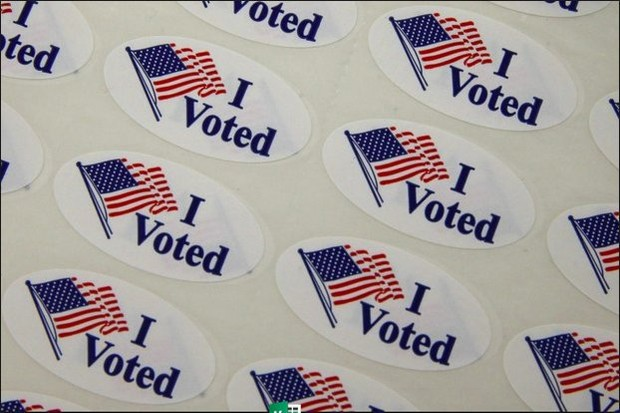
Why I Declined to Wear My ‘I Voted’ Sticker


Yes. These lapel stickers were handed out at New Jersey polling stations. In fact, my poll worker went a step further; she peeled off the backing and stuck the sticker on my shirt as I was about to enter the voting booth. But I removed it from my shirt before I was even out the door. Why? To protest the vote--specifically, the outsized importance that voting has come to acquire.


In its Founding principles, America is a nation based on the primacy of liberty--the inalienable individual rights to life, liberty, property, and the pursuit of happiness. Rights are regarded as guarantees to freedom to take the actions the individual deems necessary to achieve one’s goals and values. Rights are not an automatic claim on goods or services that others must be forced to provide. America’s government was instituted to secure these rights. Importantly, the right to vote is not among these fundamental rights. It is a secondary right derived from the need for free people to manage its government, and therefore strictly limited in scope. Voters could make certain political choices, such as choosing their political representatives. But the inalienable rights of individuals were outside the scope of electoral power.


But beginning around 1900, this republican orientation of government--first come rights, then comes limited government, then comes the vote--came under severe attack by the Progressive Movement. Instead of its primary function to protect individual rights, so-called Progressive ideology asserted that the government would represent “the will of the people” as determined by electoral victors. Thus began the radical transformation of America from a republic to a democracy, which increasingly subjected individual rights to the mercy of victorious electoral factions. As the Progressives’ democracy gained ground, more and more of our freedom gave way to electoral tyranny. 


Today, the radical transformation of our individual rights-oriented republican constitution into a “will-of-the-people” democratic constitution is close to complete. The result is that elections now are pitched battles between opposing factions eager to force their values on everyone else. In this “cold” civil war, defenders of individual rights and limited government are caught in the crossfire.


Case in point: Consider Amy Goldstein’s Three deep red states vote to expand Medicaid, published in The Washington Post after the 2018 midterm elections. She “reports”:


Citizen power propelled the biggest expansion of Medicaid in heavily Republican states since the early years of the Affordable Care Act, with hundreds of thousands of poor and vulnerable residents standing to gain health coverage as a result of Tuesday’s elections.


Voters in Idaho, Nebraska and Utah approved ballot initiatives to include in their Medicaid programs adults with incomes of up to 138 percent of the federal poverty line. The results accomplish a broadening of the safety-net insurance that the states’ legislatures had balked at for years. [My Emphasis]


Notice the generalization. “Citizen power propelled. . .” “Voters approved. . .” Which citizens? Which voters? Not all citizens. Not all voters. “Citizen power. . .” What is the nature of that power? The power of government; which means, the power of law; which means, the power of physical force--i.e., the gun. Which means, the majority of voters get to force their values on the minority who did not vote to expand Medicaid. Medicaid is a wealth redistribution program. Expanding Medicaid imposes additional costs on taxpayers--the citizens who actually pay taxes--whether they want to pay the additional cost or not. Medicaid is government-enforced “charity,” and the citizens who voted no are deprived of their moral right to judge for themselves whether to give. Why? Because other individuals voted differently, and their voting bloc outnumbered those who voted against.


These three “deep red states” did not “vote to expand Medicaid.” The simple, brutal fact is that a majority of citizens voted to impose, by force, their values on those who disagreed.


It’s not just about money. Forcing people to pay for something against their will can violate their freedom of conscience, as well. By forcing people to pay for public schools, you are not just imposing monetary costs of thousands of dollars a year. You are forcing people to support educational philosophies and curricula they may not agree with. There is no room for conscientious objectors.


These are a few examples. But the areas of voter coercion are expanding, especially considering the increasingly influential Democratic Socialist wing of the Democratic Party, which is now openly calling for the full enslavement of the healthcare profession (single payer, or Medicare-for-All), “free’ college, “guaranteed” employment, and a host of other encroachments on our freedom.


What feeds this frenzy of statism? A hideous political philosophy that constitutes the ideological heart of democracy--the idea that society is above the moral law, meaning that citizens in their capacity as government officials are not bound by the same laws or moral restraints that private individuals must adhere to. This premise means that morality is determined by society, by way of elections, which means that morality is determined by government. This means, in principle, that whatever the politicians choose to do is moral because they chose to do it. It’s a modern reincarnation of the “Divine Right of Kings”--the idea that the King is representative of God’s will, who is the sole arbiter of moral action. The modern version might be called the “Divine Right of Majorities,” with “society” replacing God as the sole arbiter of moral action. Thus, if your neighbor robs you at gunpoint to pay for some poor person’s healthcare, hers or someone else’s, the neighbor would rightfully be arrested, charged with theft, prosecuted, and sentenced by government officials. But if that same neighbor votes for politicians who pass laws to rob you at gunpoint to pay for some poor person’s healthcare, it is right because of . . . an election. Instead of law protecting you from the criminal, the law protects the criminal.


We have reached the point where whatever the government chooses to do is moral, for no other reason than that its elected officials chose to do it. This is wrong, with dangerous ramifications--and the reason for my symbolic refusal to wear the sticker. I don’t mean to say that the vote is not an important procedure. I haven’t missed a midterm or presidential election in decades, if ever. But it is just that--a procedure for free people to select the political leaders and decide certain kinds of public issues. I protest what is essentially the weaponization of the vote, which placed our liberty and property rights at the mercy of elections. 


It’s noteworthy to observe that the one major area of our lives that is electorily out of bounds is religion. No one can force their religious beliefs on you, or force you to pay for others’ religious observances. Why? Because we have an explicit doctrine, laid out in the First Amendment--the separation of religion and state. If government is to be pushed back within its proper bounds, we need more separations--the separation of economics and state; of education and state; of science and state; of healthcare and state; of charity and state--so no one can force their values in these and other areas of life on us, and force us to pay for them. Freedom is not the right to vote. Freedom is the right to live your life by your own judgement and values regardless of anyone else’s vote.


Related Reading:


What does it Mean to Say: "We'll Have to Agree to Disagree?"


Voting Rights are Not the ‘Most Fundamental Right’—or Even a Fundamental Right


Abortion Rights and Majority Rule


F.A. Harper: The Greatest Threat to Liberty Is the Idea That Democracy Guarantees Freedom


[D]emocracy is not the defining characteristic of the idea that became America—liberty is. Democracy is important only insofar as it serves and defends liberty.


Are We Now a Nation of Moochers and Thieves?


Our Pick-Pocket Nation


Related Viewing:


What Are Rights and Where Do They Come From? by Harry Binswanger


RELATED INTEREST:


The Purpose of Politics: No More Politics!--HURD


The more involved a government becomes in the everyday lives of people, the more it matters who will run that government. Because, after all, the people in politics and government are the ones who will dominate most of what goes on in your daily life.


Do Partisans Hate Each Other More Than Ever?: Scholars try to explain today's political warfare.


"Social sorting of the American electorate has been, on balance, normatively bad for American democracy," Mason concludes. "The voting booths are increasingly occupied by those who fiercely want their side to win and consider the other party to be disastrous.…As long as a social divide is maintained between the parties, the electorate will behave more like a pair of warring tribes than like the people of a single nation, caring for their shared future."


Saturday, November 2, 2024

Should 16 year-olds vote in school board elections?

In Murphy pushes lower voting age for school elections, David Cruz reports on the push in New Jersey to allow 16 year-olds to vote in school board elections. This is only a wedge issue—part of a broader push to lower the voting age below 18. 


But school board elections are particularly concerning given that the public schools, being government schools, are dominated by a public sector union. “Advocates want to get younger people more engaged,” say the proponents. NJ Spotlight News doesn’t allow comments on its articles, one reason why I’m not a paid subscriber. So I did a Facebook post instead:


“Advocates want to get younger people more engaged.”


Yes—engaged in voting for the teachers union’s anti-liberty, taxpayer-exploiting agenda. The election-corrupting conflict of interest is obvious. The  teachers union is a government-empowered political action organization that massively engages in advocacy for political candidates who favor its agenda at public expense.* The union's political allies reliably push for more taxpayer funding “for public schools,” while at the same time denying those same taxpaying parents the right to school choice for their children with those same education tax dollars.


There are good arguments for NOT lowering the voting age—in fact, for RAISING it to 21 or higher. But this is the worst proposal I’ve seen. The teachers union’s members are in charge of the classrooms, and would be in a position of influencing the children they have under their authority toward the candidates they favor. It is corruption writ large. As long as the teachers union exists (it shouldn’t), the children under their authority for hours a day should never vote.


* [According to the New Jersey Election Law Enforcement Commission, the New Jersey Education Association (NJEA) topped special interest spending from 2000 to 2022, with $52 million, which is more than four times the second biggest spender, AARP, @ $16.5 million, and third, Verizon, @ 16.3.] 


Related Reading:


16 Year Old Voters? How About 21?


The Inherent Corruption of Public Sector Unionization


School Choice is About Freedom, not "Union-Busting"


Voting Rights are Not the ‘Most Fundamental Right’—or Even a Fundamental Right


Why It’s Time To Raise The Voting Age Back To 21—Robert Tracinski

Monday, December 4, 2023

The Democrats’ Anti-Free Speech Bill HR-1—the ‘For the People Act’—is Still a Threat

HR-1, the so-called “For the People Act,” passed the House in 2019 and was debated in the Senate, but failed to pass. Pegged as a “voting rights bill” by its Democratic Party sponsors, it was re-introduced in the Congress in 2021, but still failed to pass.


I’m really distressed that the focus is, from what I can see, almost exclusively on the voter law portion of the bill, while the really dangerous elements of the bill are slipping in almost without notice. I sent this letter to the New Jersey Star-Ledger in 2019, which was never published:


To the Editor,


HR-1 [S-1 in the Senate version] is hyped as a “Voting Rights Act.” But beneath that slogan are provisions that threaten more fundamental rights to freedom of speech, association, conscience, privacy, and petition. Respectively, HR-1 severely restricts independent political spending, the means of free speech, by groups of individuals like corporations, unions, and Super Pacs, violating free speech and association rights; provides for “public” funding of elections, violating freedom of conscience by forcing the taxpayer to fund politicians’ campaigns without their consent and/or even if the politician’s policies violate the taxpayers conscientious beliefs; force disclosure of contributions to political action organizations, which violates the donors’ privacy rights by outlawing the confidentiality of donors; sharply increases requirements on lobbying, making it much harder for private citizens to peaceably assemble to petition the government.


Taken together, HR-1 is a broad-based rollback of the First Amendment. It violates the very inalienable rights which gives substance, meaning, and effectiveness to elections, and substantially reduces the ability of voters to hold their elected political leaders accountable. The “Voting Rights Act”—officially labeled, with a straight face, the “For the People Act”—is an insult to actual people who take their actual right to vote seriously.


Sincerely,

Michael A. LaFerrara


Though unpublished, the letter is still relevant because the Democrats are ready to push it through the first chance they get. 


For more on HR-1, see these posts:


HR-1 is An Assault on Free Speech, Property Rights, Freedom of Conscience, and Privacy


Democracy Doesn’t ‘Win’ When Free Speech is Suppressed, Voting Rights or No Voting Rights.


QUORA: “Is the For the People Act of 2021 (HR. 1) constitutional or not?


Statistical Disparities Don’t Prove Discrimination in Voter ID Laws


Related Reading:


Why Free Speech and Spending on Speech are Inextricably Linked


The Intimidation Game: How the Left Is Silencing Free Speech--by Kimberley Strassel


Making Private Donations Anonymously is a Right


Citizens United and the Battle for Free Speech, by Steve Simpson


‘Dark Money’ is Free Speech. Protect It


Campaign Finance—Voluntary Contributions vs. Public Funding: Which is ‘Dirty?’


Voting Rights are Not the ‘Most Fundamental Right’—or Even a Fundamental Right


Saturday, September 30, 2023

More Proof of the Left’s Fraudulent Claim of Voting Rights Under Threat

A Texas trial is challenging that state’s new voting law. A New York Times article, ‘My Vote Was Rejected’: Trial Underway in Texas Over New Voting Law, covers this issue. The sub-heading reads, “Voting rights advocates say the law, intended to curb fraud, is impeding people with disabilities, older voters and non-English speakers.” As Edgar Sandoval opens the report:


For years, Stella Guerrero Mata, a 73-year-old retired school bus driver who lives near Houston, has been able to cast her vote through the mail with little hassle. Ms. Mata, who uses a cane to walk and suffers from a long list of ailments, including diabetes, worsening eyesight and back pain, expected the 2022 midterm elections to be no different.


But sometime after she placed her ballot in the mail, she received a letter with news that left her angry and confused. Her ballot was not accepted because she had failed to include her driver’s license number and the last four digits of her Social Security number, a requirement of a contested new voting law that was approved in 2021.


“My vote was rejected,” Ms. Mata said, adding that she had realized it was too late for her to correct her mistake. “It made me feel angry, because my voice was not being heard.”


The article provides an example of the new mail-in ballot form. Note that the section for her license and Social Security information is prominent among the other lines she presumably had no trouble filling out. 


Does this rise to the level of Ms. Mata’s draconian claim the “my voice was not being heard?” Of course her voice was heard. She got a response letter of explanation—her own oversight. 


Sandoval goes on to report:


The law added new voter identification requirements for voting by mail; made it harder to use voter assisters; set criminal penalties for poll workers if they are too forceful in reining in people at polling places; and banned 24-hour voting and drive-through voting, measures that were notably used in Harris County during the pandemic.


Other than the mail-in example of Ms. Mata’s encounter with new voter identification requirements cited at the outset of the article, no other examples of how the new law hampers anyone’s ability to vote, except near the end where a disabled man objected to providing proof of disability related to his need to have someone assist him in voting. He was still able to use a voter assister, and cast his vote. Maybe some other examples of voting difficulty under the new law will emerge as the trial proceeds. As of now, only assertions.


Note that no one is claiming that the law makes it too hard to vote. It only states that the new requirements make it “harder” for some people. Perhaps these points are arguable. Perhaps some tweakings of the law may be in order. But how easy does voting have to be? Any voting procedure requires some effort, thus making it harder. The term “harder” begs the question, “Is it a real hardship, or just marginally harder?’ 


The law is intended to minimize the possibility of voter fraud, although little evidence of fraud has surfaced in recent elections under the old laws. It also “allows for expanded early-voting hours to encourage more voter participation.”


My frustration over the Dems’ hyperbolic voting rights hysteria boiled over a little when I posted this comment, which is slightly edited:


A driver's license and SS number? That's it?!? And she's "angry"?; "confused"? Well, maybe she should be embarrassed for her own incompetence. Maybe if she followed the ultra-simple instructions, she wouldn't have to worry that her "voice was not being heard" (whatever that means—we're talking about her vote, not her freedom of speech). I know this is the age of "it's-all-someone-else's-fault." But give me a break! This woman should take responsibility for her own actions. Instead, she blames the law for her own screw up. That's a new low. Shame on Ms. Mata. And shame on the simpletons who cite examples like this as somehow "proving" some kind of  conspiratorial GOP attack on the right to vote. If this is the best the Left can come up with, it's much ado about nothing.


I've said this many times. Nowhere in America is it hard for any reasonable, minimally motivated person to vote. Yes, some novel, COVID era emergency voting procedures are being streamlined or removed. But they were, after all, emergency measures. And yes, some reforms may be debatable. That notwithstanding, the Left's manufactured hysteria over voting rights is second in irrationality only to its fraudulent, Chicken Little climate crisis-mongering. In fact, never in America's history has voting been easier. If someone can't follow simple procedures, they should blame no one but themselves.


Related Reading:


Jesse Jackson’s Big Lie: ‘American Democracy is Under Siege’


Voting Rights are Not the ‘Most Fundamental Right’—or Even a Fundamental Right


The Strategic yet Self-Defeating Hyperbole of 'Democracy in Peril' Journalism by Matt Welch for Reason


Joe Biden—the Real Protégé of Jefferson Davis


Voting Rights are Not the ‘Most Fundamental Right’—or Even a Fundamental Right. 


The Dangerous Totalitarian Premise Underpinning the Justice Department’s Suit Against Georgia’s New Election Law