Showing posts with label Constitutional Republicanism. Show all posts

Friday, November 15, 2024

Democracy Wouldn’t Be a Gamble if American Principles are Adhered to.

Theodore R. Johnson posted a thoughtful pre-election op-ed in the Washington Post titled Black voters are joining a coalition. It’s always a gamble. “Black voters,” Johnson writes, “must always wonder whether their partners at the ballot box will remain partners after a victory” :


Black voters keep a watchful eye for these signs. Their trust in democracy — both the system and the people who operate it — is hard-earned. For them, choosing the right coalition partners has not been just a question of policy wins but a matter of life and death. The same system that legislated slavery and Jim Crow became the tool that secured rights and opportunity. This checkered past gives their politics a pronounced pragmatism, rooted in an understanding that Black people in America fare best when the federal government makes civil rights a priority. Their numbers and political solidarity give them electoral power — valuable even to those who might despise them.


My emphasis highlights a crucial philosophical observation that begs the question: “Is the American system both the ‘system that legislated slavery and Jim Crow’ and the system that protects civil rights the same?” Are they even compatible? Put differently, did the Founders create a Democracy, which means unlimited majority rule with our individual rights determined by vote? Or did they create a constitutionally limited republic that limits democratic power and prioritizes individual rights, which means rights are unalienable and thus outside the authority for any electoral majority to infringe? 


I posted these comments:


Democracy wouldn’t have to be a gamble if American principles are adhered to. Yes, democracy can enslave people or subjugate them under segregation. Or it can liberate them, all based on the vagaries of electoral outcomes. Democracy unconstrained by constitutional protections for individual rights is fundamentally totalitarian. That’s democracy. 


But it’s not America. 


America is the Declaration of Independence, which recognizes that fundamental intellectual, political, and economic individual rights to life, liberty, and property are equal and universal, are unalienable, and precede government. A constitution based on these principles protects us from the three basic governmental manifestations of tyranny identified by James Madison; the tyranny of the one (autocracy), of the few (aristocracy), or of the many (democracy). The U.S. Constitution, despite its flaws, is intended to implement these principles and thus secure our liberties by limiting the powers of the government.


That’s why it’s crucial to recognize that America is a constitutionally limited republic, not a democracy. Slavery and Jim Crow—and, now, the steadily encroaching “soft” tyranny of the regulatory welfare state—result when people calling themselves Americans abandon the Founding principles, and declare that America is a democracy. But no one’s rights should ever be determined by majority vote. We must recommit to the principles of the Declaration and the legislative power-limiting intent of the Constitution so that elections no longer have to be a gamble on our civil liberties. 


Related Reading:


America; Democracy or Republic or Both--Why it Matters


Abortion Rights and Majority Rule


Rights and Democracy


Constitutional Republicanism: A Counter-Argument to Barbara Rank’s Ode to Democracy


Mesmerized by Elections, the NJ Star-Ledger Forgot that Tyranny is Tyranny


The Conscience of the Constitution: The Declaration of Independence and the Right to Liberty—Timothy Sandefur


QUORA: Why does the Pledge of Allegiance say the USA is Republican not Democratic?


Senator Mike Lee is Right: America ‘is not a Democracy’


Wednesday, November 6, 2024

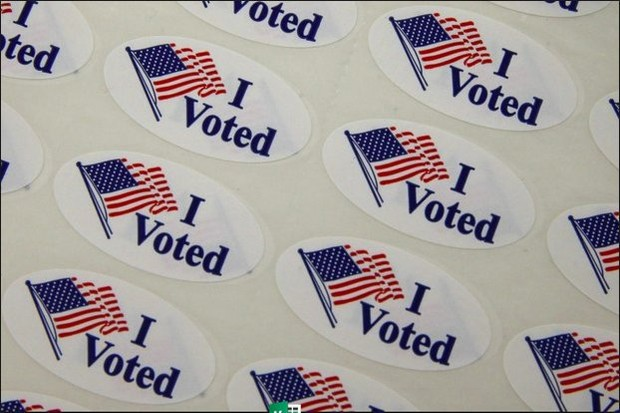
Why I Declined to Wear My ‘I Voted’ Sticker


Yes. These lapel stickers were handed out at New Jersey polling stations. In fact, my poll worker went a step further; she peeled off the backing and stuck the sticker on my shirt as I was about to enter the voting booth. But I removed it from my shirt before I was even out the door. Why? To protest the vote--specifically, the outsized importance that voting has come to acquire.


In its Founding principles, America is a nation based on the primacy of liberty--the inalienable individual rights to life, liberty, property, and the pursuit of happiness. Rights are regarded as guarantees to freedom to take the actions the individual deems necessary to achieve one’s goals and values. Rights are not an automatic claim on goods or services that others must be forced to provide. America’s government was instituted to secure these rights. Importantly, the right to vote is not among these fundamental rights. It is a secondary right derived from the need for free people to manage its government, and therefore strictly limited in scope. Voters could make certain political choices, such as choosing their political representatives. But the inalienable rights of individuals were outside the scope of electoral power.


But beginning around 1900, this republican orientation of government--first come rights, then comes limited government, then comes the vote--came under severe attack by the Progressive Movement. Instead of its primary function to protect individual rights, so-called Progressive ideology asserted that the government would represent “the will of the people” as determined by electoral victors. Thus began the radical transformation of America from a republic to a democracy, which increasingly subjected individual rights to the mercy of victorious electoral factions. As the Progressives’ democracy gained ground, more and more of our freedom gave way to electoral tyranny. 


Today, the radical transformation of our individual rights-oriented republican constitution into a “will-of-the-people” democratic constitution is close to complete. The result is that elections now are pitched battles between opposing factions eager to force their values on everyone else. In this “cold” civil war, defenders of individual rights and limited government are caught in the crossfire.


Case in point: Consider Amy Goldstein’s Three deep red states vote to expand Medicaid, published in The Washington Post after the 2018 midterm elections. She “reports”:


Citizen power propelled the biggest expansion of Medicaid in heavily Republican states since the early years of the Affordable Care Act, with hundreds of thousands of poor and vulnerable residents standing to gain health coverage as a result of Tuesday’s elections.


Voters in Idaho, Nebraska and Utah approved ballot initiatives to include in their Medicaid programs adults with incomes of up to 138 percent of the federal poverty line. The results accomplish a broadening of the safety-net insurance that the states’ legislatures had balked at for years. [My Emphasis]


Notice the generalization. “Citizen power propelled. . .” “Voters approved. . .” Which citizens? Which voters? Not all citizens. Not all voters. “Citizen power. . .” What is the nature of that power? The power of government; which means, the power of law; which means, the power of physical force--i.e., the gun. Which means, the majority of voters get to force their values on the minority who did not vote to expand Medicaid. Medicaid is a wealth redistribution program. Expanding Medicaid imposes additional costs on taxpayers--the citizens who actually pay taxes--whether they want to pay the additional cost or not. Medicaid is government-enforced “charity,” and the citizens who voted no are deprived of their moral right to judge for themselves whether to give. Why? Because other individuals voted differently, and their voting bloc outnumbered those who voted against.


These three “deep red states” did not “vote to expand Medicaid.” The simple, brutal fact is that a majority of citizens voted to impose, by force, their values on those who disagreed.


It’s not just about money. Forcing people to pay for something against their will can violate their freedom of conscience, as well. By forcing people to pay for public schools, you are not just imposing monetary costs of thousands of dollars a year. You are forcing people to support educational philosophies and curricula they may not agree with. There is no room for conscientious objectors.


These are a few examples. But the areas of voter coercion are expanding, especially considering the increasingly influential Democratic Socialist wing of the Democratic Party, which is now openly calling for the full enslavement of the healthcare profession (single payer, or Medicare-for-All), “free’ college, “guaranteed” employment, and a host of other encroachments on our freedom.


What feeds this frenzy of statism? A hideous political philosophy that constitutes the ideological heart of democracy--the idea that society is above the moral law, meaning that citizens in their capacity as government officials are not bound by the same laws or moral restraints that private individuals must adhere to. This premise means that morality is determined by society, by way of elections, which means that morality is determined by government. This means, in principle, that whatever the politicians choose to do is moral because they chose to do it. It’s a modern reincarnation of the “Divine Right of Kings”--the idea that the King is representative of God’s will, who is the sole arbiter of moral action. The modern version might be called the “Divine Right of Majorities,” with “society” replacing God as the sole arbiter of moral action. Thus, if your neighbor robs you at gunpoint to pay for some poor person’s healthcare, hers or someone else’s, the neighbor would rightfully be arrested, charged with theft, prosecuted, and sentenced by government officials. But if that same neighbor votes for politicians who pass laws to rob you at gunpoint to pay for some poor person’s healthcare, it is right because of . . . an election. Instead of law protecting you from the criminal, the law protects the criminal.


We have reached the point where whatever the government chooses to do is moral, for no other reason than that its elected officials chose to do it. This is wrong, with dangerous ramifications--and the reason for my symbolic refusal to wear the sticker. I don’t mean to say that the vote is not an important procedure. I haven’t missed a midterm or presidential election in decades, if ever. But it is just that--a procedure for free people to select the political leaders and decide certain kinds of public issues. I protest what is essentially the weaponization of the vote, which placed our liberty and property rights at the mercy of elections. 


It’s noteworthy to observe that the one major area of our lives that is electorily out of bounds is religion. No one can force their religious beliefs on you, or force you to pay for others’ religious observances. Why? Because we have an explicit doctrine, laid out in the First Amendment--the separation of religion and state. If government is to be pushed back within its proper bounds, we need more separations--the separation of economics and state; of education and state; of science and state; of healthcare and state; of charity and state--so no one can force their values in these and other areas of life on us, and force us to pay for them. Freedom is not the right to vote. Freedom is the right to live your life by your own judgement and values regardless of anyone else’s vote.


Related Reading:


What does it Mean to Say: "We'll Have to Agree to Disagree?"


Voting Rights are Not the ‘Most Fundamental Right’—or Even a Fundamental Right


Abortion Rights and Majority Rule


F.A. Harper: The Greatest Threat to Liberty Is the Idea That Democracy Guarantees Freedom


[D]emocracy is not the defining characteristic of the idea that became America—liberty is. Democracy is important only insofar as it serves and defends liberty.


Are We Now a Nation of Moochers and Thieves?


Our Pick-Pocket Nation


Related Viewing:


What Are Rights and Where Do They Come From? by Harry Binswanger


RELATED INTEREST:


The Purpose of Politics: No More Politics!--HURD


The more involved a government becomes in the everyday lives of people, the more it matters who will run that government. Because, after all, the people in politics and government are the ones who will dominate most of what goes on in your daily life.


Do Partisans Hate Each Other More Than Ever?: Scholars try to explain today's political warfare.


"Social sorting of the American electorate has been, on balance, normatively bad for American democracy," Mason concludes. "The voting booths are increasingly occupied by those who fiercely want their side to win and consider the other party to be disastrous.…As long as a social divide is maintained between the parties, the electorate will behave more like a pair of warring tribes than like the people of a single nation, caring for their shared future."


Friday, May 31, 2024

America: Democratic Republic or Constitutionally Limited Republic?

The Founders were clear on what form of government they intended to create—a republic. They were also clear on what kind of republic—a revolutionary kind never before seen. The basic principles are laid out in the Declaration of Independence—a republican form of government that protects individual rights equally at all times, requires the consent of the governed, and limits the elected officials to that function, thus protecting rights from the tyranny of the majority. 


Yet America’s Founding is widely misunderstood today, thanks largely to the Democratic Party’s centuries long, largely successful reactionary campaign to recast America as a Democracy. Thus it was of interest to me to come across Theodore R. Johnson’s Washington Post article American democracy is fine. It’s the republic that’s in trouble. He’s right, and points in the right directioin. But he still gets some things wrong.


I posted these comments, slightly edited for clarity:


America is not a “democratic republic.” It is a constitutionally limited republic, in which, contrary to Biden and the Democratic party, the inalienable rights of the individual to personal self-governance trumps the vote. When Biden said “the fundamental right to vote is the right from which all other rights flow,” he got it exactly backward. Our fundamental rights do not depend on other people’s vote—they are protected from it.  Of course, Biden’s reactionary view is the totalitarian heart of his party that dates back to its pro-slavery “states rights” origins, which held that the enslavement of a segment of Americans could be determined by vote.


America is not based on rule by “the peoples’ will”; i.e., majority rule. That’s a totalitarian concept and leads not to a free, peaceful civil society but to Robespierre and Napoleon. America is a nation that protects individual rights from “the tyranny of the many”—democracy. The people’s will as expressed in electoral outcomes, usually a majority, matters, but only within limits established by the Constitution.


The Electoral College does not “trump the popular vote”: It is based on it, at the state level. It is a balance of power mechanism that protects the relevance of state legislatures vs. the federal government. A national tally is only one way of counting the popular vote, and in a diverse nation it is absurd. Furthermore, an individual’s vote “counts” proportionally more when broken down into 51 distinct contests, rather than thrown into one giant pot of 160 million or so. I prefer the Electoral College, for these and other reasons.


Hamilton was right. “The voice of the people” as expressed in elections needs to be checked, not blindly followed. That’s the purpose of a republic whose elected representatives are themselves checked in their power by an individual rights-protecting constitution.


Related Reading:

Senator Mike Lee is Right: America ‘is not a Democracy’


The 'New American Socialists' Dilemma: The Declaration is as much anti-Socialist as anti-Slavery 


Slavery was in fact defended by pro-slavery Confederate intellectuals like George Fitzhugh on socialist grounds.


America's Revolutionary Mind: A Moral History of the American Revolution and the Declaration That Defined It by C. Bradley Thompson


A New Birth of Freedom: Abraham Lincoln and the Coming of the Civil War by Harry V. Jaffa


Mesmerized by Elections, the NJ Star-Ledger Forgot that Tyranny is Tyranny


The Conscience of the Constitution: The Declaration of Independence and the Right to Liberty—Timothy Sandefur


Rights and Democracy


Constitutional Republicanism: A Counter-Argument to Barbara Rank’s Ode to Democracy


QUORA: ‘Why does the Electoral College of the United States of America exist?’


Democracy is Democracy


Iraqi Democracy vs. Freedom


Democracy in Action in Egypt


Wednesday, January 17, 2024

Biden Reaffirms the Democratic Party’s Reactionary Agenda in Kickoff to his 2024 Reelection Campaign

President Biden kicked off his 2024 reelection campaign with a rousing speech at Valley Forge. And it was a good speech. 


As expected, Biden focussed on Trump as a threat to “American Democracy.” “Democracy itself,” Biden railed, “will be on the ballot in 2024.” As usual, I focussed on the much more important philosophical content of his speech. And as expected, Biden reaffirmed his and his party’s reactionary recasting of America’s Founding and fundamental ideals. And he did it by, despicably, channeling George Washington.


In 1776-77, George Washington and his rag-tag Continental Army were facing, Biden correctly observed, “the most powerful empire in existence in the world at the time” while lacking “blankets and food, clothes and shoes.” And what were they enduring unimaginable suffering to fight for?


Their mission, George Washington declared, was nothing less than a sacred cause. That was the phrase he used. A sacred cause. Freedom, Liberty. Democracy. American democracy.


America’s “sacred cause,” according to Biden’s historical revisionism, was Democracy. Yes, he mentions freedom and liberty. But left unqualified, those terms are meaningless. Was he referring to individual liberty, or collective “liberty?” Keep that question in mind.  


Leaving no doubt about his theme, Biden continued. “Valley Forge,” Biden said, is

“the very site that I think every American should visit, because it tells the story of the pain and the suffering and the true patriotism it took to make America.” Pain . . . suffering . . . patriotism—for and to what? Biden leaves no doubt:


Today, we gather in a new year, some 246 years later, just one day before January 6, a day forever seared in our memory because it was on that day that we nearly lost America, lost it all.


Today, we’re here to answer the most important of questions. Is democracy still America’s sacred cause? I mean it.


This is not rhetorical, academic or hypothetical. Whether democracy is still America’s sacred cause is the most urgent question of our time.


And it’s what the 2024 election is all about.


The choice is clear.


My emphasis.


Freedom and liberty, according to Biden, is the right to vote. Nothing else. Is this really what Washington, and Americans, risked all to fight for? This is as despicable a smear of America’s revolutionaries as one can imagine. What’s missing from Biden’s conception of “America’s sacred cause?”


After a long and mostly true diatribe against Trump and his MAGA supporters, Biden returns to his philosophical thrust:


They made their choice.


Now, the rest of us, Democrats, independents, mainstream Republicans, we have to make our choice.


There’s that word again . . . choice. What’s Biden’s choice? Hint: it’s no better than Trump’s.


I know mine, and I believe I know America’s.


We’ll defend the truth, not give in to the big lie.


We’ll embrace the Constitution of the Declaration, not abandon it. [sic]


We’ll honor the sacred cause of democracy, not walk away from it.


Today, I make this sacred pledge to you: The defense, protection and preservation of American democracy will remain, as it has been, the central cause of my presidency.


America, as we begin this election year, we must be clear: Democracy is on the ballot. Your freedom is on the ballot.


Note Biden explicitly ties “your freedom” to the ballot box. Sound familiar? Biden is reaffirming his stated belief that “the fundamental right to vote is the right from which all other rights flow.” From which all of our other rights flow. Let that sink in.


Yes, we’ll be voting on many issues: on the freedom to vote, and have your vote counted. On the freedom of choice.


The freedom to have a fair shot.


The freedom from fear.


And we’ll debate and disagree.


Without democracy, no progress is impossible. Think about it.


The alternative to democracy is dictatorship. The rule of one, not the rule of we, the people.


That’s what the soldiers of Valley Forge understood.


Did they?


James Madison, the “Father of the Constitution,” listed the three forms of tyranny that the Constitution was meant to protect against. In Federalist #47, Madison explained:


The accumulation of all powers legislative, executive and judiciary in the same hands, whether of one, a few or many, and whether hereditary, self appointed, or elective, may justly be pronounced the very definition of tyranny.


My emphasis. The one (monarchy), the few (aristocracy), or the many (Democracy, or “the rule of we,” in Biden’s words) are the three forms of tyranny Madison, and the Founders, feared. Note Madison’s precision. Tyranny is tyranny, even if elected. Madison understood the totalitarian possibilities of democracy. The Founders didn’t vew democracy as “America’s sacred cause.” They saw democracy as something to be protected against.


Thus, while Trump may represent the tyranny of “the one,” Biden chooses the tyranny of the many.


Biden goes on to define his concept of Democracy 


Democracy means having the freedom to speak your mind, to be who you are, to be who you want to be.


But those freedoms are not yours by unalienable right. They are permissions at the mercy of the ballot box—which means, the mercy of the state. “The fundamental right to vote is the right from which all other rights flow.” Remember that the elected Biden administration tried to make an end run around the First Amendment by bullying social media into “moderating” their content to the government’s liking. Remember the Twitter Files.


Democracy is about being able to bring about peaceful change.


Democracy. Democracy is how we open the doors of opportunity wider and wider with each successive generation, not notwithstanding our mistakes.


But if democracy falls, we’ll lose that freedom, we’ll lose the power of we, the people, to shape our destiny.


“We, the people,” Biden explains, distorting the American understanding of that term, is where our freedom resides—with the collective, i.e. the state, not with the individual. If we, the people, decide that you don’t have freedom to speak your mind, then you don’t. It’s “we, the people,” that shapes “our” destiny. Where does that leave the freedom of we, as individuals, to shape our personal destinies? 


The following statement rings hollow in the shadow of Biden’s “democracy [as the] America’s sacred cause”:


And look at what these [foreign] autocrats are doing to limit freedom in their countries.


They’re limiting freedom of speech, freedom of press, freedom to assemble, women’s rights, LGBQ rights, people are going to jail. So much more.


Note that Biden condemns those freedom limitations by autocrats. They’re not elected, after all. He doesn’t condemn those limitations as such. No surprise. Biden,being elected, feels no compunction to limit our freedoms at will, like by bullying social media, forcing us to pay off others’ student loans, imposing vaccine mandates, outlawing “dark money,” and other rights-violating initiatives. Biden nails shut the coffin of Americanism near the end of his speech:


That’s why he doesn’t understand the most fundamental truth about this country.


Unlike other nations on Earth, America is not built on ethnicity, religion, geography.


We’re the only nation in the history of the world built on an idea, not hyperbole, built on an idea.


We hold these truths to be self-evident that all men and women are created equal.

It’s an idea, declared in the Declaration, created in a way that we’ve viewed everybody as equal and should be treated equal throughout their lives.


The Founders never viewed everyone as equal, except in a very specific and delimited respect. Note where Biden stops in his quote from the Declaration of Independence. Here is what the relevant part of the Declaration says in full:


We hold these truths to be self-evident, that all men are created equal, that they are endowed by their Creator with certain unalienable Rights, that among these are Life, Liberty and the pursuit of Happiness.--That to secure these rights, Governments are instituted among Men, deriving their just powers from the consent of the governed . . .


Why does Biden stop short of mentioning the “unalienable Rights, that among these are Life, Liberty and the pursuit of Happiness?” The Founders understood that rights are natural endowments of every individual human being—that is, derived from man’s nature and his relation to broader nature—that these rights precede government. 


Biden talks about America’s sacred cause, but never mentions America’s actual sacred cause. Nowhere does Biden mention inalienable individual rights. In fact, the word individual isn’t even mentioned. 


America is not a Democracy. It is a Constitutionally limited Republic in which people can abide by the majority because their inalienable individual rights are shielded from the majority’s power. No, President Biden, America is not a country in which “the fundamental right to vote is the right from which all other rights flow.” You’ve got it exactly backwards. The fundamental inalienable individual rights to life, liberty, and property are the rights from which the right to vote flows.


Misreading another American concept, Biden concludes:


In the cold winter of 1777, George Washington and his American troops to Valley Forge waged a battle on behalf of a revolutionary idea, that everyday people like where I come from, and the vast majority of you, not a king or a dictator, that everyday people can govern themselves without a king or a dictator.


“Self-government” fundamentally means the individual’s right to self-govern his own life. That is where the Declaration’s equality comes in—equality of rights to individual freedom of action in shaping his own life. It is from this moral concept of equality of individual self-government that the broader concept of political self-government in the democratic sense comes from. It is a limited democratic process, a process that forbids the majority from voting away the rights to “freedom of speech, freedom of press, freedom to assemble, women’s rights, LGBQ rights.” Remember that the Democratic Party was founded as the party that believed that a majority could vote a minority into slavery


There you have it. Biden and Trump are fraternal twins. Both favor tyranny, with Biden’s the most dangerous form because of people’s vague understanding of genuine Americanism. The Democratic Party, founded in 1828 on a pro-slavery platform, has always rejected the American concept of Constitutionally limited rights-protecting government. Now, in 2024, the Democratic president has reaffirmed his party’s reactionary, anti-American philosophic heart.


Related Reading:


Joe Biden—the Real Protégé of Jefferson Davis


Voting Rights are Not the ‘Most Fundamental Right’—or Even a Fundamental Right. 


The Dangerous Totalitarian Premise Underpinning the Justice Department’s Suit Against Georgia’s New Election Law


America's Revolutionary Mind: A Moral History of the American Revolution and the Declaration That Defined It by C. Bradley Thompson


Brad Thompson on “the unidentified, unacknowledged union of proslavery and progressive thought.”


America; Democracy or Republic or Both--Why it Matters


Senator Mike Lee is Right: America ‘is not a Democracy’


Rights and Democracy


Constitutional Republicanism: A Counter-Argument to Barbara Rank’s Ode to Democracy


Mesmerized by Elections, the NJ Star-Ledger Forgot that Tyranny is Tyranny


The Conscience of the Constitution: The Declaration of Independence and the Right to Liberty—Timothy Sandefur