Thursday, January 14, 2016

China’s Recovery from Socialism vs. Bernie Sanders, The Most Evil Politician in America

One of the most remarkable developments of the past half century is modern China’s journey from poverty-ridden undiluted socialism to a prospering capitalist-trending mixed economy.


Chinese Communist Party Chairman Mao Zedong’s collectivization of China’s economy and people under his “Great Leap Forward” in the mid 20th Century unleashed a human tragedy on a scale for which no words exist to describe. Then, in the late 1970s, a new post-Mao leadership took over, and the Chinese economic miracle began. But while China’s new leadership deserves recognition for initiating free market economic reforms, don’t credit them with starting the ball toward recovery rolling.


In a piece titled CHINA’S FIRST CAPITALISTS: HOW DISSIDENTS CREATED THE WORLD’S SECOND LARGEST ECONOMY, DISSIDENT’s M. Nolan Gray discusses China’s transformation in the context of that nation’s current economic troubles. As Gray reports, “China’s economic miracle didn’t begin with state planners or Chinese Communist Party (CCP) officials, but with dissident farmers in an impoverished village”:


In 1978, a group of farmers decided they had had enough of the poverty caused by Mao Zedong’s disastrous Great Leap Forward. Secretly meeting in a farmhouse, the farmers engaged in a revolutionary act of institutional innovation: they divided up the collective farm among the member families, and allowed each to keep what they produced once the CCP quotas were met, enshrining the new system in a written document. By establishing modest protections for property rights, they became, as NPR’s Planet Money puts it, “the first capitalists in modern China.”


What were the results? Encouraged by the possibility of keeping the fruits of their labor and a healthy sense of competition, the farmers’ productivity dramatically increased. Once the victim of communist-induced famine, they enjoyed prosperity for the first time in decades. More food was produced in one year than in the past five years combined. Reformers interested in moving away from Mao’s dystopia, including [Mao’s successor] Deng Xiaoping, noticed the village’s success and ultimately abandoned collectivized farming.


The decollectivization of agriculture set off a wave of reforms enhancing the economic liberty of the Chinese people. Market prices allowed efficient ground-up markets to develop in place of inefficient top-down plans. Many state-owned industries were privatized, and entrepreneurs were permitted to start businesses. Although the state and party leaders maintained their oligarchical status by preserving certain state-owned enterprises, a flourishing private sector enabled 500 million Chinese citizens to pull themselves out of poverty. The bottom-up, market-driven miracle of the post-1978 era stands in stark contrast to the top-down, communist controlled nightmare of the 50s and 60s.


Mao’s grand utopian experiment is estimated to have killed 40-60 million people. Keep that gargantuan famine in mind when you consider Bernie Sanders, the openly self-described “democratic socialist” who has a real chance of becoming America’s next president. China under Mao’s collectivism is what real socialism looks like. Sanders’ policies are actually far from undiluted socialism. But by dressing up his comparatively benign welfare state agenda in the garb of socialism, Sanders is creating in many people’s minds—in particular the uninformed minds of the young—the false idea that socialism isn’t so bad—and even good; in effect, camouflaging socialism’s blood-drenched history under a cloak of respectability and even compassion. This sanitization of socialism, to the extent it takes hold in American culture, will make it easier to push through more and more socialist “reforms” in the future, accelerating an unsuspecting America down the road to full, totalitarian socialism.


This, despite the lessons of China—perhaps the most dramatic of many demonstrations of the moral and practical power of even highly diluted freedom, free markets, and individualism over authoritarianism, central planning, and collectivism—that has unfolded in our lifetimes.


For the past hundred years, the progressive-“liberal”-Democrat Left has advanced a socialist-leaning, mixed economy agenda under the guise of “making capitalism work better.” But they always denied being socialists, as Hillary clinton and Democratic National Committee Chairwoman Debbie Wasserman Schultz recently did. They’re not being completely honest—fascism, or back-door socialism, is a more accurate label for their agenda—but the mainstream democrats’ refusal to call their agenda socialist is an implicit acknowledgement that socialism is bad. To be honest, I think few Democrats actually want socialism.


Notwithstanding, Sanders is the first prominent Democrat candidate, to my knowledge, to openly espouse socialism. True, Sanders’ high tax, high regulation, heavily redistributionist “democratic socialism” is not undiluted socialism, just a more statist regulatory welfare state mixed economy than we have now.


But that’s irrelevant in this context. Keep in mind that socialism is the political expression of collectivism. Collectivism holds that the standard of moral concern is the group, and that the individual’s only moral purpose is to serve the good of the collective. The individual’s life, liberty, property, goals, and values—and personal pursuit of happiness—has no moral relevance under collectivism. Those ideals belong to collectivism’s antipode; individualism and its political expression, laissez-faire capitalism. Under collectivism, the state is the enforcer of the collective will. With the individual stripped of any moral right to live for his own sake, the state under socialism is free to loot, regulate, enslave, or kill any individual or any number of individuals that it deems necessary to further the “common” or “public good”—and invariably does wherever the collectivist trend is left unchecked.


But the damage is not just economic. To understand what socialism does to the moral fabric of society, consider the contrast between socialism and capitalism.

Under capitalism, aggressive force is banned from society, and the ban extends to people in their capacity as government officials. Thus people are free to work to satisfy their own needs and pursue their own flourishing by their own productive efforts and work, but only by dealing with each other by voluntary consent to mutual advantage, or trade. Through this mutually self-interested association, people get better together, each keeping what property he has earned by giving a value that by the other person’s voluntary judgement enhances his life. Since voluntarism rules, no one is a threat to anyone else.

Socialism inverts this moral social compact. Under socialism, everyone’s need is a moral claim on others’ property and the moral claim is enforced by law; i.e., at the point of a gun. In place of capitalism’s ban on aggressive physical force, socialism institutionalizes aggressive force by tying everybody to everybody else in a chain gang of need. Since you have no right to your own property—which can be confiscated at the will of society, with the government as society’s hired gun—everyone else is a threat to you, to the extent they have unfilled needs. And you are a threat to them. With your path to supporting your life through self-reliance and trade forbidden, your only path to personal survival is to rely on government’s guns to take from others. Instead of people getting better together by satisfying each others’ needs and desires based on voluntary trade, under socialism one person’s gain is another person’s loss. This inverted moral social compact turns people against one another. In place of the peaceful coexistence of trade under capitalism, socialism gives you universal predation.

The moral repudiation of the individual is the heart and soul of socialism, which explains its brutal history. Since the individual is the only human entity that exists in reality—only the individual breaths, thinks, values, acts, and feels—brutality in some degree is the only end that can result from any “ideal” that repudiates the individual. Socialism is inherently unfit for human life. It doesn't just kill economic well-being. It doesn't just kill freedom. It kills hope and aspiration of ever rising as an individual. Socialism is irredeemably evil. Yet Sanders extolls socialism. Don’t be fooled by the term “democracy” that Sanders attaches to his socialism. Democracy unconstrained by the principle of individual rights is just another manifestation of totalitarianism. Democracy doesn’t change the nature of socialism. It makes no difference if socialism is established by coup-d'etat, as in Soviet Russia, or by vote, as in Nazi Germany or Venezuela. Given the bloody, authoritarian, impoverished history of socialism in all of its manifestations, including the democratic and nationalist brands, Bernie Sanders’ sanitization of socialism makes him, in my view, the most evil politician in America.


Related Reading:


Sanders’s Open Socialism Blows the Cover Off of the Left’s Stealth Socialism

Tuesday, January 12, 2016

How We Pay for Other People’s Education in a Free Society

In the comments section of the New Jersey Star-Ledger editorial If you believe in racial equity, don't opt out of PARCC* (see my post of 12/14/15), correspondent Dale said:


The education of children and adults is an overall benefit to society. In general, education helps improve the nation by increasing the Gross National Product (GNP), encouraging scientific and technological advances, providing opportunities for the successful participation in society, decreasing the crime rate, and producing a more informed electorate.


As education benefits the entire nation, not just those who have children, it is a cost borne by all society.


I left these comments:


Translation: “Society” is supreme over the individual.


There is a fatal flaw in your collectivist premise, Dale: “Society” is only a number of individuals. “Society” is an abstraction. When you claim the “benefit to society” as a justification to make education “a cost borne by all society,” you are just rationalizing seizing some people’s money by force, for the unearned benefit of others, based on your own subjective judgement of what is a “benefit”—with the government as your hired gun. You are also rationalizing putting government central planners in charge of education—what is taught, or not taught; who teaches it; how it is taught, etc—replacing parents and educators.


But every individual has a right to decide for himself what benefits him, and spend his money accordingly. When an individual benefits himself, he benefits society, because every individual is part of society. There is no “benefit to society” apart from the benefit of individuals, and no rational justification for anyone to force his idea of “benefit” onto others. This goes especially for a field as crucial as education.


Yes, “education” is a benefit. But it is morally up to each individual to determine what kind of education constitutes a benefit, and how and when to pay for it. In a free society, where all education is privately and voluntarily funded, we as individuals pay for [other people's] education in the way we spend our money, because the cost of education is embedded in the price we pay for goods and services. When I buy a cell phone, I pay for the education of the people who produced it. Same with cars or hammers. I don’t pay for the education required for products I don’t buy, and shouldn’t be forced to for the sake of “Gross National Product.” I shouldn’t have to pay for the education of someone, if the end result of that person’s education isn’t a benefit to me, as determined by my own free judgement. What if the line of work someone goes into is not a value to me, such as motorcycles? Or of products I consider harmful, such as cigarettes? Or of ideas I disagree with, such as this editorial? Or of “progressive” education, which I believe harmful to children’s minds? What if an “educated” person turns out to be lazy and doesn’t work? Or if someone’s “education” doesn’t result in a marketable skill? Why should I be forced to fund their educations?


Collectivism, one of mankind’s greatest evils, says otherwise. The group is morally supreme, and individuals may be sacrificed for the group’s benefit. The group always turns out to be the state—as it logically must, since a collective is an abstraction, not an entity that thinks and acts, like an individual. If “education” is deemed by the state to be a benefit to “society,” then the individual’s wealth must be sacrificed to education, regardless of the value of that education to the individual. And the group, or collective, comes in many forms. Substitute the race for society, and you get Nazi Germany. Substitute the proletariat for society, and you get Soviet Russia. If you believe it is just to sacrifice people’s wealth for the collective—be it “society,” the race, the economic group—then why not sacrifice people’s liberty and lives in addition to his earned wealth? After all, the group is the central focus of moral concern.


When you peddle collectivist rationalization, you are declaring “society, c'est moi,” announcing your intention to impose your values on everyone else, regardless of the cost to others’ wealth and liberty. You are aligning with evil.


NOTES:


* “The Partnership for Assessment of Readiness for College and Careers (PARCC) is a group of states working together to develop a set of assessments that measure whether students are on track to be successful in college and their careers,” according to the PARCC website. The standardized tests associated with PARCC is colliding with a growing rebellion from teachers and parents, who are increasingly opting their children out of the PARCC tests.


Related Reading:


Selflessness vs. Egoism: Or, ‘Real Education’ vs. Real Education

Sunday, January 10, 2016

Eminent Domain: The Dark Side of Pipelines

The principle of free trade—the freedom to work and trade one’s work product for the work product of other producers—is a core individual right. So are property rights—the freedom to keep, dispose of, and be secure in one’s earned wealth. But what if the two fundamental rights clash? That’s the case with pipelines.


There is a real threat to the vital American fossil fuel industry in the form of a jihad on pipelines now sweeping the country. The Environmentalist Jihadists, who oppose fossil fuels, are increasingly teaming up with local NIMBY (Not-In-My-Back-Yard) groups, and together employ many rationalizations, from “green” ideology to economic need, for stopping pipelines at any cost. They are highly organized and effective, and even the Federal Energy Regulatory Commission (FERC), the federal agency charged with the power to approve pipeline proposals, is feeling the heat.


Pipelines are vital to our energy security and economic well-being, and pro-industrial, pro-free market advocates must fight off the jihadists. But there is a dark side to FERC approvals of pipelines, and the NIMBYs do have one valid issue—the eminent domain powers typically granted to pipeline companies as part of the government’s pipeline approval process. Eminent domain is blatantly rights-violating and illegitimate in all of its manifestations, including in its Constitutional form.


But the NIMBY’s fighting pipelines based on eminent domain have some baggage of their own that somewhat undercuts their case.


For example, consider the current battle over the proposed PennEast pipeline in New Jersey.


The Hunterdon County, New Jersey Board of Freeholders has recently voted to actively fight to stop the pipeline (although they are on record “that they are not against underground pipelines in general”). Among other reasons, the Freeholders cited eminent domain for their action. As Sallie Graziano reports for NJ.com:


"Among the properties lying in the proposed pipeline's path are 23 farms constituting 2,007 acres of county-preserved open space," [Freeholder Director John] King said, reading from the proposed resolution. "If approved, the PennEast pipeline would necessarily extinguish the county's conservation easemetnts [sic] on those farms and trump a county open space policy mandated by three successive voter referenda. This issue alone warrants county opposition."


The way the land preservation program works is, farmers apply for payment from the government in exchange for giving up certain development rights, and deed-restricting the farm as is. Application for “preserved” status is strictly voluntary on the part of the farmers.


But how are the land preservation and open space programs funded? By forcibly taking monetary property, in the form of taxes, from people across the state against their will. How is monetary taking different from eminent domain taking? In an important sense, farmland preservation funding is worse than eminent domain.  At least victims of eminent domain have some constitutional protection—they must be compensated. But there’s no such protection for nonconsenting taxpayers, who get nothing in compensation for funding the “preserved” land the money forcibly seized from them pays for. (Majority voter approval of preservation taxation doesn’t mitigate the fundamental injustice. Citizens are free to voluntarily pool their money to preserve land. But they have no “democratic right” to force unwilling citizens to pay also, regardless of the unfortunate fact that it is legally permissible. Those who vote “no” to open space taxation—who don’t consent—are victims of an uncompensated taking.)


And often, open space is preserved through regulatory taking and/or zoning.


So owners of “preserved” land complaining about the eminent domain threat to their property are being somewhat disingenuous (though likely unintentionally). What moral right do the farmers or county government have to complain about eminent domain when they themselves are beneficiaries of government-sponsored takings, albeit not strictly defined as eminent domain?


Of course, not all threatened landowners are guilty of this disingenuousness. John and Jodi Markowski, for example, could have part of the backyard of their home taken for the pipeline construction and related easement whether they agree to it or not. They are pure victims.


But even regarding the Markowskis, there is a murky question mark. Do the Markowski's oppose eminent domain consistently and across the board? Or do they oppose eminent domain only as it applies to their property? The question points to a more subtle double standard at work in the eminent domain/pipeline controversy.


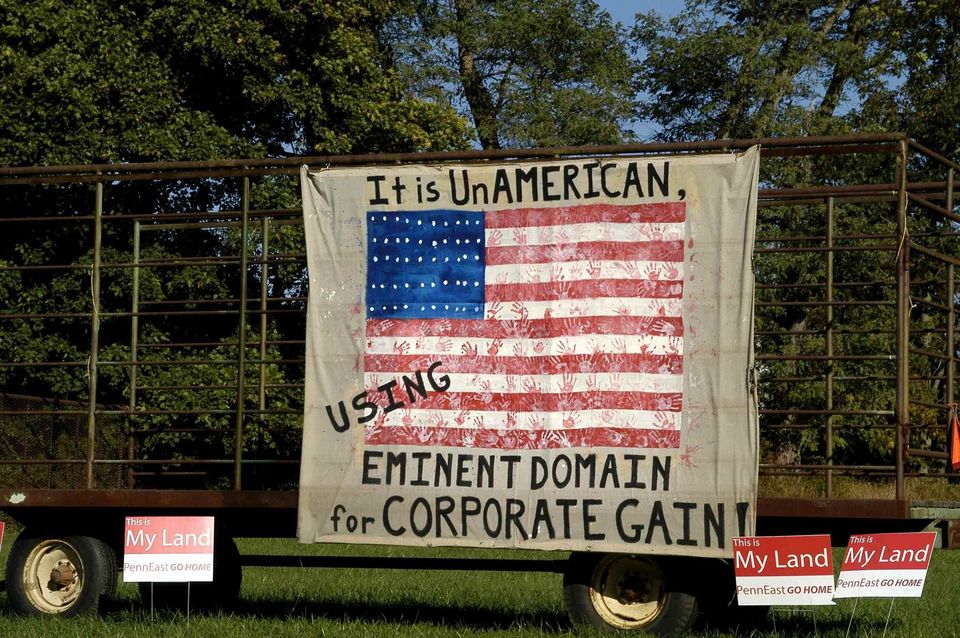
Observe the following protest sign, which headlines the front page article of the 10/22/15 Hunterdon County Democrat titled PIPELINE PUSHBACK:


The sign refers to the eminent domain powers to take private land for easements that would accompany federal approval of the PennEast Pipeline company’s natural gas conduit through the region, and hand it over to other private interests for private purposes.


It is certainly true that eminent domain transfers of private property to other private parties is un-American, and contrary to the “takings clause” of the U.S. Constitution, which allows takings for public use only. But, the victims of the eminent domain threat, while private property owners, are not actually all themselves pure victims. Many are beneficiaries of another kind of taking—the far less controversial “public use” form. This includes John and Jodi Markowski.


Public vs. private use (or purpose) is in an essential respect an artificial distinction. What do we mean by “public?” After all, the public is made up of. . . what? Private individuals, that’s what. Highways are generally considered a “public use” and thus a relatively uncontroversial use of eminent domain. But if you use a highway built on private land taken through eminent domain, how is that fundamentally different than a private corporate entity benefiting through eminent domain? You, the driver, are a private citizen. And here you are, benefitting from eminent domain by using that road. A public use is really a means for benefitting private individuals.


Of course, no one can escape being a beneficiary of eminent domain in some way. The simple fact that I drive a car doesn’t make me a hypocrite if I oppose domain. The key is consistency. I am fully consistent. I oppose all eminent domain, whether for private or public purposes. Do John and Jodi Markowski? If not, then their stand against the PennEast pipeline based on the eminent domain threat to their property must be considered morally compromised.


You can’t be for eminent domain when it serves a public use, and against it when it serves “corporate gain,” and escape a double standard. That’s both having and eating your cake. You can’t be against eminent domain when it targets you, but for it when you benefit. On closer examination, obfuscation of the issue with meaningless distinctions like public vs. private disintegrates. The builders, investors, and consumers of the pipeline are each as much members of the public as the driver of the car. If you support eminent domain as a means of providing you with roads, then how can you be against eminent domain as a means of providing jobs to pipeline employees or natural gas to energy consumers? Only those who stand uncompromisingly opposed to eminent domain and other government property takings in all of their manifestations—direct or indirect, tax or regulatory, monetary or land, for public or private purposes, “just” compensation or not—can with good conscience take a clear moral stand against the PennEast pipeline for reasons of eminent domain.


Granting that people fearful of eminent domain provisions included in pipeline approvals have double standards, the provisions are a serious concern for a pro-individual rights perspective. Does one oppose pipelines, in effect joining the anti-pipeline jihad and violating free trade rights? Given the importance of pipelines to energy freedom, that’s not a good choice, in my view. But neither is it a good choice to simply pretend that the dark side of pipelines doesn’t exist, in effect neglecting the rights of property owners.


Eminent domain should not be part of the pipeline approval process. We should advocate for its removal, but not as an uncompromising condition of pipeline approval. That doesn’t mean nothing can be done for the property owner. Short of getting eminent domain stripped from pipeline approvals, which would make the pro-pipeline advocacy cleaner and less problematic, we can go to bat for the victims in ways other than simply opposing pipelines and, in effect throwing the baby out with the bathwater. For example, by fighting for better “just compensation” for the victims. In this last regard, the Hunterdon Freeholders advanced a proposal that can fit with the pro-pipeline/anti-eminent domain scenario. As part of its resolution to oppose the pipeline, the Freeholders cited “insufficient proposed compensation for affected landowners.” Their proposed solution has merit. As Graziano reports:


The freeholders also take issue with a one-time payment for an easement, stating that with PennEast reaping continuous profits, it should handle the situation as wireless companies handle cell towers, giving the landowner a stream of income. "If PennEast is going to earn continuous proficts [sic--profits] from the exploitation of the land of another, it should make that owner a partner," the board's resolution states.


Of course, you could make the same argument about roads built on eminent domain takings. Roads facilitate ongoing commerce.


Conflicts of rights are not inherent in free market economies. Such conflicts are inherent in mixed economies. Only a mixed economy can pit the right to production and trade against property rights. It’s something that, for now and for the foreseeable future, we must live with. That can create a situation of having to choose the lesser of two evils. That’s the case with pipelines. Anti-fossil fuel environmentalists have targeted pipelines on the theory that preventing the means of delivering fossil fuels to refineries and consumers—pipelines—will slow and eventually stop the drilling, particularly hydraulic fracturing. In alliance with NIMBY groups, the environmentalists’ growing organized jihad against pipelines poses a significant threat to the energy market and to our energy security. That is unacceptable to anyone who values human life and liberty. The jihad must be defeated and the pipeline industry defended.

But we must keep in mind the bigger picture, as well. The fight for pipelines is a vital one. But it requires fighting for individual rights not just on behalf of pipeline companies but on the eminent domain and other fronts, as well.


Related Reading:


Untangling the PennEast Pipeline Rights Conundrum

Friday, January 8, 2016

The Woodrow Wilson Controversy

In November, 2015, a group of Princeton University students demanded that the university stop honoring President Woodrow Wilson, such as naming buildings after him; e.g., the “Woodrow Wilson School of Public and International Affairs.” The students want university recognition of the former Princeton University president and New Jersey governor removed because he was a racist.


He was a racist. But that fact alone does not justify dishonoring Wilson. Historical figures, as with all people, must be judged within the full context of their ideas, actions, and accomplishments. For example, Thomas Jefferson, one of our most significant Founding Fathers, was a slave owner. But he wrote and, along with 55 other Revolutionary leaders, signed the Declaration of Independence, which set down the political principles that would eventually eradicate slavery in America; that all men are created equal, possessing unalienable individual rights that deserve equal protection before the law from a government whose sole purpose for being is to protect those rights.


Those principles fueled the Abolitionist, Women’s Suffrage, and Civil Rights movements. Martin Luther King Jr. built his famous “I Have a Dream” speech around Jefferson’s words—words that still resonate as a beacon to pro-liberty forces here and around the world. Jefferson did many great things in helping to create the United States of America, and from a pro-liberty American perspective his positives more than offset his negatives, like being a slave owner. He is a genuine American hero.


But there are plenty of reasons for eliminating Wilson as an American hero, or even as a great president. In fundamental ways, Wilson was the opposite of—indeed the anti-—Jefferson. New Jersey Star-Ledger columnist Paul Mulshine has a great article explaining why titled Removing Woodrow Wilson's name from Princeton? I'll drink to that. Mulshine, citing Georgetown law professor and "Restoring the Lost Constitution” author Randy E. Barnett, writes:


It's not merely that Wilson, who grew up in the Deep South, imposed segregation as a federal policy.  Those horror stories have been chronicled in detail in the past few days.


What's been overlooked is the fact that Wilson was not a fan of the system of limited government and individual rights set up by the founders.


"He hated our constitution," said Randy E. Barnett. "He didn't like our system at all."


There is no way Jefferson and Wilson can stand side by side as American heroes. If one is a hero, the other can’t be. Jefferson believed government should be limited by a constitution based on fixed principles. Wilson rejected the principles as laid out in the Declaration—or any fixed principles, on principle. By Wilson’s logic, a constitution should be a “living” document; which means, it can be interpreted in any way that meets the political expediency of the moment—in effect, there are no limits on political power. Jefferson is the champion of the free individual. Wilson was the champion of the power-luster.


I left these comments:


Great article. I do believe that historical figures should be judged in the full context of their times, ideas, and actions. By the big-picture analysis, Wilson was our first counter-American Revolutionary president. He’s a hero to the Left. But he’s no American hero.


The only thing I can think of that this crusading statist got right was his economic policy in the face of the 1920-21 deflationary depression: His policy was to do nothing. James Grant documents this in his book, “The Forgotten Depression” (See my review in The Objective Standard). That depression started a year before Wilson left office. Under Wilson, there was no “quantitative easing” from the Fed; no taxpayer-soaking “stimulus” packages from Congress; no perpetually extended government unemployment benefits; no saver-screwing 0% interest rates; no efforts to keep wages, prices, or profits artificially propped up.


Grant gives two reasons for Wilson’s inaction. First, pre-Keynesian conventional economic wisdom at the time taught that the depression was a necessary corrective to the rampaging wartime inflation, and that the economy should be left to take its natural course back to normal peacetime equilibrium. Second, Wilson was preoccupied by his League of Nations cause and recovery from a stroke.


Grant calls Wilson’s inaction “laissez-faire by accident.” But, laissez-faire it was. The result was that—unlike the milder 1929 recession, which was met by massive Keynesian Hoover/FDR interventionist policies and thus turned into a Great Depression—the 1920 downturn was “forgotten” instead of turning “great.” Instead, the depression was over and done with by June the following year, and the job-filled 1920s boom got underway.


------------------------------------


Obviously, Wilson was no admirer of laissez-faire. He certainly would have approved of Hoover, FDR, Bush 43, and Obama-type interventionism in the face of economic adversity. Nevertheless, Wilson’s inaction in the face of the 1920 crash, though contrary to his statist inclinations, demonstrates the power of free economies to correct and move on. This post just goes to show that some bad can be found in the best, and some good in the worst—and that context is paramount.


Related Reading:


Progressivism and Liberalism—The Heritage Foundation
           EXCERPTS:


The Progressives derived their political ideas from European thinkers. The seeds of Progressivism were first sown by Jean-Jacques Rousseau (born in Geneva, lived in France) who wrote that citizens ought to be “forced to be free” and that the “general will” should govern the individual wills of citizens, placing individuals in the service of the collective will of society.


These ideas made their way to Germany in the early 19th century, and had an important influence on the German philosopher G.W.F. Hegel. Hegel incorporated them into what he called a philosophy of History, in which ideas, society, and humanity itself are evolving toward a higher form of freedom. This progress is achieved, Hegel argued, by abandoning the antiquated ideas and traditions of the past, and embracing a new form of freedom, where individuals give the government unlimited authority over their lives.


Many of the American Progressives studied in Germany, and were taught by students of Hegel. They brought the German model of education and German political ideas back to America with them and established Ph.D. programs in several areas of study, producing a new generation of professors and students who sought to replace the principles of the Founding with the new Progressive teaching on politics. These ideas, mixed with Darwinism and a deep faith in science, form the roots of modern American Liberalism.

Lincoln Understood the Indispensable Connection Between Rights and Self-Government

Wednesday, January 6, 2016

‘States Rights’: An Un-American Doctrine

In a smear piece (Why racists donate to Republicans), the New Jersey Star-Ledger in effect labeled the Republican Party as racist, guilty by association because a single “white supremacist leader—Earl Holt III—has contributed to a slew of Republican candidates.”

Never mind that the Democratic Party is the party of slavery, Jim Crow, the Ku Klux Klan, or that Martin Luther King Jr. was a Republican who was once jailed by Democrats. Today, the Democrats, not the Republicans, are the ones that collectivistically divide us by race.

Incredibly, The Star-Ledger—stretching beyond credulity for more evidence—raises the specter of state opposition to ObamaCare as proof of Republican racism.

Think about the historical use of the dog-whistle of "state's rights" to oppose federal civil rights protections, and its current use to rally opposition to a black president and his Affordable Care Act.

Consider this for a moment. The Civil Rights Act of 1964 and the Voting Rights Act of 1965 were passed with significantly more Republican support than Democrat support. The main opposition came from the Southern Democrats.

About the only thing the Star-Ledger got right, sort of, was its rejection of states rights. I left these comments, focussing on that:

I reject the hysterical charges of racism that the Star-Ledger levels against Republicans. The Left sees racism wherever anyone disagrees with them, for their own political purposes.

But the Star-Ledger is right to reject “States Rights.”   

States Rights doctrine was concocted by defenders of slavery as a counterpoint to the Abolitionists. The Abolitionists based their movement on the principles of the Declaration of Independence, America’s original Founding document and the philosophic blueprint for the U.S. Constitution. The Declaration stands for the principle that all individuals, including Southern slaves, possess rights that no government can infringe.

States Rights doctrine essentially holds that rights are not inalienable, but are the property of the state governments, which can grant or withhold rights from its citizens by majority vote. Thus, States Rights holds, state governments can override the federal guarantees of rights and liberties for the purpose of protecting slavery.

But this is absurd. If valid, States Rights doctrine would render the U.S. Constitution a hollow, meaningless document. It’s a repudiation of the Declaration of Independence, and essentially a resurrection of the Divine Right of Kings in democratic form. States Rights advocates are essentially saying: The Federal Government cannot violate individual rights, but state governments can violate rights at will! This would mean that the purpose of the Revolutionary War was to throw off British tyranny in order to establish a free nation made up of state tyrannies—an absurd contradiction. Did the Founders really shed blood and treasure in order to create only a limited national government, while granting the states a blank check to trample rights at will?

Nothing could be further from the truth. The U.S. Constitution, created by “We the People,” not “We the States,” grants states enumerated powers, not rights. As the Declaration states, rights belong only to individuals. “That to secure these rights, Governments [plural] are instituted among Men.” The Bill of Rights was added to the U.S. Constitution as a redundant means to solidify the principle that protecting individual rights is the government’s role. There are no “states rights” mentioned. The first eight amendments enumerate certain individual rights, and the Ninth Amendment makes clear that unenumerated rights are “retained by the people.” No mention of the states. Only the Tenth Amendment mentions the states, and only in regard to delegated powers not prohibited to the states by the U. S. Constitution. Again, no mention of states rights. Clearly, this can only be understood as meaning that state governments are subordinate to the protections of individual rights guaranteed by the U.S. Constitutional—rights that are understood to be inalienable.

States Rights doctrine was concocted to protect slavery by repudiating the Revolutionary War—which was fought to secure inalienable individual rights under limited rights-protecting government—and to create a rationalization for the Southern States to go so far as to rip America apart to protect its slavery. States Rights is the antipode of the Declaration of Independence, and modern States Rights advocates are unwittingly repudiating individual liberty. The fact that the Federal government itself has become a huge rights-violator under the rise of the regulatory welfare state doesn’t mitigate the fact that rights belong to individuals, not governments at any level, or that the doctrine of States Rights is a threat to all of our rights and is patently un-American.

Related Reading:

On This Constitution Day, Remember the Declaration of Independence

Saturday, January 2, 2016

Without “Big Pharma,” Government Research Would Be Useless

New Jersey state Senator Richard J. Codey has “introduced a [NJ] Senate Resolution, SR-121, urging Congress to double Alzheimer's research funding in fiscal year 2016 and to develop a plan for fiscal years 2017 through 2020 to increase funding to $2 billion annually so that we can reach our national goal of preventing and effectively treating Alzheimer's by 2025.”

In response, Bill Keller of Scotch Plains, NJ, submitted a letter to the NJ Star-Ledger, published in print on 6/15/15, Demanding Real Cures for Research Investments. After praising Cody for his “concern,” Keller writes:

[B]efore the tax payers [sic] hand over any more research money to the National Institutes of Health, we'd like to know what it has to show for the annual $6 billion on cancer research and the $2 billion on cardiovascular disease research it receives.

Why didn't Sen. Codey include this in his plea for $2 billion for Alzheimer's disease research? These research "sink holes" are fronts for Big Pharma to come up with new drugs which they sell for big profit to the hapless public who indirectly finance these through the research grants in the first place. Let's start demanding real cures for these research investments.

I left these comments, edited for clarity:

  • I take cholesterol-lowering drugs, which lessen my chances of suffering and dying from heart disease.
  • A life-long friend of mine takes pain medication for chronic back pain, enabling her to live an active, pain-free life in retirement.
  • My son-in-law was cured of cancer by drugs at the age of 21. He’s now 41, and still cancer-free.
  • My grandson was diagnosed with Crohn's Disease two and a half years ago, but today this debilitating, growth arresting, life-threatening disease is in remission—thanks to the man-made miraculous drugs he takes—and my grandson is growing and flourishing like a normal 15 year-old.

These are just a few examples from my personal experience of the benefits of profit-seeking pharmaceutical companies. I could list plenty more. If you open your eyes, you’ll see millions upon millions of people whose suffering has been alleviated and lives extended by real treatments and cures produced and marketed by profit-seeking pharmaceutical companies.

Some of those cures start with basic research funded by government. But that research funding comes from taxpayers. The government shouldn’t be selling that research to pharmaceutical companies. It should be giving it away. Pharmaceutical companies, their investors, and their employees are taxpayers. Taxpayers own the research because they paid for it, and any taxpayer should have access to that research at no extra charge. The government shouldn’t be taxing us to pay out research grants to politically-connected scientists and research institutions to begin with. But as long as it does, pharmaceutical companies, being taxpayers and part of “the hapless public who indirectly finance these through the research grants in the first place,” have a right to that research. By charging extra for it, the government is double-dipping.

Nor should the government “start demanding real cures for these research investments.” Those “investments” belong to the taxpayers in the first place, and should not have to satisfy any conditions for accessing what they already own.

And what do pharma companies do with that research? They do the really hard work of turning the research into commercial—i.e., usable, beneficial—end products that improve health. Basic research is only a starting point. That research doesn’t miraculously turn into cures. What follows basic research is hundreds of $billions and years of work trying to turn that basic research into drugs that treat our myriad ailments. Ayn Rand, in her talent for succinctness,
correctly identified the unsung, often demonized, heroes of industrial progress:

The professional businessman is the field agent of the army whose lieutenant-commander-in-chief is the scientist. The businessman carries scientific discoveries from the laboratory of the inventor to industrial plants, and transforms them into material products that fill men’s physical needs and expand the comfort of men’s existence.

Rand didn’t just say it: She concretized the indispensable role of productive businessmen in Atlas Shrugged.

And there are no guarantees that any of Big—or for that matter Little—Pharma’s $billions will produce profit. There are many blind alleys on the road to commercialization of scientific knowledge, especially the development of useful drugs. To demand “real cures for these research investments” is to demand the impossible from pharma companies—omniscience. Such a condition attached to access to the government's basic research is to stop all drug development, which would end up leaving the basic research just a pile of useless data—which is all it is until profit-seeking  “Big Pharma” turns that knowledge into valuable drugs.

The pharma companies don’t profit from a “hapless public.” Nor do they profit from the 9 out of 10 drugs that fail to get out of the development stage, despite enormous expense. Pharma companies profit from the useful drugs that get approved and start helping people. Profit is both the reward for creating valuable, life-saving, life-enhancing products, and the incentive for pursuing them in the first place. No cures. No profits. To condemn Big Pharma’s “big profits” is to ignore and condemn millions of people who are helped by their products.

I don’t generally use nor like terms that end in “phobia”; e.g., “Islamophobia,” “homophobia.” But in this case, the term fits. Bill Keller is a pharmaphobe. He has let his irrational bias against “Big Pharma” profits cloud his judgement, leading him into the cruel position of putting death and suffering over profits.

Related Reading:


"Government Investment" = Money Laundering