Showing posts with label Eminent Domain. Show all posts

Thursday, October 24, 2019

PennEast Turns to Eminent Domain, Violating Rights


The long-running battle over the PennEast corporation’s application to run a natural gas pipeline from the fracking fields of Pennsylvania into New Jersey, which I have strongly supported, last year reached a point that I cannot support. In an article updated January 2019, Landowners are holding up PennEast. Now the pipeline is fighting back, Michael Sol Warren of NJ Advance Media for NJ.com reported:

Carla Kelly-Mackey has been fighting to keep a pipeline off of her farm for years.

Now, the private company is looking to use eminent domain, a right usually reserved for the government, to get at the land.

I posted these comments:

I am a big supporter of energy production, including pipelines that deliver natural gas. Energy is vital to human life and flourishing. Energy is the industry that powers all other industry that keeps us alive and well. 

I am also a big supporter of freedom based on individual rights, including property rights. So I draw the line on my support for the PennEast pipeline at eminent domain. 

It is said that “Eminent domain is generally used by local, state and federal agencies to seize private land for projects that serve the public good.” But a public good justification is vague. Since every person is a part of the public, then any project that serves any member of the public can be deemed to be in “the public good.” Thus, you get bizarre distinctions like, if its for a road, we can seize your land. But a pipeline?—no way.

But roads are different than private nat-gas pipelines, you say? Why? Are users of roads “the public,” but users of natural gas are not? But the PennEast pipeline is used for private profit, you say? But so are the roads. Did you ever see all those trucks traveling the roads carrying merchandise intended for sale for profit? What about all those cars carrying people to work—people looking to profit from their labor? Why are their jobs more important than the jobs of people who would work on building and maintaining the pipeline? When the “public good” is the standard, it turns out that the “good” of some people takes precedence over the “good” of others.

Why? How is that just? Just because the good of some people is deemed good for “the public”?

Patricia Kornick, a spokeswoman for PennEast, observes that “organized and unaccountable opposition groups have their own political agenda.” True. Everyone has a political agenda, thanks to eminent domain. When “the public good” (or “public need”) is the standard, then the public good turns out to be defined by whoever gets the upper hand of government power on their side. 

Federal approval or not, there is no justification for anyone using the power of government to seize private property—not even by government officials; not even for a road. The “public good” or the “public need” is a terrible standard, precisely because there is no way to be fair about it. The proper standard is to protect private property rights. This means PennEast can only gain access to land by voluntary agreement of landowners, or not at all. What if owners refuse? Then find another route, make a better offer, etc. 

Most of the arguments used by opponents of the pipeline are hogwash, driven by Environmentalist dogma or “clean energy” agendas or bogus and irrelevant economic arguments. However, much as I want to see the pipeline built, I side with the property owners on this. This is another example of why eminent domain should be abolished in all of its manifestations. America is the land of unalienable individual rights. Eminent domain is un-American. Except, perhaps, for very narrow military purposes directly related to national security, the power of eminent domain should be abolished.

Related Reading:


Thursday, March 8, 2018

The NJCF’s Rant Against Human Energy Needs

In an editorial that served as the negative side of a New Jersey Star-Ledger “pro-con” debate on the proposed PennEast natural gas pipeline that will cut across Western areas of the state, the New Jersey Conservation Foundation’s Tom Gilbert presented the argument against allowing the pipeline to be built.

But the editorial is more a rant than an argument. Gilbert issues the usual warning of environmental catastrophe, despite the fact that millions of miles of existing pipelines already deliver life-enhancing energy to Americans, including in New Jersey. This includes the Transco/Williams Pipeline that crosses the same Delaware River as the PennEast will, and that passes through my township of Readington, and which I cross right over on my daily walks. Transco includes a brand new pipeline recently constructed. No catastrophe.

Facts don’t stop Gilbert from offering vague warnings. “PennEast proposes a serious risk to drinking water supplies from heightened arsenic levels, and threatens critical wildlife habitats and thousands of acres of preserved open space and farmland,” he writes—ignoring the fact that plentiful reliable energy from the likes of fossil fuel pipelines are required to deliver the drinking water; ignoring the fact that wildlife thrives around existing pipelines; ignoring the fact that pipelines are underground, leaving the land just as preservable and that without fossil fuels to power modern farm equipment, there would be no farms to preserve.

Gilbert's sloppy rationalization comes to a head with the favorite environmentalists’ claim that the pipeline “isn’t needed”, which contradicts Gilbert’s later claims that the motive behind the proposed pipeline “is driven by utility company profits.” Gilbert doesn't explain how companies are to earn profits by not selling natural gas to consumers who don’t need it. By its own rhetoric, the argument from need makes no sense whatsoever.

Gilbert does have one valid argument: The pipeline builders’ approval of the pipeline is accompanied by the power of eminent domain, which can be used against landowners should voluntary agreements not be possible.* But where is the Conservation Foundation when it comes to seizing taxpayers’ monetary property to buy the development rights for the purpose of creating the preserved open space and farmland? Defending taxpayers? No, defending open space. Where was the NJCF when Solberg Airport in Readington was spending $millions fighting the township’s years-long attempt to seize it through eminent domain? The Conservation Foundation’s new-found concern for private property rights rings hollow, indeed. **

Gilbert’s arguments fall flat. But the main thrust of the article revolves around pushing the state government bureaucrats to stop the project.

It would be a big mistake for PennEast to think the conditional approval it received from Federal Energy Regulatory Commission (FERC) means their pipeline will be built, said New Jersey Conservation Foundation (NJ Conservation) and other opponents of the dangerous and costly project today.

"It's just the beginning. New Jersey doesn't need or want this damaging pipeline, and has the power to stop it when it faces a more stringent state review," said Tom Gilbert, campaign director, New Jersey Conservation Foundation (NJ Conservation).

The U.S. Second Circuit Court of Appeals recently upheld a decision by the New York State Department of Environmental Conservation (NYSDEC) to deny a key water permit for the proposed Constitution gas pipeline that had been approved by FERC, effectively halting its construction. Very recently, FERC itself confirmed the State's right to make such a determination by refusing to allow Constitution pipeline to proceed given the state's denial.

Those are the first three paragraphs. It’s all about “the power to stop it”. And that really gets to the heart of the motive of people lake Gilbert and organizations like the New Jersey Conservation Foundation. “Conservation”—of what? Of nature. From what? Of man’s building of industrial projects. Don’t be fooled by quack statements like “commitments to reduce greenhouse gas emissions and move New Jersey to 100 percent clean energy,” which appears near the end of Gilbert’s Star-Ledger print version of the article. As it stands now, so-called “clean energy”, usually solar and wind, provides only a tiny fraction of our energy, and for good reason: It is unreliable and cannot satisfy the massive energy needs of our industrial progress.

And that’s the point. Environmentalists’ like the NJCF seek to conserve nature from human industrial development—meaning, they don’t care about human well-being. Reduce greenhouse gas emissions? Hydraulic fracturing (fracking) reduces greenhouse gas emissions because it is replacing coal through price competition. Nuclear and hydroelectric release no greenhouse gases. Yet, environmentalists oppose them all. If they were primarily concerned about the climate from a human life perspective, they would embrace all three. But of course, Environmentalists don’t oppose climate change. They oppose only human activity that contributes to, or may contribute to, climate change.

Thank God for profit-seeking energy companies like the PennEast company. Environmentalists love to oppose new pipelines on the ground that they are “not needed?” But if not for the existing network of pipelines, our lives would be miserable, or non-existent. And if not for the farsighted willingness of today’s energy builders to invest in new infrastructure to meet future energy needs, we won’t have the plentiful, affordable, reliable energy that we so much take for granted today. There are “serious risks” and “threats” in every human life-advancing project. But those can be ameliorated. The benefits far outweigh the risks—that is, if human well-being is the standard. The anti-pipeline activists who use so much energy (both literally and figuratively) trying to stop this pipeline, and their passive supporters, should keep that in mind.

-------------------------------

* That governmental pipeline approvals are accompanied by grants of eminent domain power to the builders complicates matters for those of us who defend fossil fuel pipelines against the anti-pipeline jihadists. But this is not an argument against pipelines. It is an argument against eminent domain. See my link below.

** Having gotten approval from FERC, PennEast has begun filing eminent domain notices, according to Jon Hurdle for NJ Spotlight. NJCF purports to defend the property rights of people like Jacqueline Evans, whose 6.5 acre Organic-certified farm is threatened. But would the Environmentalist organization be defending her if an “endangered species” was discovered on her property?

Related Reading:

PennEast Pipeline Objections Don’t Add Up

Eminent Domain: The Dark Side of Pipelines

The ‘Jihad on Pipelines,’ New Jersey Front

PennEast Pipeline Objections Don’t Add Up

Sunday, January 10, 2016

Eminent Domain: The Dark Side of Pipelines

The principle of free trade—the freedom to work and trade one’s work product for the work product of other producers—is a core individual right. So are property rights—the freedom to keep, dispose of, and be secure in one’s earned wealth. But what if the two fundamental rights clash? That’s the case with pipelines.


There is a real threat to the vital American fossil fuel industry in the form of a jihad on pipelines now sweeping the country. The Environmentalist Jihadists, who oppose fossil fuels, are increasingly teaming up with local NIMBY (Not-In-My-Back-Yard) groups, and together employ many rationalizations, from “green” ideology to economic need, for stopping pipelines at any cost. They are highly organized and effective, and even the Federal Energy Regulatory Commission (FERC), the federal agency charged with the power to approve pipeline proposals, is feeling the heat.


Pipelines are vital to our energy security and economic well-being, and pro-industrial, pro-free market advocates must fight off the jihadists. But there is a dark side to FERC approvals of pipelines, and the NIMBYs do have one valid issue—the eminent domain powers typically granted to pipeline companies as part of the government’s pipeline approval process. Eminent domain is blatantly rights-violating and illegitimate in all of its manifestations, including in its Constitutional form.


But the NIMBY’s fighting pipelines based on eminent domain have some baggage of their own that somewhat undercuts their case.


For example, consider the current battle over the proposed PennEast pipeline in New Jersey.


The Hunterdon County, New Jersey Board of Freeholders has recently voted to actively fight to stop the pipeline (although they are on record “that they are not against underground pipelines in general”). Among other reasons, the Freeholders cited eminent domain for their action. As Sallie Graziano reports for NJ.com:


"Among the properties lying in the proposed pipeline's path are 23 farms constituting 2,007 acres of county-preserved open space," [Freeholder Director John] King said, reading from the proposed resolution. "If approved, the PennEast pipeline would necessarily extinguish the county's conservation easemetnts [sic] on those farms and trump a county open space policy mandated by three successive voter referenda. This issue alone warrants county opposition."


The way the land preservation program works is, farmers apply for payment from the government in exchange for giving up certain development rights, and deed-restricting the farm as is. Application for “preserved” status is strictly voluntary on the part of the farmers.


But how are the land preservation and open space programs funded? By forcibly taking monetary property, in the form of taxes, from people across the state against their will. How is monetary taking different from eminent domain taking? In an important sense, farmland preservation funding is worse than eminent domain.  At least victims of eminent domain have some constitutional protection—they must be compensated. But there’s no such protection for nonconsenting taxpayers, who get nothing in compensation for funding the “preserved” land the money forcibly seized from them pays for. (Majority voter approval of preservation taxation doesn’t mitigate the fundamental injustice. Citizens are free to voluntarily pool their money to preserve land. But they have no “democratic right” to force unwilling citizens to pay also, regardless of the unfortunate fact that it is legally permissible. Those who vote “no” to open space taxation—who don’t consent—are victims of an uncompensated taking.)


And often, open space is preserved through regulatory taking and/or zoning.


So owners of “preserved” land complaining about the eminent domain threat to their property are being somewhat disingenuous (though likely unintentionally). What moral right do the farmers or county government have to complain about eminent domain when they themselves are beneficiaries of government-sponsored takings, albeit not strictly defined as eminent domain?


Of course, not all threatened landowners are guilty of this disingenuousness. John and Jodi Markowski, for example, could have part of the backyard of their home taken for the pipeline construction and related easement whether they agree to it or not. They are pure victims.


But even regarding the Markowskis, there is a murky question mark. Do the Markowski's oppose eminent domain consistently and across the board? Or do they oppose eminent domain only as it applies to their property? The question points to a more subtle double standard at work in the eminent domain/pipeline controversy.


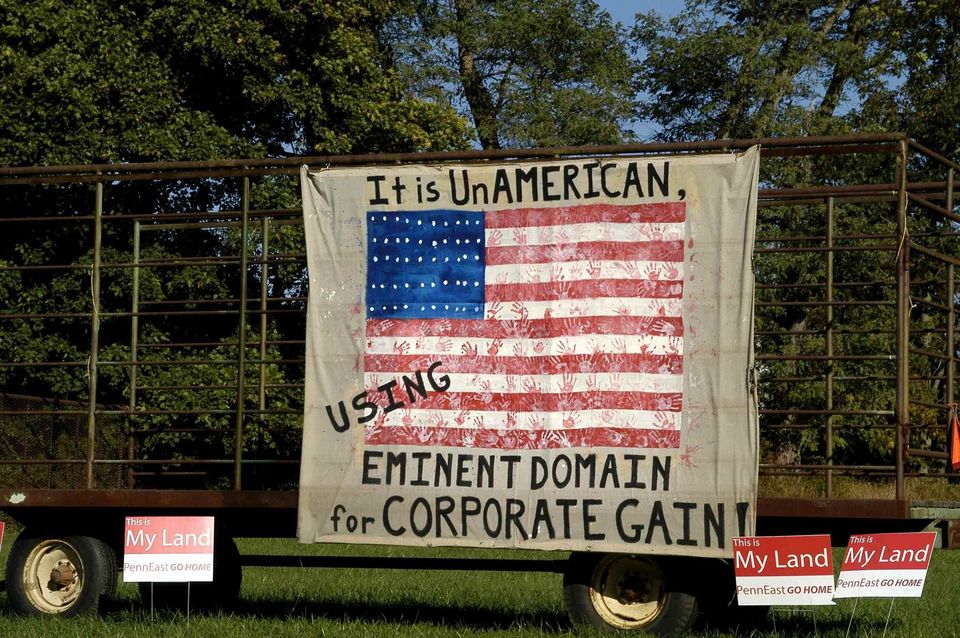
Observe the following protest sign, which headlines the front page article of the 10/22/15 Hunterdon County Democrat titled PIPELINE PUSHBACK:


The sign refers to the eminent domain powers to take private land for easements that would accompany federal approval of the PennEast Pipeline company’s natural gas conduit through the region, and hand it over to other private interests for private purposes.


It is certainly true that eminent domain transfers of private property to other private parties is un-American, and contrary to the “takings clause” of the U.S. Constitution, which allows takings for public use only. But, the victims of the eminent domain threat, while private property owners, are not actually all themselves pure victims. Many are beneficiaries of another kind of taking—the far less controversial “public use” form. This includes John and Jodi Markowski.


Public vs. private use (or purpose) is in an essential respect an artificial distinction. What do we mean by “public?” After all, the public is made up of. . . what? Private individuals, that’s what. Highways are generally considered a “public use” and thus a relatively uncontroversial use of eminent domain. But if you use a highway built on private land taken through eminent domain, how is that fundamentally different than a private corporate entity benefiting through eminent domain? You, the driver, are a private citizen. And here you are, benefitting from eminent domain by using that road. A public use is really a means for benefitting private individuals.


Of course, no one can escape being a beneficiary of eminent domain in some way. The simple fact that I drive a car doesn’t make me a hypocrite if I oppose domain. The key is consistency. I am fully consistent. I oppose all eminent domain, whether for private or public purposes. Do John and Jodi Markowski? If not, then their stand against the PennEast pipeline based on the eminent domain threat to their property must be considered morally compromised.


You can’t be for eminent domain when it serves a public use, and against it when it serves “corporate gain,” and escape a double standard. That’s both having and eating your cake. You can’t be against eminent domain when it targets you, but for it when you benefit. On closer examination, obfuscation of the issue with meaningless distinctions like public vs. private disintegrates. The builders, investors, and consumers of the pipeline are each as much members of the public as the driver of the car. If you support eminent domain as a means of providing you with roads, then how can you be against eminent domain as a means of providing jobs to pipeline employees or natural gas to energy consumers? Only those who stand uncompromisingly opposed to eminent domain and other government property takings in all of their manifestations—direct or indirect, tax or regulatory, monetary or land, for public or private purposes, “just” compensation or not—can with good conscience take a clear moral stand against the PennEast pipeline for reasons of eminent domain.


Granting that people fearful of eminent domain provisions included in pipeline approvals have double standards, the provisions are a serious concern for a pro-individual rights perspective. Does one oppose pipelines, in effect joining the anti-pipeline jihad and violating free trade rights? Given the importance of pipelines to energy freedom, that’s not a good choice, in my view. But neither is it a good choice to simply pretend that the dark side of pipelines doesn’t exist, in effect neglecting the rights of property owners.


Eminent domain should not be part of the pipeline approval process. We should advocate for its removal, but not as an uncompromising condition of pipeline approval. That doesn’t mean nothing can be done for the property owner. Short of getting eminent domain stripped from pipeline approvals, which would make the pro-pipeline advocacy cleaner and less problematic, we can go to bat for the victims in ways other than simply opposing pipelines and, in effect throwing the baby out with the bathwater. For example, by fighting for better “just compensation” for the victims. In this last regard, the Hunterdon Freeholders advanced a proposal that can fit with the pro-pipeline/anti-eminent domain scenario. As part of its resolution to oppose the pipeline, the Freeholders cited “insufficient proposed compensation for affected landowners.” Their proposed solution has merit. As Graziano reports:


The freeholders also take issue with a one-time payment for an easement, stating that with PennEast reaping continuous profits, it should handle the situation as wireless companies handle cell towers, giving the landowner a stream of income. "If PennEast is going to earn continuous proficts [sic--profits] from the exploitation of the land of another, it should make that owner a partner," the board's resolution states.


Of course, you could make the same argument about roads built on eminent domain takings. Roads facilitate ongoing commerce.


Conflicts of rights are not inherent in free market economies. Such conflicts are inherent in mixed economies. Only a mixed economy can pit the right to production and trade against property rights. It’s something that, for now and for the foreseeable future, we must live with. That can create a situation of having to choose the lesser of two evils. That’s the case with pipelines. Anti-fossil fuel environmentalists have targeted pipelines on the theory that preventing the means of delivering fossil fuels to refineries and consumers—pipelines—will slow and eventually stop the drilling, particularly hydraulic fracturing. In alliance with NIMBY groups, the environmentalists’ growing organized jihad against pipelines poses a significant threat to the energy market and to our energy security. That is unacceptable to anyone who values human life and liberty. The jihad must be defeated and the pipeline industry defended.

But we must keep in mind the bigger picture, as well. The fight for pipelines is a vital one. But it requires fighting for individual rights not just on behalf of pipeline companies but on the eminent domain and other fronts, as well.


Related Reading:


Untangling the PennEast Pipeline Rights Conundrum

Sunday, November 1, 2015

'Preserved land' is a Form of Eminent Domain

In a Hunterdon County Democrat article, Don't let 'flawed' pipeline process allow land condemnation, Michele S. Byers, Executive Director New Jersey Conservation Foundation, argues against the PennEast Pipeline company’s proposed natural gas pipeline through portions of Pennsylvania and New Jersey because on grounds that, as the title suggests, Federal Energy Regulatory Commission (FERC) approval would carry with it eminent domain powers granted to PennEast. (On September 24, 2015, PennEast formally submitted its FERC application to build the pipe.)


On the face of it, liberty advocates certainly could agree with Byers on this. But the issue is not that simple. I left these comments:


Most of the reasons for opposing the PennEast pipeline are rationalizations and double standards used by opponents as tactics to support a broader anti-energy agenda against pipelines specifically and, more generally, fossil fuels. But this column highlights one of the few valid—and, in my view, the most serious—arguments against the pipeline.


As I’ve argued before in letters to the Democrat concerning the Solberg Airport condemnation proceedings in Readington, eminent domain is immoral and un-American, even if for a so-called “public purpose.” My arguments regarding Solberg relate also to the PennEast pipeline. Easements between PennEast and landowners should be negotiated on a level legal playing field; meaning, by voluntary contract to mutual benefit. While I strongly support PennEast’s right to build the pipeline and market the gas to willing consumers, wherever they may live, without coercive impediments from their fellow man or government—and to leave it up to producers and consumers to determine what is “needed”—condemnation powers should not be part of the approval process. PennEast should have to engage in legitimate negotiations with landowners, in which the landowner would not have the legalized gun of eminent domain hanging over their heads. This would commit PennEast to take full account of landowners’ concerns, and make offers based on those concerns, including regarding compensation. This is as it should be. This is the free market way. This is the American way.


Having said that, my argument applies only to fully private land. Their is a hidden double standard regarding so-called “preserved land” or  “taxpayer-protected open space.” The argument against the pipeline relating to condemnation of “preserved” land begs the question: Is the method of preserving land just? No.


Eminent domain, as the author observes, involves the forcible taking of private land, against the owner’s consent, leaving the owner with a pile of coercively imposed “just compensation.” But how is the land preservation program funded? By forcibly taking monetary property, in the form of taxes, from people across the state against their will. How is monetary taking different from eminent domain taking? In an important sense, farmland preservation funding is worse than eminent domain.  At least victims of eminent domain have some constitutional protection—they must be compensated. But there’s no such protection for nonconsenting taxpayers, who get nothing in compensation for funding the “preserved” land the money forcibly seized from them pays for. (Majority approval of preservation taxation doesn’t mitigate the fundamental injustice. Citizens are free to voluntarily pool their money to preserve land. But they have no “democratic right” to force unwilling citizens to pay also. Those who vote no to open space taxation—who don’t consent—are victims of an uncompensated taking.)


It’s ironic, and hypocritical, that people who complain about preserved farmland being taken for the pipeline through eminent domain ignore the taking from the taxpayer. Private landowners who exchange development rights for taxpayer money in order to “preserve” their land have no moral right to object to eminent domain exercised by PennEast, and neither do other pipeline opponents. The same goes for so-called public lands. You can’t at once oppose eminent domain and support tax-funded preservation/open space with any credibility whatsoever. The “preserved land” argument against the PennEast pipeline is just one more double standard added to the tactics employed by pipeline opponents.


Related Reading:


Eminent Domain- Always an Abuse

Saturday, July 25, 2015

Development is Not ‘Inverse Condemnation’

The eminent domain battle between the New Jersey township of Readington (my home town) and Solberg Airport, which began in 2006, reached a new stage in May when a court ruled in favor of Solberg Airport. Eminent domain was initiated to prevent the development of Solberg Airport’s unused land, possibly intro a housing development of airport expansion. The court concluded that Readington’s attempted use of eminent domain against the airport was a "manifest abuse of power." This was the third consecutive court loss for Readington, which cost the taxpayers and the Solbergs millions of dollars in legal fees and other related expenses.


I don’t know where the battle goes from here. But I do know that the debate among residents will continue. That being the case, I want to address a letter published in the Hunterdon County Democrat in February 2015 titled Inverse Condemnation. In his letter, John Kalinich Jr. claimed that if the Solberg’s expand their airport, it would lower home property values, resulting in “inverse condemnation.” (A previous letter writer used the term “reverse eminent domain.)


Having followed this issue for many years, it is apparent to me that the alternative to litigation is the inevitable expansion of Solberg Airport into a jetport capable of 24/7 operations in good weather and bad. The litigation is all that stands in the way of the resumption of the Solberg's development plans. Without it, we will again be at the mercy of the Department of Transportation and the Federal Aviation Administration because they have jurisdiction over approval and preemptive authority over our municipality. We learned, much to our dismay, in the decade between 1995 and 2005 that the township has no meaningful say in the matter of an airport expansion.


Thor Solberg has testified under oath during the trial that he will expand his airport. Now Don Baldwin is trying to lay the groundwork for a full political takeover of the Township Committee in the June primary. He and the Solbergs know that this would be, by far, the easiest way to accomplish the Solberg's expansion goal. An expansion would rob Readington residents of the property value in their homes. An inverse condemnation! Solberg's financial gain would become our financial loss.


All of the actions taken by the Township Committee to budget for the trial and deal with increases were transparent and fully compliant with the law, and certainly not unusual or underhanded as Holman and Baldwin would have us believe. The costs of the trial are a necessary investment in the future of our township and I am happy to pay my share to protect my investment in my home here. [emphasis added]


I left these comments:


John,


Let’s get our terms straight. In this context, “condemnation”—or eminent domain—means only one thing; forcible taking of private land by governmental action. There is no such thing as “inverse condemnation.” There is only condemnation. There is no condemnation action against your property. There is against the Solberg’s land. Eminent domain is strictly a government action. No private person, acting as a private person, can initiate any condemnation.


What about property values? There are many things that affect property values; highways, industrial parks, schools, housing developments, railroads, shopping malls, pipelines. Should all of those things—and anything else deemed by existing property owners to be bad for property values—be stopped? Indeed, “value” is in the eye of the beholder. Many people once believed—and some, sadly, still believe—that a neighborhood sale to the “wrong” racial or ethnic neighbor will drag down his property values. Should communities be allowed to legally bar certain family from buying homes based on their ethnicity?


This would be NIMBYism run amok. If the peaceable use of our land were at the mercy of anyone who alleges a loss of property values—real or imagined—we wouldn’t have an advanced industrial society. Or a free society. Or any kind of civilized society.


No one has a “right” to any particular resale value. No one has a “right” not to be affected by other people’s property usage. There is only the right to the peaceable use of one’s own property, possessed equally and at all times by all. The question is not, does person A’s use of his land ‘affect’ person B? When people live amongst each other, there are no end to ways in which one person’s actions can affect another. The only valid question is, does person A’s use of his property violate the property rights of person B; by, for example, polluting person B’s property? Then and only then can person A be stopped. But it is never just to take person A’s property from him against his will.


Put more specifically, does the expansion of Solberg Airport objectively infringe on other people’s right to be physically safe and secure on his property, or in his use of his property? I don’t know all of the issues involved in airport expansion. Perhaps there are valid reasons for preventing airport expansion. That’s to be hashed out in an objective forum under due process. One thing that is certain: the Solberg’s have a right to use their land in any legal and peaceable way they please, just like the rest of us—so long as their use doesn’t violate the rights of others. They have a right to apply for approvals for airport expansion, and surrounding property owners have a right to present their case against if they believe expansion would violate their property rights. But no one has a right to use eminent domain—i.e., legalized theft—as a means of preventing Solberg’s plans.


For the record, I have no ties to the airport vested interests. I spoke briefly with Don Baldwin on a couple of occasions. My wife and I met John Broten [a township committeeman who ran against and defeated the incumbents who initiated the Solberg eminent domain lawsuit] on one occasion. I have never met any of the Solberg family. I am neither pro- or anti-airport. I am a citizen concerned about the steady erosion of our rights and liberty by a government increasingly used as a tool of special interests seeking to impose their values on others by legalized force. As I said in my pre-election letter last October, Is any taking just?, eminent domain “contradicts every fundamental premise of America.” All around the country, eminent domain is increasingly trampling people’s property rights, including homeowners. None of us are safe from eminent domain. It is a cancer that must be stopped. You say “All of the actions taken by the Township Committee to budget for the trial . . . were transparent and fully compliant with the law.” Perhaps. But that only confirms how corrupt our law has become. As I said in my letter, “That our government has the power of eminent domain doesn’’t mitigate its immorality . . .”


I live in Readington. I’d prefer the airport stay as is. But if keeping it that way means continuing the legal action against Solberg Airport, violating their property rights, I’d prefer to live with an expanded airport. You say you are “happy to pay” your “share” of the trial costs. Well, I’m not, and no one has the moral right—and shouldn’t have the legal right—to force me to continue doing so against my conscience and convictions. If you and like-minded residents want to pool your money privately and voluntarily and attempt to buy the land in a private contract with the Solbergs, for the purpose of purchasing and preserving the land in question, you are free to do so. But you have no right to use the municipal government to force others to join you. The proper purpose of a government is to protect, equally and at all times, every individual’s right to act on his own judgement. Readington’s condemnation proceeding violates that purpose. For practical, philosophical, and moral reasons, the eminent domain suit against Solberg Airport must end.


--------------------

Kalinich Jr.’s term “inverse condemnation” is another manifestation of the blurring of the distinction between government force and private voluntary action. The failure to know or acknowledge the difference is a major cause of the growth of rights-violating government controls. For a clarification of this issue, see Harry Binswanger, The Dollar and the Gun.


Related Reading:


Big Government vs. Big Business; or, Political Power vs. Economic Power

Thursday, May 28, 2015

Solberg Eminent Domain Ruling and Zoning

In the letter by Readington Township, N.J. Committee candidates Liz Duffy and Ben Smith, Readington has options following Solberg ruling, which I discussed in my last post, Duffy and Smith wrote:

One thing to keep in mind is that In addition to the decision on the eminent domain suit, the township is now also faced with defending against the lawsuit filed by the Solbergs to have the entire 700-plus acres zoned for airport use. That suit had been stayed pending the outcome of the eminent domain action, and will now be re-activated if no appeal is filed.

In my last post, I argued against Duffy and Smith’s collectivist claim that they “are in the best position to represent the interests of the entire Township.” Zoning powers are an outgrowth of collectivist thinking. As such, zoning is integral to the matter of Readington’s attempted eminent domain seizure of Solberg land. The township forbids Solberg from expanding or developing by zoning those uses into illegality. The eminent domain action grew from Solberg’s lawsuit challenging the zoning ordinance blocking the Solberg’s plans.

So zoning is at the root of the eminent domain controversy. But zoning powers themselves are illegitimate because they are contrary to the proper purpose of government, which is to protect individual rights, including property rights. Zoning violates rights, so the state has no legitimate authority to dictate private property use, so long as the use of one’s property doesn’t violate the rights of others.

But since we have zoning, any landowner has a right to seek zoning changes in pursuit of the peaceable use of his own land. There’s nothing sacred about zoning powers or zoning maps. The Solbergs have the same rights as anyone else, and deserve not to be threatened with eminent domain—which is nothing more that legalized Mafia-like aggression—for seeking zoning changes needed to use their land as they judge best. Property rights should be the standard for decision making.

Property rights—the right to use one’s property as one pleases—doesn’t mean a landowner can do whatever he wants regardless of the effect on others. If resident “A” believes his rights—his use and enjoyment of his property, or his physical safety and security—will be infringed by resident “B’s” use of his property, then “A” can fight to stop “B’s” use. But the burden of proof is on “A”. If the municipal officials really had the interests of township residents at heart—rather than some undefinable “interests of the entire Township”—, they would seriously consider the rezoning, based on respect for the property rights of the Solbergs, and the valid concerns of residents as these concerns relate to their property rights, which means being safe and secure in the use of their property. If surrounding residents can demonstrate, in an objective forum, that airport expansion would violate their rights—i.e., initiate physical force against them—they would have a valid argument for stopping airport expansion.


The Solberg’s lawsuit to overturn their township’s zoning of their property is no justification for eminent domain aggression, because there is no justification for eminent domain.

Related Reading:


Eminent Domain- Always an Abuse

How Property Rights Solve Problems—David R. Henderson for the Library of Economics and Liberty

Tuesday, May 26, 2015

Solberg Eminent Domain Ruling and Collectivism

The battle over Solberg Airport in my hometown of Readington Township, NJ will reach a new stage soon. The battle involves the long-running attempt to seize Solberg land through eminent domain in order to prevent development of the property into a larger airport capable of handling corporate jets, or into housing. The battle has split the township, and elections have become a de facto referendum on the Solberg issue.


In the last election, two pro-eminent domain township committee incumbents were defeated by two anti-eminent domain challengers. This election will once again pit two pro-eminent domain candidates—Liz Duffy and Ben Smith—against an anti-eminent domain team, Larry Lelah & Deb Lyons.


All the candidates that will face the voters in the June 2, 2015 primary are Republicans. Generally, no Democrats run in Readington, so the winner of the primary is usually in effect the winners of the November general election by virtue of running unopposed.


This new stage of the Solberg battle was set by Readington’s third court loss, in which the Solbergs are fighting to protect their land from eminent domain seizure. In this latest court decision, N.J. Superior Court Judge Paul W. Armstrong labeled Readington’s action “a manifest abuse of the power of eminent domain.”


In reaction, Duffy and Smith penned a Letter describing Readington’s options going forward:


1. Appeal Armstrong's decision. An appeal would be a small fraction of the cost of the trial and the years of discovery leading up to it. If we win on appeal, the township would not have to pay the Solbergs' legal fees, and the land around the airport would be preserved.


2. Don't appeal, and let the judge's ruling stand. In this case, the township would pay the Solbergs' legal fees, and the parties should go back to the positions they were in the day before the taking. This means the Solbergs would have an airport on between 50-100 acres surrounded by 600-plus acres of land zoned Agricultural-Residential.


Duffy and Smith support option 1, and concluded their letter with:


These critical decisions should be made by people who have the interests of the entire township in mind; not by candidates hand-picked and supported by the most vocal supporters of the Solbergs. Can you imagine a Township Committee with four out of five members that the Solbergs and their closest supporters helped elect negotiating with the Solbergs? We are in the best position to represent the interests of the entire Township.


“Most vocal supporters” happen to be a majority of the township’s voters, many of whom are not merely supporters of the airport or of the Solbergs, but conscientious opponents of eminent domain (such as me).


I left these comments:


Beware politicians peddling undefined collectivist slogans, like this one:


“We are in the best position to represent the interests of the entire Township.”


Just what are those “interests,” and who determines them?


It is not in the interests of the Solbergs to be forced into “negotiations” with township officials, while those officials hold over their heads the threat to take their land if they don’t agree to township demands. That’s Mob-style “negotiating.” Good faith negotiation implies voluntary give-and-take on both sides, with each side having the right to say no to any offer without threats of aggression to coerce an “agreement.” A negotiation in which one side is holding a gun to the head of the other party is not a negotiation. It is “an offer that you can’t refuse”—literally.


It’s not in my interests to be forced to finance, through my taxes, what I consider a grossly immoral and un-American action against a Readington neighbor, while that neighbor is stuck with huge legal expenses just to protect their property and their right to use it in any peaceable manner they choose. Nor is it in the interests of any other Readington Township resident who opposes their township officials’ eminent domain aggression.


There are no “interests of the entire township,” apart from the diverse interests of the individuals who comprise the township. Neither Duffy, Smith, or anyone else have any right to declare themselves the township interest czars claiming the authority to impose their idea of “the interests of the entire Township” on everyone else. There are only the interests of individual residents.


The “option” of negotiating with the Solbergs from a position of aggression as the final arbiter is no option at all for those whose land is threatened, or for those forced to finance the threat against their consciences and convictions. The fact that our constitution wrongly grants the power of eminent domain to government officials does not mitigate its immorality. Differences among residents should be worked out without the threat of force, and with due respect for private property and other individual rights.


Related Reading:


The Rise of Collectivism and the Fall of the Constitution