Showing posts sorted by relevance for query penneast pipeline. Sort by date Show all posts

Saturday, July 18, 2015

PennEast Pipeline’s ‘Economic Impact Statement’ Understates Benefits of its Pipeline

As part of its drive to get Federal Energy Regulatory (FERC) approval for it proposed natural gas pipeline through Pennsylvania and New Jersey, the PennEast Pipeline Company released an  economic impact study. As Lillian Shupe reports for the Hunterdon County Democrat:


The proposed PennEast pipeline will have lasting economic impact during and after its construction, according to a study released on Feb. 9.


The study was done by Drexel University School of Economics and Econsult Solutions, Inc., both in Philadelphia, Pa. for PennEast Pipeline Company, LLC.


Penneast has proposed a 114-mile-long natural gas pipeline from Pennsylvania to New Jersey. The pipeline would run through Hunterdon and into Mercer County. The project would provide gas markets in eastern Pennsylvania, southeastern Pennsylvania, and New Jersey with natural gas that is produced from Marcellus shale in Pennsylvania.


"We forecast the PennEast Pipeline Project to generate a significant positive economic impact in Pennsylvania and New Jersey, increasing economic activity and supporting new jobs. Construction and ongoing operations of the Project will be economically beneficial to the counties in which the pipeline will traverse and both states as a whole. In addition, the possibility for increased income derived from potentially lower energy bills could induce spending in the regional economy and spur an even broader and larger economic impact," the study concluded.


The PennEast project has generated a lot of opposition from the NIMBY/Environmentalist coalition. I have been active against this coalition and in support of PennEast’s pipeline, and you can peruse my activism here. You can also read my comments posted on the FERC website in support of the PennEast pipeline here. On this article about PennEast’s Economic Impact Statement, I left these comments:


Actually, the study vastly understates the economic value of the pipeline. Energy distributed across America by the existing half million miles of petroleum and natgas transmission pipelines and 2 million miles of natgas distribution pipelines provides the energy that every aspect of our lives depend on. Here’s one example: Our local supermarkets are well-stocked because of food delivered by trucks that run on diesel fuel and railroads that run mostly on diesel or natural gas. Every single one of us enjoys the benefits of this amazing pipeline network—and we, in fact, cannot do without them. Everywhere one looks, one sees a better life delivered by pipelines—which points to the moral value of pipelines, as well.


Yet, based on most of the arguments we hear from PennEast pipeline opponents, we in Hunterdon County can expect unprecedented catastrophe and the end of life as we know it if this single new, state-of-the-art natgas pipeline is built. And every argument advanced against this new pipeline could be used against all pipelines. So, here’s my question to PennEast pipeline opponents: Given the unmitigated disaster you say PennEast’s pipeline will bring, do you advocate the immediate shutdown of every mile of America’s pipelines? If not, then what is the basis for opposing the PennEast pipeline through your “backyard,” while continuing to enjoy the benefits of other pipelines?


-------------------------

I’ll cover some of the opposition comments posted under this article in my next few posts.


Related Reading:


Why Do We Need Pipelines?—Pipeline 101

Monday, June 6, 2016

Economic Benefits of the PennEast Pipeline Don’t Impress Pipeline Enemies

In an effort to gain public support for Federal Energy Regulatory Commission (FERC) approval for a  proposed natural gas pipeline through Pennsylvania and New Jersey, New Jersey Business & Industry Association CEO Michele Siekerka posted a guest column in the New Jersey Star-Ledger titled PennEast Pipeline will pump dollars into N.J. businesses. She writes:


The dramatic cold experienced in our region over the last two winters [2013-14 and 2014-15] – and the corresponding increase in the cost to heat a home or business – only further illustrates a growing problem for both homeowners and businesses throughout New Jersey.


Studies have shown that if another pipeline existed in the region during the winter of 2013/2014, New Jersey businesses and families would have saved an estimated $378.4 million in energy costs in just that year alone.


Should there be any doubt as to the need for more affordable, clean, domestic energy, it should be put to rest by the fact that every utility in the state of New Jersey has signed on as a customer so that their consumers in New Jersey will have direct access to affordable, regional gas.


I left these comments:


The economic benefits are what makes the pipeline a moral undertaking, precisely because the pipeline energy improves human lives.


But the pipeline’s opponents don’t see it that way. Environmentalists, the leading opponents, don’t care about human improvement. Their concern is only with leaving the environment untouched in its natural state, because their standard of value is non-impact on nature, not human life. They’re not just against bad impacts. They oppose impact as such. Since man’s survival, comfort, and flourishing requires him to alter and improve the natural environment to make it livable, environmentalists stand in opposition to human life. It’s not that they seek cleaner, less impactful industrialization. They are opposed to human work and flourishing through technology and industry—to industrial development as such.


Environmentalists have forged an alliance with organized NIMBY groups. These people enjoy the direct and indirect benefits of energy delivered through the millions of miles of other pipelines that pass through other backyards around the nation. They enjoy the benefits of “preserved” lands funded by taxpayers. Yet, they hypocritically fight to stop the PennEast pipeline and the access to energy benefits that it will deliver to others.


There is even a mystical element to the pipeline opposition, where modern-day witch doctors perform prayer rituals for the rivers as if they are some supreme consciousness that possess intrinsic holy value that trumps the values that improve human life. The 35 people participating in this ritual along the Delaware should not be brushed off as a fringe group. The view of “Mother Earth” as some kind of organic entity of which humans are no more valuable to the whole than any other species is widely held. The river-worshippers are a derivative of that irrational and dangerous mysticism.


This unholy alliance of environmentalist anti-pipeline jihadists, NIMBY’s, and primitive witch doctors pose a threat to our long-term safety and well-being. This alliance operates all over the country, seeking to strangle pipeline development as part of a broader anti-energy agenda to end all forms of reliable, affordable energy, including fossil fuels, nuclear power, and hydro-electric infrastructure. Don’t be fooled by the alliance's beating of the drum for so-called “clean energy alternatives.” You can bet that, if the PennEast utility consortium proposed to build a string of hundreds of windmills along the pipeline route, with all of the required supporting infrastructure like access roads and transmission lines, the alliance would be fighting that, too—and for the same reasons.


People who value their lives, their children’s lives, and other’s lives generally should think about the immense indispensability of the energy this alliance is fighting against. Projects like the PennEast pipeline is not just an economic necessity but a moral imperative.


Another correspondent commented, “This pipeline is only wanted by those who would benefit financially from its approval. It is not needed or wanted in the state of NJ. . .”


Comments like these are common, and highlight the utter shallowness of much of the opposition’s arguments and the irrational bias against money making generally and profit-seeking specifically. I left this reply:


How do you know? Who are you to speak for everyone? The financial benefits don’t happen in a vacuum. They derive from consumers who do want the gas, and willingly buy it. If you don’t need or want the gas, don’t buy it. But don’t cruelly stand in the way of other people’s access to the energy they need and want.


Fortunately, there are long-sighted people who look years and decades in advance, and who are willing to invest $billions in infrastructure so that they can financially benefit by meeting our energy needs in 2017 and 2025-26 and beyond, not just in 2015-16.


Related Reading:


The ‘Jihad on Pipelines,’ New Jersey Front

Wednesday, February 10, 2016

PennEast Pipeline Objections Don’t Add Up

The Jihad against pipelines being waged by the Environmentalists usually features heavily biased one-sidedness rooted in a small-picture viewpoint. Consider a letter published in the Hunterdon County Democrat titled Don't believe the feel-good claims about the PennEast pipeline. PennEast Pipeline company has applied for federal approval to run a natural gas pipeline through Hunterdon County, New Jersey.


I left these comments, rebutting point by point the objections offered by the writer The italicized quotes are the writer’s:


The pipeline objections presented here don’t add up.


“They claim pipelines are ‘safer’ than oil trains, which is like saying lung cancer is ‘safer’ than liver cancer.”


Pipelines are much safer. As the NJ Star-Ledger observed:


[T]here are enough studies, notably from the Department of Transportation’s pipeline agency, that suggest pipelines are the safest form of energy transport -- especially when the technology is new.


Comparing pipelines to cancer is like condemning food, because you are condemning the energy our lives depend upon. There are 2.6 million miles of pipelines delivering the energy of life across America. To focus only on the risks of the pipeline without also considering the incredible life-serving benefits—and the risks of not having pipelines—is so irrationally biased as to border on insanely cruel. What do you think would happen to your life, if those pipelines ceased to operate? Or are you content to continue enjoying the benefits of pipelines passing through other people’s communities, while denying PennEast’s future customers the same benefits?


“The damage they will do to the Sourlands and the Delaware River is inestimable.”


Damage—by what standard? On a standard of human well-being as a value, the pipeline is an improvement  to the Sourland, and to the environment, based on the vital necessity to human life of the energy being delivered.


“PennEast claims that all of this gas is for Pennsylvania and New Jersey customers, but their own spokeswoman said ‘For now it is for utility companies only.’”


Of course. Utilities’ job is to deliver the gas to the end user. Besides, it’s irrelevant who buys the gas. You have no more right to dictate to whom PennEast’s gas is sold than Everett, Washington residents have to stop Boeing from selling planes to China—or Flat Rock, Michigan citizens have to forbid you from buying a Ford Fusion from Ford’s Flat Rock plant.


Of course, I hope the gas is made available here. Maybe then I’d finally have gas mains laid in my street, so I could get rid of my oil-fired heating system in favor of natgas (even though Andrea Bonette would deny me that access).


“Their published claims of New Jersey households in need of gas are wildly inflated . . .”


“Inflated,” by whose estimate? Not by PennEast’s future customers’ judgement. You have no right to decide for others whether they need the gas or not. If there really is no need, there will be no customers. But as of last March, 96% of the gas has been reserved by purchasers. But again, every individual customer has a right to decide for themselves whether they need the gas or not. If you don’t need it, don’t buy it. But don’t stand in my way.


“They say they will lower gas prices to consumers, but someone has to pay for this billion-dollar pipeline - and their SEC filings indicate it will be their customers, not their shareholders, who pay for it.”


First, as Bloomberg reports, natural gas prices are up to 35 times higher in the Northeast than other areas, including nearby Pennsylvania, thanks to “a dearth of pipelines.”


Second, there are no customers until the pipeline is up and running, so clearly the investors, not the customers, are paying for the construction. Customers will pay for the gas, by voluntary agreement with the suppliers—hopefully at a price that enables PennEast and its investors to recoup their cost and earn a profit for the energy value they deliver to their customers. That would be win-win.


“Their claims about the thousands of jobs it will create rarely mention their own report's statement: ‘The workforce for the Project is likely to be composed of personnel from across the country due to the specialized nature of pipeline construction.’”


So? Most jobs are related in some way to the nation and the world, due to the interconnectedness of national and world economic activity. Of course, the pipeline would create and sustain myriad jobs in myriad industries, because almost every job in an advanced industrial economy is reliant on energy, and pipelines are an integral part of our energy infrastructure. But the absolute number of jobs, who fills them, and from where the job-fillers come is irrelevant. In fact, due to the complexity of the economy, it’s virtually impossible to determine how many jobs this pipeline will ultimately support. What’s not in dispute is that it will support jobs, because without energy, almost all of our jobs would be impossible. One thing is certain: Anti-pipeline means anti-jobs.


“Their cost for this is lower than normal market value because property with conservation or farmland easements is appraised lower.”


And these property owners were paid, at taxpayer expense, for the reduced value of their land’s “preserved” status. Thank the state for keeping property values “lower than normal market value.”


But this is really beside the point. It’s sad that Bonette goes on and on about irrelevancies, while she ignores the one legitimate objection to pipeline approval—the “elephant in the room,” eminent domain. If property owners’ rights were properly protected, PennEast would have to offer property owners what the easement is worth to them, because the property owner would retain his inalienable right to say “no.” True market value would be determined by voluntary agreement between land owner and PennEast. Without eminent domain, PennEast might have to give the landowner regular payments for the use of his land. Or perhaps profit sharing, natural gas supplies at a discount or no charge, or whatever innovative compensation arrangement PennEast and the property owner voluntarily work out. When everyone's rights  are protected—the right to produce and trade, contractual rights, property rights—disputes are resolved on a level legal playing field. Rather than fight an irrational battle against the pipeline, residents should be demanding that PennEast renounce the use of eminent domain.

You’d think the enormous life-giving value of reliable, affordable energy would be obvious to everyone. But the irrational Jihad on Pipelines shows otherwise. This letter proves that PennEast’s opponents are grasping at straws, and are irrationally biased, non-objective, and one-sided in their arguments.


Related Reading:


The ‘Jihad on Pipelines,’ New Jersey Front

Monday, September 25, 2017

PennEast Pipeline and Arsenic

The PennEast Pipeline poses arsenic risk to N.J. water supplies, writes T.C. Onstott and Julia L. Barringer in a guest column for the New Jersey Star-Ledger. The proposed pipeline will bring natural gas from Pennsylvania’s hydraulic fracturing fields into NJ. It is one of the front line battles in the environmentalists’ war against oil and gas pipelines.


I left these comments, edited for clarity:


Much of this article is devoted to telling us that arsenic is toxic to humans and animals, which is already well-known (although only above certain thresholds). And then we see the word “potential” mentioned several times. But what are the risks of not having reliable energy—you know, the kind that well owners need to bring that water into our homes on demand? Such energy is delivered to millions of Americans through millions of miles of existing pipelines in service today in the U.S.


It’s easy to find risks everywhere. But big picture thinking is vital. Negative side effects could be mitigated. But the vastly greater benefits of pipelines like PennEast dwarf the environmental risks involved. After all, where would we be without this energy? At the mercy of environmental dangers.


The issue is really moral. It pits environmentalists against human well-being. Environmentalists value untouched nature, which runs counter to what human beings need to survive and thrive—reshape nature to satisfy human needs. Pipeline builders and their supporters, including the future buyers of their energy, value human life.


Environmentalists use the so-called “precautionary principle” to fight industrial progress wherever projects are proposed. The principle holds that no project should be undertaken until all possible environmental risks have been neutralized. Of course, that would require omniscience, which is impossible to human beings. If the precautionary principle were in effect at the dawn of human progress, the discovery of fire would have been abandoned, and humans would never have risen from the cave. And, of course, the precautionary principle never considers the risks to humans of not having natural gas pipelines. Environmentalists and their allies in academia and government can concoct an endless stream of potential risks and use them, no matter how minute, to stop progress by imposing more studies paid for by someone else.


I’m not an expert on this subject. So I can’t state unequivocally that the authors don’t have a legitimate point. But I am observant and a thinker. Three natural gas pipelines pass right through Readington, passing about a mile from my house, which is supplied by well water. This gas provides thousands of people with their vital energy. There are 320,000 miles of natgas transmission lines around the USA. Yet people are flourishing thanks to the natgas, not dying all over the place from arsenic.


Excuse me for my skepticism when nothing but negatives, but no positives, are listed by pipeline opponents. Pipeline proponents are always willing to acknowledge, and rightly made to address, the risks. If human well-being is the moral standard, then big picture thinking is vital. I hope someone with the appropriate expertise posts an opposing opinion on these pages.


[NOTES: PennEast posted “Arsenic Myths” on its website to counter pipeline opponents’ arsenic threat theory. Patricia Kornick, spokesperson for the PennEast Pipeline Company, posted this letter, PennEast Pipeline no threat to drinking water. Also, this letter titled Proposed pipeline won’t create an arsenic issue in drinking water, unfortunately behind a paywall, appeared in the Burlington County Times.]


Sunday, January 10, 2016

Eminent Domain: The Dark Side of Pipelines

The principle of free trade—the freedom to work and trade one’s work product for the work product of other producers—is a core individual right. So are property rights—the freedom to keep, dispose of, and be secure in one’s earned wealth. But what if the two fundamental rights clash? That’s the case with pipelines.


There is a real threat to the vital American fossil fuel industry in the form of a jihad on pipelines now sweeping the country. The Environmentalist Jihadists, who oppose fossil fuels, are increasingly teaming up with local NIMBY (Not-In-My-Back-Yard) groups, and together employ many rationalizations, from “green” ideology to economic need, for stopping pipelines at any cost. They are highly organized and effective, and even the Federal Energy Regulatory Commission (FERC), the federal agency charged with the power to approve pipeline proposals, is feeling the heat.


Pipelines are vital to our energy security and economic well-being, and pro-industrial, pro-free market advocates must fight off the jihadists. But there is a dark side to FERC approvals of pipelines, and the NIMBYs do have one valid issue—the eminent domain powers typically granted to pipeline companies as part of the government’s pipeline approval process. Eminent domain is blatantly rights-violating and illegitimate in all of its manifestations, including in its Constitutional form.


But the NIMBY’s fighting pipelines based on eminent domain have some baggage of their own that somewhat undercuts their case.


For example, consider the current battle over the proposed PennEast pipeline in New Jersey.


The Hunterdon County, New Jersey Board of Freeholders has recently voted to actively fight to stop the pipeline (although they are on record “that they are not against underground pipelines in general”). Among other reasons, the Freeholders cited eminent domain for their action. As Sallie Graziano reports for NJ.com:


"Among the properties lying in the proposed pipeline's path are 23 farms constituting 2,007 acres of county-preserved open space," [Freeholder Director John] King said, reading from the proposed resolution. "If approved, the PennEast pipeline would necessarily extinguish the county's conservation easemetnts [sic] on those farms and trump a county open space policy mandated by three successive voter referenda. This issue alone warrants county opposition."


The way the land preservation program works is, farmers apply for payment from the government in exchange for giving up certain development rights, and deed-restricting the farm as is. Application for “preserved” status is strictly voluntary on the part of the farmers.


But how are the land preservation and open space programs funded? By forcibly taking monetary property, in the form of taxes, from people across the state against their will. How is monetary taking different from eminent domain taking? In an important sense, farmland preservation funding is worse than eminent domain.  At least victims of eminent domain have some constitutional protection—they must be compensated. But there’s no such protection for nonconsenting taxpayers, who get nothing in compensation for funding the “preserved” land the money forcibly seized from them pays for. (Majority voter approval of preservation taxation doesn’t mitigate the fundamental injustice. Citizens are free to voluntarily pool their money to preserve land. But they have no “democratic right” to force unwilling citizens to pay also, regardless of the unfortunate fact that it is legally permissible. Those who vote “no” to open space taxation—who don’t consent—are victims of an uncompensated taking.)


And often, open space is preserved through regulatory taking and/or zoning.


So owners of “preserved” land complaining about the eminent domain threat to their property are being somewhat disingenuous (though likely unintentionally). What moral right do the farmers or county government have to complain about eminent domain when they themselves are beneficiaries of government-sponsored takings, albeit not strictly defined as eminent domain?


Of course, not all threatened landowners are guilty of this disingenuousness. John and Jodi Markowski, for example, could have part of the backyard of their home taken for the pipeline construction and related easement whether they agree to it or not. They are pure victims.


But even regarding the Markowskis, there is a murky question mark. Do the Markowski's oppose eminent domain consistently and across the board? Or do they oppose eminent domain only as it applies to their property? The question points to a more subtle double standard at work in the eminent domain/pipeline controversy.


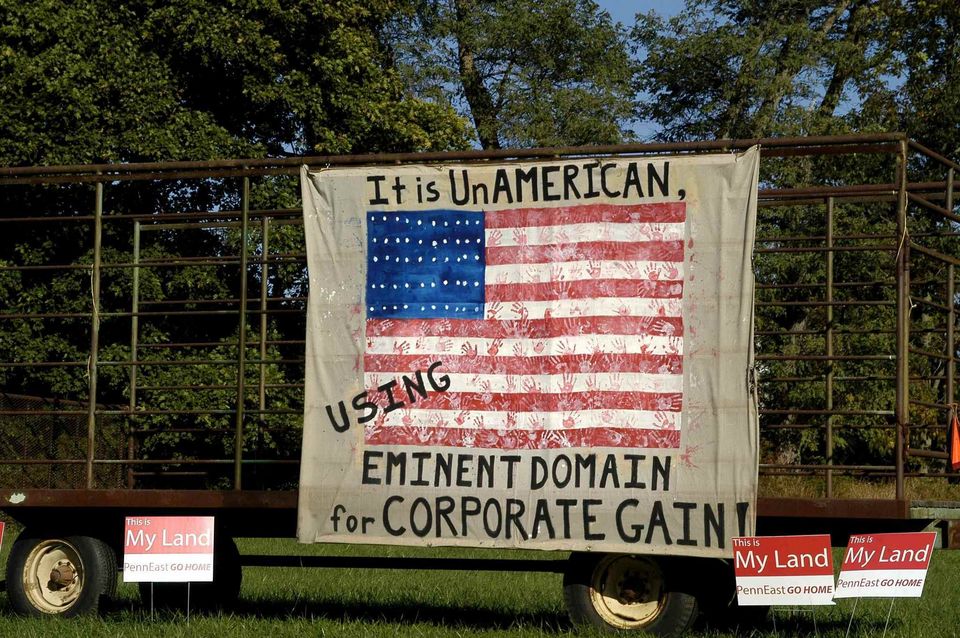
Observe the following protest sign, which headlines the front page article of the 10/22/15 Hunterdon County Democrat titled PIPELINE PUSHBACK:


The sign refers to the eminent domain powers to take private land for easements that would accompany federal approval of the PennEast Pipeline company’s natural gas conduit through the region, and hand it over to other private interests for private purposes.


It is certainly true that eminent domain transfers of private property to other private parties is un-American, and contrary to the “takings clause” of the U.S. Constitution, which allows takings for public use only. But, the victims of the eminent domain threat, while private property owners, are not actually all themselves pure victims. Many are beneficiaries of another kind of taking—the far less controversial “public use” form. This includes John and Jodi Markowski.


Public vs. private use (or purpose) is in an essential respect an artificial distinction. What do we mean by “public?” After all, the public is made up of. . . what? Private individuals, that’s what. Highways are generally considered a “public use” and thus a relatively uncontroversial use of eminent domain. But if you use a highway built on private land taken through eminent domain, how is that fundamentally different than a private corporate entity benefiting through eminent domain? You, the driver, are a private citizen. And here you are, benefitting from eminent domain by using that road. A public use is really a means for benefitting private individuals.


Of course, no one can escape being a beneficiary of eminent domain in some way. The simple fact that I drive a car doesn’t make me a hypocrite if I oppose domain. The key is consistency. I am fully consistent. I oppose all eminent domain, whether for private or public purposes. Do John and Jodi Markowski? If not, then their stand against the PennEast pipeline based on the eminent domain threat to their property must be considered morally compromised.


You can’t be for eminent domain when it serves a public use, and against it when it serves “corporate gain,” and escape a double standard. That’s both having and eating your cake. You can’t be against eminent domain when it targets you, but for it when you benefit. On closer examination, obfuscation of the issue with meaningless distinctions like public vs. private disintegrates. The builders, investors, and consumers of the pipeline are each as much members of the public as the driver of the car. If you support eminent domain as a means of providing you with roads, then how can you be against eminent domain as a means of providing jobs to pipeline employees or natural gas to energy consumers? Only those who stand uncompromisingly opposed to eminent domain and other government property takings in all of their manifestations—direct or indirect, tax or regulatory, monetary or land, for public or private purposes, “just” compensation or not—can with good conscience take a clear moral stand against the PennEast pipeline for reasons of eminent domain.


Granting that people fearful of eminent domain provisions included in pipeline approvals have double standards, the provisions are a serious concern for a pro-individual rights perspective. Does one oppose pipelines, in effect joining the anti-pipeline jihad and violating free trade rights? Given the importance of pipelines to energy freedom, that’s not a good choice, in my view. But neither is it a good choice to simply pretend that the dark side of pipelines doesn’t exist, in effect neglecting the rights of property owners.


Eminent domain should not be part of the pipeline approval process. We should advocate for its removal, but not as an uncompromising condition of pipeline approval. That doesn’t mean nothing can be done for the property owner. Short of getting eminent domain stripped from pipeline approvals, which would make the pro-pipeline advocacy cleaner and less problematic, we can go to bat for the victims in ways other than simply opposing pipelines and, in effect throwing the baby out with the bathwater. For example, by fighting for better “just compensation” for the victims. In this last regard, the Hunterdon Freeholders advanced a proposal that can fit with the pro-pipeline/anti-eminent domain scenario. As part of its resolution to oppose the pipeline, the Freeholders cited “insufficient proposed compensation for affected landowners.” Their proposed solution has merit. As Graziano reports:


The freeholders also take issue with a one-time payment for an easement, stating that with PennEast reaping continuous profits, it should handle the situation as wireless companies handle cell towers, giving the landowner a stream of income. "If PennEast is going to earn continuous proficts [sic--profits] from the exploitation of the land of another, it should make that owner a partner," the board's resolution states.


Of course, you could make the same argument about roads built on eminent domain takings. Roads facilitate ongoing commerce.


Conflicts of rights are not inherent in free market economies. Such conflicts are inherent in mixed economies. Only a mixed economy can pit the right to production and trade against property rights. It’s something that, for now and for the foreseeable future, we must live with. That can create a situation of having to choose the lesser of two evils. That’s the case with pipelines. Anti-fossil fuel environmentalists have targeted pipelines on the theory that preventing the means of delivering fossil fuels to refineries and consumers—pipelines—will slow and eventually stop the drilling, particularly hydraulic fracturing. In alliance with NIMBY groups, the environmentalists’ growing organized jihad against pipelines poses a significant threat to the energy market and to our energy security. That is unacceptable to anyone who values human life and liberty. The jihad must be defeated and the pipeline industry defended.

But we must keep in mind the bigger picture, as well. The fight for pipelines is a vital one. But it requires fighting for individual rights not just on behalf of pipeline companies but on the eminent domain and other fronts, as well.


Related Reading:


Untangling the PennEast Pipeline Rights Conundrum

Sunday, November 1, 2015

'Preserved land' is a Form of Eminent Domain

In a Hunterdon County Democrat article, Don't let 'flawed' pipeline process allow land condemnation, Michele S. Byers, Executive Director New Jersey Conservation Foundation, argues against the PennEast Pipeline company’s proposed natural gas pipeline through portions of Pennsylvania and New Jersey because on grounds that, as the title suggests, Federal Energy Regulatory Commission (FERC) approval would carry with it eminent domain powers granted to PennEast. (On September 24, 2015, PennEast formally submitted its FERC application to build the pipe.)


On the face of it, liberty advocates certainly could agree with Byers on this. But the issue is not that simple. I left these comments:


Most of the reasons for opposing the PennEast pipeline are rationalizations and double standards used by opponents as tactics to support a broader anti-energy agenda against pipelines specifically and, more generally, fossil fuels. But this column highlights one of the few valid—and, in my view, the most serious—arguments against the pipeline.


As I’ve argued before in letters to the Democrat concerning the Solberg Airport condemnation proceedings in Readington, eminent domain is immoral and un-American, even if for a so-called “public purpose.” My arguments regarding Solberg relate also to the PennEast pipeline. Easements between PennEast and landowners should be negotiated on a level legal playing field; meaning, by voluntary contract to mutual benefit. While I strongly support PennEast’s right to build the pipeline and market the gas to willing consumers, wherever they may live, without coercive impediments from their fellow man or government—and to leave it up to producers and consumers to determine what is “needed”—condemnation powers should not be part of the approval process. PennEast should have to engage in legitimate negotiations with landowners, in which the landowner would not have the legalized gun of eminent domain hanging over their heads. This would commit PennEast to take full account of landowners’ concerns, and make offers based on those concerns, including regarding compensation. This is as it should be. This is the free market way. This is the American way.


Having said that, my argument applies only to fully private land. Their is a hidden double standard regarding so-called “preserved land” or  “taxpayer-protected open space.” The argument against the pipeline relating to condemnation of “preserved” land begs the question: Is the method of preserving land just? No.


Eminent domain, as the author observes, involves the forcible taking of private land, against the owner’s consent, leaving the owner with a pile of coercively imposed “just compensation.” But how is the land preservation program funded? By forcibly taking monetary property, in the form of taxes, from people across the state against their will. How is monetary taking different from eminent domain taking? In an important sense, farmland preservation funding is worse than eminent domain.  At least victims of eminent domain have some constitutional protection—they must be compensated. But there’s no such protection for nonconsenting taxpayers, who get nothing in compensation for funding the “preserved” land the money forcibly seized from them pays for. (Majority approval of preservation taxation doesn’t mitigate the fundamental injustice. Citizens are free to voluntarily pool their money to preserve land. But they have no “democratic right” to force unwilling citizens to pay also. Those who vote no to open space taxation—who don’t consent—are victims of an uncompensated taking.)


It’s ironic, and hypocritical, that people who complain about preserved farmland being taken for the pipeline through eminent domain ignore the taking from the taxpayer. Private landowners who exchange development rights for taxpayer money in order to “preserve” their land have no moral right to object to eminent domain exercised by PennEast, and neither do other pipeline opponents. The same goes for so-called public lands. You can’t at once oppose eminent domain and support tax-funded preservation/open space with any credibility whatsoever. The “preserved land” argument against the PennEast pipeline is just one more double standard added to the tactics employed by pipeline opponents.


Related Reading:


Eminent Domain- Always an Abuse